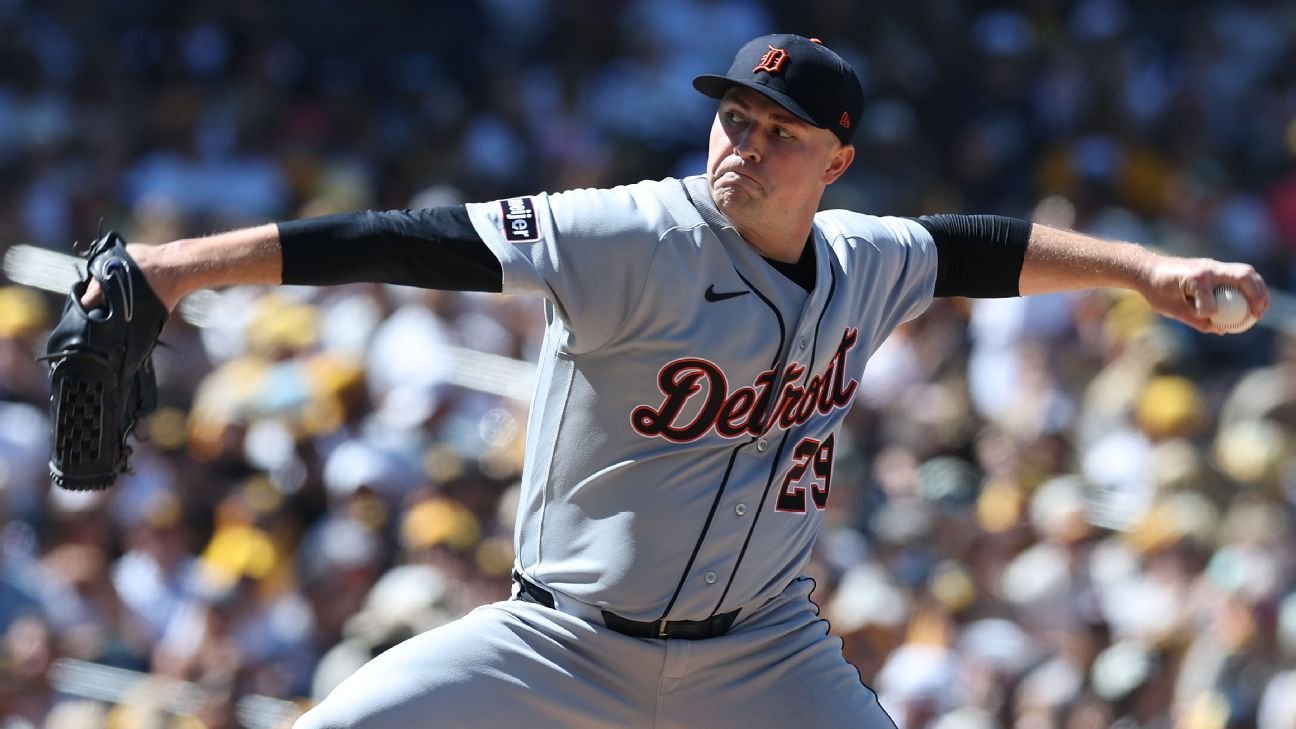
Even as baseball evolves, the power of the starting pitcher remains clear. So as the 2026 season heats up, let’s look at the top starters in MLB, with some of my own evaluation included but mostly based on insight from scouts and front office executives I polled going into the season.
Here’s where we stood on this exercise at the beginning of the 2025 season: The top few spots, as you would expect, look quite similar while the back of the list and honorable mentions churned a good bit.
Scouts see aces as a tier of trusted starters, not 30 Opening Day starters of various ability, but the cutoff of this tier is not clear at all and varies widely from evaluator to evaluator. It’s generally 10 to 12 pitchers.
This year, there are several pretty proven starters in the mix for the end of this list, as reasonable minds can have the same pitcher seventh or 15th and there are a few up-and-comers you genuinely need a little more information about to decide. I believe by the end of the season, some young pitchers such as Chase Burns, Nolan McLean and Jacob Misiorowski, among others, could insert themselves into this discussion.
Here is my ranking of MLB’s true aces for the 2026 season.

The two obvious picks

This is a huge season for Skubal, who is headed to free agency after the year and headlines the rotation of a contender with some real postseason expectations. One start into 2026, his stuff looks remarkably similar to last year, along with his feel/execution, so all systems are go for a potential Cy Young three-peat (only Greg Maddux and Randy Johnson have done that) followed by a potentially record-breaking contract in free agency right before a likely lockout.

Skenes was shelled in his first start and there were some slight differences in his pitch shapes, but his velo was basically the same. So he still seems like the same pitcher, who just had a bad command day at a time when everyone was paying a little more attention than usual. Given their ages, I would lean Skenes in the long term over Skubal, but it’s basically a coin flip in the short term.
The challengers to the top tier

Crochet is throwing a bit harder this season (fastball velocity up 0.5 mph, when most pitchers need some time to fully ramp up to peak velo), and looked crisp in his first outing of 2026.
From a quick straw poll of evaluators, some have Crochet in the top group with Skubal and Skenes, and some have him at the top of this tier, so a huge season could put him in a consensus grouping with Skenes and Skubal.

Yamamoto hasn’t yet posted huge inning totals in MLB, maxing out at 173⅔ last season, but that might be the only thing separating him from moving a couple spots higher on this list. Even casual fans are aware of Yamamoto’s legendary flexibility and athleticism along with his outstanding four-seam/splitter combo, which gives some hope that he’ll break 190 innings this year at age 27 like he did twice in Japan.
His rainbow curveball changes hitters’ eye level while his cutter/slider keeps hitters off his two primary pitches and grades out above average on its own merits.
Yamamoto gets a slight nod over Cristopher Sanchez because he’s two years younger and evaluators have a little more confidence in what he’ll look like in the medium term.

In 2023, Sanchez established himself as a big-league starting pitcher. In 2024, he broke out, posting 181⅓ innings at a 3.32 ERA. In 2025, he made the leap, posting 202 innings at a 2.50 ERA. The difference in 2025 was that his velo went up a full mph and the sink on his sinker increased by 3 inches, giving him an elite primary pitch that helped his secondary pitches (changeup and slider) play better.
Sanchez is about as good as a lefty sinker-based starter can get, following Dallas Keuchel and Framber Valdez (and you could argue Chris Sale, too) as recent examples, with the power stuff and durability to make up for a fastball shape that isn’t geared to rack up whiffs. Sanchez also got a new extension this spring: six years, $104 million.
Some question marks, but in the ace club

Brown has steadily improved his innings count (155⅔ to 170 to 185⅓ the past three seasons) and while also bringing his walk rate under three per nine innings last season. He’s fastball-reliant, throwing his four-seam and two-seam variations 60% of the time, but it’s not because his off-speed stuff lags: His power curveball was the second best in baseball last year. Brown’s playoff performances (1.65 ERA over 16⅓ innings) help underscore that this is the kind of pitcher who tends to excel when the heat gets turned up.

Cease must be invigorated by his new deal (seven years, $210 million last winter) as his fastball was livelier (up 1.6 mph and with 1.2 inches more lift/ride) in his first start for the Jays. It’s not like he didn’t throw hard before — he sat between 95 to 99 mph last year with the Padres — but Cease was generally seen as not reaching his absolute ceiling due to a combination of walks and inconsistency, manifested by not getting to 190 innings in his career despite making 32 or 33 starts five seasons in a row.
It’s not common for players to make a leap after getting a huge deal, but there was some optimism from the evaluators I polled that it could be happening with Cease.

Webb’s stuff is a little down in the early going (sinker down 1.4 mph, sweeper down 1.3 mph and breaking less) but that’s also somewhat typical for pitchers who are still building up a bit, so it’s just something to watch over the next month or so.
Webb has been incredibly durable, leading the league in innings (820) since 2022, way ahead of second place (767⅔, Framber Valdez). He is also second in pitcher WAR since then (19.1) behind only Zack Wheeler (19.5). Like Sanchez, Webb relies on a sinker that isn’t designed for whiffs, but Webb has the traits — lively off-speed stuff, tunneling, command — to make the most of what he has. His sweeper might show up more on Pitching Ninja, but his changeup is the real outpitch, with his other offerings to keep hitters from locking in on the two sinking and running offerings.

Sale missed time last year with a fractured rib cage but was as effective as ever when he was on the mound. There’s risk in assuming that will continue since he just turned 37 years old, but Sale looks up for the challenge, with his fastball velo up 1.1 mph from last year’s average in his first outing of 2026. That velocity (95.9 mph) matches his best seasonlong average fastball velocity since he was 22 years old in 2011; I’d imagine it’ll come down a bit from here, but that’s a great early sign.
10. Zack Wheeler, RHP, Philadelphia Phillies
Wheeler hasn’t made his 2026 MLB debut yet, but made a rehab start in Triple-A on Monday as he comes back from thoracic outlet decompression surgery. He’s slated to make at least a few more rehab appearances, building up as though he’s making a month’s worth of spring training starts, so his fastball velocity (93.3 mph on average) in his first outing was normal for that stage of his ramp up to full strength.
Wheeler is here because of his long track record of excellence (he leads pitchers in WAR since 2021 with 26.7, with second-place Webb at 23.2) even though Wheeler is turning 36 in May.
11. Jesus Luzardo, LHP, Philadelphia Phillies
Luzardo got an extension (five years, $135 million) before the season and might also be on the verge of breaking well into the consensus ace tier based on new pitch shapes.
His four-seam velocity and movement are almost identical to last season, but Luzardo’s sweeper has an additional three inches of sweep and 0.4 mph more velocity, his sinker is a bit harder with more sink and run and his changeup looks to be an entirely new pitch/grip with eight inches more sink at two mph lower velocity.
This is the sort of change — a wide base of incremental improvements with one entirely new pitch — that you often see early in a breakout season, and Luzardo already posted a 5.3 WAR season last year; I’ll get in front of this train and sneak him on the end of the list.
Others of note
Generally, the tier of aces is seen as up to a dozen names, and the back of the list especially varies from evaluator to evaluator. The closest this time are Max Fried, Bryan Woo, Cole Ragans and Logan Gilbert. Kevin Gausman is also in this conversation while Gerrit Cole and Jacob deGrom have age and durability working against them but certainly qualify on their best days which might be occurring this season.
There will be plenty of movement within this group of pitchers all season, so it wouldn’t be surprising if two of those mentioned here are clearly part of the ace tier by the end of the year rather than just getting some support from scouts for this edition.

