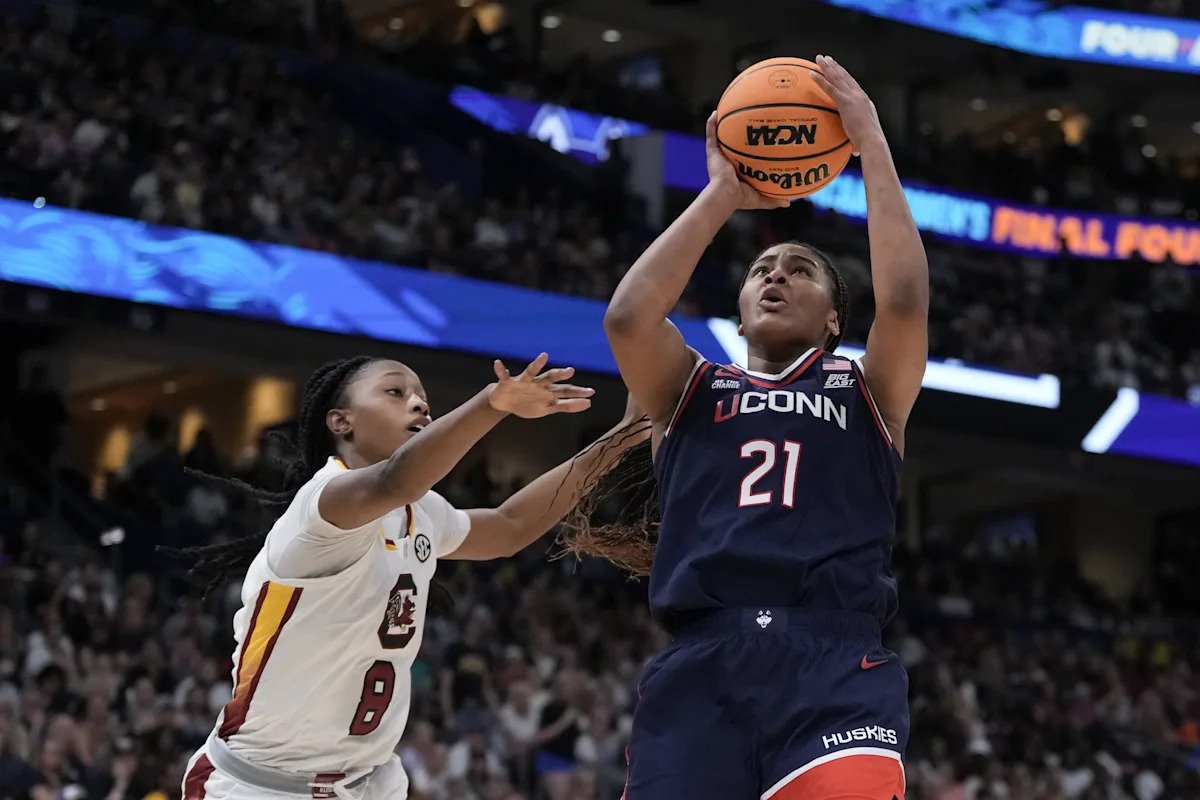
On Thursday, UConn sophomore Sarah Strong, unsurprisingly, swept National Player of the Year honors, winning the Naismith Trophy and Wade Trophy while also being named the AP Player of the Year.
Asked if winning the Naismith was a “dream come true,” Strong suggested, “A dream come true? I wouldn’t say that, but I mean, it’s defintely a cool side quest.”
Side quests complete, Strong and the No. 1-overall seed and undefeated Huskies resume their main quest—a second-straight national championship—on Friday night. UConn meets South Carolina, the team they dismissed in last season’s national championship game after also beating the Gamecocks during the 2024-25 regular season, at 7 p.m. ET in Mortgage Matchup Center in Phoenix (ESPN).
Advertisement
That recent success against South Carolina, however, will not have the Huskies underestimating their opponent. As our Beckett Harrison wrote, South Carolina will be UConn’s toughest test yet, something head coach Geno Auriemma, aiming for national championship No. 13, certainly understands.
So, what are the chances that the Gamecocks derail the Huskies’ quest? And how can UConn make sure their main quest continues on Sunday afternoon?
Okot and Edwards are the key to a South Carolina upset
South Carolina will present a challenge UConn hasn’t faced all season: elite frontcourt size, athleticism and skill.
Advertisement
6-foot-6 Madina Okot and 6-foot-3 Joyce Edwards are an interior force with the potential to overwhelm UConn on the glass. Rebounding represents one of the lone weaknesses in the Huskies’ statistical profile, while boarding, once again, is a strength for South Carolina.
It will be essential for South Carolina to end UConn possessions after a single shot attempt by grabbing the defensive board. South Carolina cannot count on using turnovers to fuel their transition offense, as UConn has strong ball security. Running off rebounds, therefore, will be the Gamecocks’ best route to finding early offense; the more South Carolina can score before UConn’s defense gets set, the better.
The Gamecocks will not just be relying on Okot and Edwards, as the likes of Raven Johnson and Tessa Johnson are good on the defensive glass and capable of quick starting grab-and-go opportunities. They can fire a hit-ahead pass to a streaking Edwards or find Okot for an early bucket on the block. The ascendent Agot Makeer also can be a weapon in South Carolina’s board-to-bucket attack.
On the other end, more pressure will be on Okot and Edwards to take care of the glass and generate second-chance scoring opportunities. Okot is elite on the offensive glass, grabbing nearly four o-boards per game. Efficiently converting on putbacks, and on any foul shots that come from putbacks, also will be crucial. While free throw shooting was a weak point for Edwards, she has made real strides at the stripe, going 18-for-22 across four tournament games.
Advertisement
If Okot and Edwards establish early success, if will be interesting to see if Auriemma again calls on Jana El Alfy. The 6-foot-4 sophomore center has had a more limited bench role this season, but her minutes helped swing the momentum to UConn in their Elite Eight victory over Notre Dame. El Alfy also was huge for the Huskies at this stage of last season’s tournament, stymying UCLA’s Lauren Betts as UConn prevailed in that Final Four matchup.
However, Okot and Edwards also have the goods to counter an an attempt to neutralize their interior advantages. Okot is a legitimate 3-point shooter; the volume is still low, but the stroke suggests her high percentage is not a fluke. Edwards hasn’t stretched her offensive game out behind the arc, but she is comfortable taking a midranger or applying her improved passing chops to find a teammate.
While interior dominance is the more likely path to a South Carolina win, it’s not their only way to take down UConn.
Advertisement
UConn can shoot their way to the national championship game

As head coach Dawn Staley herself admitted on ESPN, her squad might need a “bad night” from UConn to swing the outcome in South Carolina’s favor.
When these two teams met last season, both in the regular season and national championship game, UConn did not have a “bad night.”
They enjoyed the opposite, as the Huskies’ highly-efficient offense sliced and diced the Gamecocks’ defense, with UConn complementing their sharp shooting with on-point ball and body movement. During the regular-season game in Columbia, UConn doused 13 3s on South Carolina, with six of them coming from Azzi Fudd as she scored a game-best 28 points in the 19-point win. Fudd, again, was a problem in the national championship game. But rather than going off from behind the arc, she feasted from the midrange and on cuts to the basket, with her 24 points securing her Most Outstanding Player honors in the 23-point title clincher.
It’s easy to see why Staley’s hoping for a “bad night.”
Advertisement
If the shots are falling for Fudd, who is shooting better than 45 percent from 3 on almost seven attempts per game, and Strong, who shoots 40 percent on four attempts per game, and Ashlynn Shade, who takes almost four per game and is more threatening than her percentage suggests, and Blanca Quiñonez, who is just under 40 percent as she fires off close to three 3s per game, it might be impossible to beat UConn. By percentage, the Huskies are the second-best 3-point shooting team in the nation, equipping the team with elite floor spacing that they then maximize through precision passing that leads to a nation-best 23.4 assists per game.
Last year, however, Staley and South Carolina prioritized slowing down Paige Bueckers—and they mostly succeeded. Bueckers was more inefficient than usual in UConn’s two wins. But, Paige ultimately solved South Carolina’s strategy, as she effectively exploited the attention devoted to her to create easy opportunities for others, particularly Fudd.
On Friday , can Staley and her staff conjure up a defensive game plan that limits UConn’s 3-point shooting opportunities?
Most basketball analysts argue that a defense cannot necessarily control whether a 3-point shooter makes or misses; it’s more important to just prevent the attempts. Notre Dame succeeded in holding UConn to 17 3-point attempts, compared to the Huskies’ season-long average of almost 24 total triple attempts per game That helped the Irish remain in contact for close to three full quarters. South Carolina has a lot more talent than Notre Dame; if they can similarly keep UConn in check from behind the arc, they can make sure the outcome remains in question until the final moments.
Advertisement
And at that point, might the Gamecocks, experienced from gutting out close games in the SEC, have the advantage over UConn and their single game of crunchtime experience, which came back in November against Michigan?

