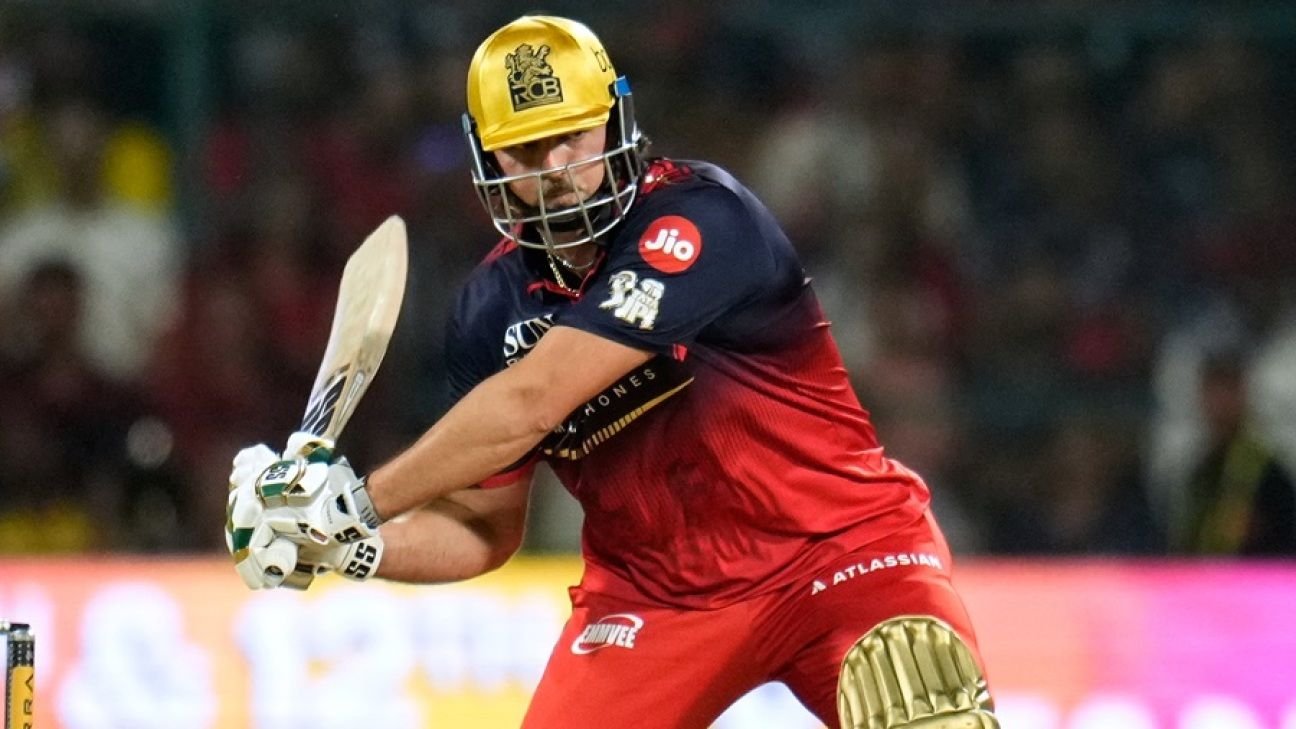
Until Sunday, Chennai Super Kings (CSK) had not conceded 250 runs in an IPL innings. Until Sunday, CSK had not gone for 78 runs in the death overs of an IPL game. Until Sunday, CSK had not lost four games on the bounce to Royal Challengers Bengaluru (RCB). Until Sunday, the CSK bowlers had never looked as bereft of ideas in the death as they did in Bengaluru.
Even in IPL 2025, when CSK won just four games in 14 and finished at the bottom of the points table, their death-overs economy rate of 11 was the fourth-best among all teams.
While these are still early days in IPL 2026, CSK have so far conceded 111 runs in 40 balls in the death, an economy rate of 16.65, easily the poorest among the ten teams.
And remember, in CSK’s opening match of the tournament, Rajasthan Royals didn’t even allow the game to go into the death, finishing off a modest 128-run chase in 12.1 overs.
In the previous game, at Chepauk, Punjab Kings smashed 33 runs in 2.4 overs in the death to complete the 210-chase with more than an over to spare. And, on Sunday, led by a brutal assault from Tim David and Rajat Patidar, CSK were taken for 78 in the last four overs, the fifth-highest tally in that period in the history of IPL.
Unlike the first two games, the CSK bowlers had a much better start against RCB after Ruturaj Gaikwad elected to field. They got rid of Virat Kohli in the fifth over and on a tacky surface with the outfield plugging, they kept RCB to 51 runs in the powerplay, and after 11 overs the score was 98 for 2, under nine an over.
That’s when the scenario flipped. As the surface became better and Rajat Patidar and Devdutt Padikkal went on the offensive, the bowlers completely lost the plot. The next five overs were taken for 74 runs but the real damage was yet to come. Padikkal fell, in walked Tim David, and began a sensational death-overs assault, CSK wilted.
2:12
Ambati Rayudu decodes CSK’s death-bowling problems against RCB
Ambati Rayudu and Gaurav Sundararaman on CSK’s bowling problems against RCB
More than the application, it was in the execution, or lack of it, where CSK got it horribly wrong.
According to ESPNcricinfo’s ball-by-ball data, more than half of the deliveries that CSK bowled in the death were either full tosses or full, and they bowled just one yorker. There weren’t too many variations in length or pace, and RCB smashed nine sixes in the last four overs, with David hitting eight on his own.
It isn’t that the current CSK bowlers don’t have experience of bowling in the death overs. Before the RCB game, Noor Ahmad had bowled more than 14 overs in the death in the IPL with an economy rate of 8.02. On Sunday evening, he went for 21 runs in the 17th over. Coming into this game, Jamie Overton had a death-overs economy rate of 9.26 in T20s since the start of 2025. David clubbed him for 30 runs in the 19th. Anshul Kamboj bowled a terrific yorker to dismiss David, but he had overstepped, costing the team more than 40 runs – David was on 29 at the time, he finished with 70.
There was a clear lack of consistency from CSK. Noor, who had conceded 28 runs in his first three overs, tried too hard in his final over and ended up bowling too quick. With not a lot of turn on offer, it was easy pickings for David. In the penultimate over, Overton kept bowling in the slot and David kept going the distance. The one time he bowled the hard length, David miscued a top-edge over the wicketkeeper. Kamboj bowled decently but the no-ball was a poor effort.
“Today we just didn’t execute,” head coach Stephen Fleming said of CSK’s death bowling. “It’s been different [in the two games]. I thought we were a bit passive in the last game throughout the innings. The fast bowlers, in particular, just searching a little bit. It was much better for the first half today but then just the execution under pressure [went wrong].
“Against a hitter like Tim David, who is very destructive, you’ve got to be absolutely spot on once we fell behind and he got his rhythm, and there’s a no-ball in there as well. Let’s not forget that. There’s probably 40 runs in there. There’s really small margins and with a good hitter like David, we’ve got to be more exact than that. So, we missed where we needed to be and we got hurt in the hardest of fashions.”
That death bowling would be a concern for CSK was known when Nathan Ellis pulled out of IPL 2026 with a hamstring injury. The extent of his absence has been seen across two games now. Fleming was defensive of his bowlers, suggesting that teams across the board have struggled, but he agreed that CSK needed to work their way “into a better game rhythm”.
“We’ve got a young group trying to create a core moving forward,” Fleming said. “We’ve got players who aren’t quite at their best and you talk about trying too hard; sometimes, the effort is a little bit too desperate.
“We’ve got to work our way into a better game rhythm and for the bowlers in particular, it is tough. It’s incredibly tough. The margins for error are very small. We started our way to, what, 210. That has been winning scores in the past. So the bar has been lifted with the aggression of the batting, and the bowlers are scrambling. It’s not just us. Bowling teams are scrambling to find a little bit of assistance in the pitch but also find methods to shut these hitters down. So it’s a tough contest for bowlers. Batters are certainly dominating with the rules we’ve got.”
This is the first time in the history of the IPL that CSK have conceded more than ten runs per over in three successive games. They have Spencer Johnson on the bench, but even he is recovering from an injury, while Gurjapneet Singh isn’t known for his death bowling. Having lost three in three, CSK need to find a solution to their death-bowling woes, else this could again end up being another long season for the five-time champions.

