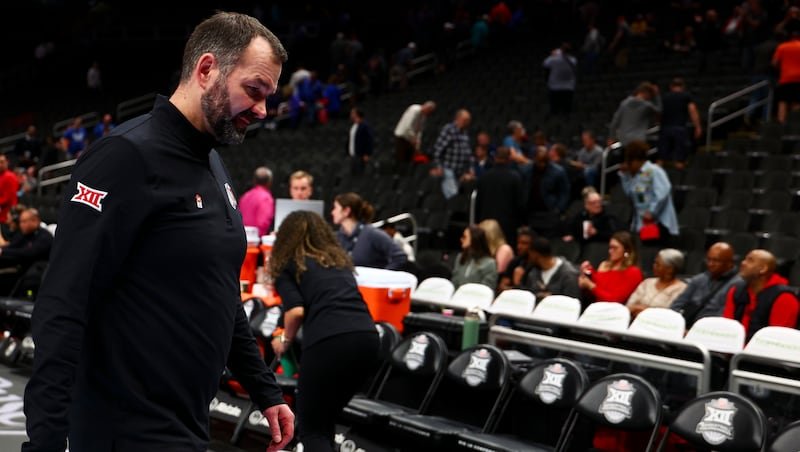
Only one offseason into his tenure, Utah men’s basketball coach Alex Jensen is already facing a critical juncture.
After watching the Runnin’ Utes win just 10 games — only two of which came in Big 12 play — in his first year as head coach, the program is facing the reality of trying to become more competitive while dealing with a lack of player continuity, a luxury in the NIL era.
Advertisement
As of Saturday, eight Utah players who finished the 2025-26 season on the roster — and two others who left midseason — are reportedly in the transfer portal.
Consider that the transfer window has only been open officially since Tuesday, and it’s clear another near-full reset is at hand after Jensen’s first group returned only one rotation player, Keanu Dawes.
“We knew that (we) were going to learn a lot because college is different,” Jensen told the Deseret News before Utah headed to the Big 12 tournament last month.
“We knew we didn’t have the answers, but having gone through a season, having gone through a portal process, a preseason, and especially the Big 12, I think your frame of reference is a lot better. With anything, we’ll be better in all aspects as far as the program goes moving forward.”
Advertisement
Unlike last offseason, Jensen and his coaching staff have had the chance to fully scout the landscape and gather a more comprehensive recruiting game plan.
During an appearance on “Crimson Corner with Bill Riley” in late February, team general manager Wilcox said the staff had a list of 20-25 players at each position to get them ready when the transfer portal opened, a testament to the work that’s gone on over the past year.
The portal window officially opened Tuesday and will stay open through April 21, giving athletes 15 days to officially enter.
“Now that we’ve had more time, I clearly see a path to be competitive in the Big 12 and I think it can be done here.”
Utah basketball coach Alex Jensen
Players can withdraw from the portal at any time and return to their previous school or decide a new destination after that time, but they must enter the portal during that window if they want to transfer.
Advertisement
“From the beginning, we knew it wasn’t going to happen all at once. We can definitely be competitive in the Big 12,” Jensen said.
“Now, we’re not going to be at Arizona’s level in five months — that takes time. The one thing I know is there’s a history here at Utah, which I don’t think we’re necessarily starting from scratch. … The top of the Big 12 reflects NIL resources and I think that’ll continue to grow, but I think you can be competitive.”
He concluded, “Now that we’ve had more time, I clearly see a path to be competitive in the Big 12 and I think it can be done here.”
Utah guard Terrence Brown (2) drives the ball toward the basket while guarded by Iowa State guard Tamin Lipsey (3) during an NCAA basketball game held at the Huntsman Center in Salt Lake City on Tuesday, Feb. 24, 2026. | Isaac Hale, Deseret News
Utah’s priority needs this offseason
Point guard(s) to set the tone — Numerous times throughout the 2025-26 season, especially as the year wore on, Jensen bemoaned Utah’s assist to turnover ratio and the team’s carelessness in taking care of the ball.
Advertisement
The Utes finished the 2025-26 season as the Big 12’s worst in turnover margin — at minus-2.34 — and third-worst in assist-to-turnover ratio — at 1.2-to-1.
Terrence Brown was brought in last offseason after two years at Fairleigh Dickinson and ended up leading the Utes with averages of 19.9 points and 3.8 assists per game, all while earning All-Big 12 honorable mention honors.
Brown had five games of five or more turnovers, though, and his assist-to-turnover ratio, at 1.6-to-1, was half that of the conference leaders.
His value as a high-volume scorer can’t be underscored, as well as his desire to win.
Advertisement
Following Utah’s 91-78 loss at BYU on Jan. 24, one wherein Jensen said he felt his team “quit at the end,” a frustrated Brown said, “To be honest, it’s getting too late for moral victories. We just gotta win. The moral victories is getting a little old. We just gotta start winning.”
Now, the ultra-competitive Brown is in the transfer portal and has high-end suitors. North Carolina, USC, Kansas, Kentucky, Oregon and Ole Miss are in the mix for him, according to The Field of 68’s Jeff Goodman, and he reportedly has visits scheduled to North Carolina and Kansas next week.
Obomate Abbey came to Utah as a freshman out of Finland last year, and while he had a handful of flashes, more often than not particularly in Big 12 play, he looked rushed by the speed of the game.
If he stays at Utah — Abbey is one of three scholarship players who hasn’t yet announced anything regarding his future plans — he could provide depth at the point guard position, though more growth would be expected in Year 2.
Advertisement
There is a high school recruit joining the mix — Styles Clemmons, a Georgia native who wrapped up his prep career at Overtime Elite, is rated a three-star talent and the No. 34 point guard in the 2026 recruiting class, according to 247 Sports’ composite rankings.
Like Abbey, the expectation is that Clemmons is a depth piece who will likely need more seasoning this upcoming season.
That makes it imperative the Utes find help at point guard from the portal.
This early in the process, close to a dozen names have been tied to Utah in terms of transfer portal chatter. Among them is a reported list of point guards including Merrimack’s Kevair Kennedy, Tulsa’s Tylen Riley, Villanova’s Bryce Lindsay, Northwestern’s Jayden Reid and Toledo’s Leroy Blyden Jr.
Advertisement
Kennedy held a Zoom call with the Utes on Friday, according to 247 Sports’ Dushawn London.
As a freshman, he averaged 18.4 points, 4.6 rebounds and 4.2 assists per game while earning MAAC player and rookie of the year honors, and Kennedy could provide a young talent with years of opportunity for growth under Jensen’s staff.
Two areas where Kennedy, who has three years of eligibility remaining, can improve is 3-point shooting — he made 13 last season — and turnover-to-assist ratio, at 1.4-to-1.0.
Another important consideration is that Utah will need to locate an emotional leader like Brown was for the Utes this past year, and that easily could come from point guard additions.
Advertisement
Big men to compete inside in the Big 12 — Utah is going to look completely different in the paint this year after losing almost every big to the transfer portal or graduation.
It’s a point of emphasis for the Utes to get better at, with Big 12 competition providing so many challenges to teams who are lacking a physical post presence.
“That was the one thing we all went through once we hit the Big 12. I think Tommy (Lloyd) at Arizona had a good line, ‘You gotta win the rim.’ That was one thing I think we realized when we got to the conference play, the rim’s not as open as it was before,” Jensen said.
“At any level, you want to get size, you want to get bigger, better shooting, better passing, better everything. … It’s been fun, it’s been actually a great learning experience playing the other teams in the Big 12, especially coaches that have been there a long time and we kind of get a feel for how they’ve approached building their team and what’s important.”
Advertisement
The biggest departure for Utah in the front court is that of the 6-foot-9 Dawes, who played the past two seasons at Utah and averaged career-bests of 12.5 points, 8.8 rebounds and 2.2 assists per game during the 2025-26 season.
Dawes also hit a career-high 32 3-pointers last year, and while he had stretches where he disappeared, Dawes was easily one of Utah’s top talents and gave them a solid presence in the post.
For the second straight offseason, he hit the transfer portal. Last year, he removed his name from the portal, but this year, there isn’t much chatter yet on where he could end up.
One player Utah was going to rely on primarily in the post last season, Babacar Faye, was hurt before the year even started, leaving the Utes’ plan for attacking the interior altered.
Advertisement
He still has one year of eligibility remaining after using a medical redshirt and, if he stays at Utah, Utes fans could finally see why Jensen’s staff is so high on the 6-9 talent from Senegal who’s also played at Western Kentucky and College of Charleston.
A surprising transfer portal entrant for Utah was Kendyl Sanders, who showed promise as a stretch four, as well as the ability to get outmatched as a true freshman competing in one of the top conferences in college basketball.
Still, with three years of eligibility remaining, he appears to be a player on the rise, even if it takes another year or so for it to fully develop.
James Okonkwo (eligibility is up) and Josh Hayes (transfer portal) also provided energy in the post for Utah, while it was clear they could be overwhelmed by the physicality of the Big 12.
Advertisement
Ibi Traore (transfer portal), meanwhile, had his two seasons in Utah impacted by injury — he only played in nine games last year, and the former four-star talent is likely looking for a fresh start.
There is some immediate help the Utes know is headed to Salt Lake City.
The program is bringing in international big man Fynn Schott from Austria, former Alta High forward Jaxon Johnson is returning from a two-year church mission and 6-9 wing Zati Loubaki is a top JUCO transfer, rated No. 2 nationally by JUCOrecruiting.com.
While Johnson could take some time readjusting to the game after his mission, Schott and Loubaki have the versatility to play multiple positions and could be starters are/or key rotation players next year.
Advertisement
Schott has four years of international pro experience and has played for the Austrian national team, while Loubaki, who will have two years of eligibility remaining, earned JUCO third-team All-American honors while averaging 11.4 points, 5.2 rebounds and 1.4 assists per game.
Still, Utah needs help from the transfer portal to bolster the front court.
One name that has been tied to Utah in the transfer portal thus far is Albany power forward Okechukwu Okeke.
He was the America East Defensive Player of the Year while averaging 10.8 points, 7.3 rebounds and 2.1 blocks per game for the Great Danes. His 58 blocks ranked No. 25 nationally.
Advertisement
Okeke has been contacted by more than a dozen schools since entering the portal, according to League Ready’s Sam Kayser, and that list includes other power conference programs in Texas, Missouri, South Carolina, Maryland, Virginia Tech and Cal, as well as fellow Big 12 program West Virginia.

Alta’s Jaxon Johnson shoots the ball with Brighton’s Jaxon Soto on defense in the quarterfinals for 5A high school boys basketball at the Jon M. Huntsman Center in Salt Lake City on Saturday, Feb. 24, 2024. | Megan Nielsen, Deseret News
Length, shooting and physicality across the board — In addition to losing Brown and Dawes, several others from last season aren’t expected to return for the Utes that played big roles.
Shooting guard Don McHenry was the team’s second-leading scorer, at 17.0 points per game, and he made a team-high 78 3-pointers.
Advertisement
McHenry’s eligibility is out, though, and his absence will be felt.
Wing Seydou Traore, who transferred from Iowa, was an every-game starter while averaging 9.0 rebounds and 3.4 assists per game, and while his inconsistency could be frustrating at times, Traore provided stability along the perimeter.
Like so many others, though, he’s reportedly hit the portal.
Jacob Patrick, another international talent from Germany, had his season cut short by injury and is also in the transfer portal.
That leaves Utah looking for a bevy of talent that can provide length, shooting and physicality at shooting guard and along the wing.
Advertisement
Lucas Langarita, a mid-year transfer addition from Spain, hasn’t entered the portal and could be back — he missed a large portion of time last year due to injury.
The intriguing shooting guard ended up playing in five games, averaging 2.6 points and 1.2 rebounds in limited action at the tail end of the season.
Langarita is just one of several examples that Utah isn’t afraid of going the international route to find talent.
The team will need to find versatility and physicality, as well as a nice blend of experience and youth — preferably guys who have two to three more years of eligibility remaining.
Advertisement
Another homegrown talent joining the program is shooting guard David Katoa, who is coming off a church mission after starring at Layton High and the previous RSL Academy.
Orem High’s Simeon Suguturaga is also a part of Utah’s 2026 recruiting class. He told former Ute Parker Van Dyke and Goodkind Network last month he will serve a two-year mission for The Church of Jesus Christ of Latter-day Saints before joining the program in 2028.
As for the transfer portal, a number of wings and other shooters have been linked with Utah thus far. It’s a group that includes Wyoming combo guard Damarion Dennis, Colgate combo guard Jalen Cox, Penn State small forward Eli Rice, UVU shooting guard Jackson Holcombe, BYU combo guard KJ Perry and Charleston Southern shooting guard Brycen Blaine.
The Utes are getting several of these players to Salt Lake City for visits.
Advertisement
The Daily Utah Chronicle’s John Leone reported he saw Holcombe on campus Friday.
Holcombe, who prepped at Timpanogos High, had a breakout season for the Wolverines this past season, averaging 16.0 points, 7.0 rebounds, 3.6 assists, 2.2 steals and 1.3 blocks per game while earning All-WAC first team and all-defensive honors.
Perry was the top-rated JUCO talent when he signed with BYU as a mid-year addition and redshirted this year with the Cougars.
Perry was on Utah’s campus Saturday — he shared a photo of himself touring the team practice facility on social media.
On Saturday, Kayser reported that Dennis will visit Utah on Monday, and that he’s already held Zoom meetings with Utah, Virginia and Wichita State so far.
Advertisement
Dennis has two years of eligibility remaining. As a sophomore, Dennis averaged 11.2 points, 3.2 rebounds and 1.3 assists per game. He shot 52% from the floor and 34% from 3-point range.
Jensen emphasized finding guys that are not only physical, but can establish a defensive presence for the Runnin’ Utes — much like the former All-Mountain West Player of the Year did in his time playing for Utah.
“A lot of teams have success with that stronger undersized guy that’s just physical,” he told the Deseret News, “and I think that’s one thing that we’ve talked about — getting physical, whether it’s defensively, whether it’s at the rim or on the perimeter.
“Defense will always give you a chance to win a game.”

Utah guard Lucas Langarita dribbles during game against BYU at the Huntsman Center Jan. 10, 2026. | Anna Fuder, Utah Athletics

