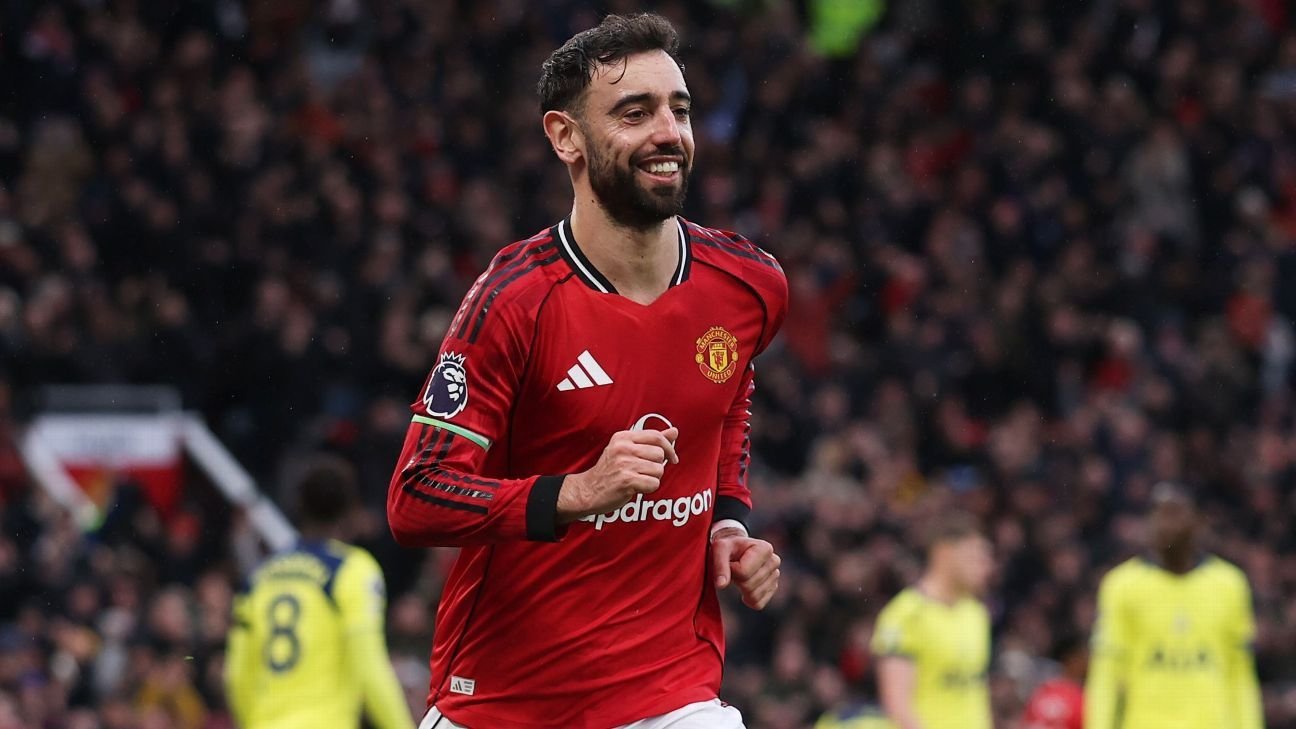
Bruno Fernandes‘ impact on Manchester United since arriving is unquestionable. Just look at his work in the March games vs. Crystal Palace and Aston Villa. Both teams looked to pack the middle of the pitch, and the games were level when Fernandes grabbed them by the reins, tallying a goal and three assists in the two matches. Sometimes a player just knows what to do and isn’t afraid to do it.
From bursting on to the Premier League scene as a January signing in 2020 and powering United to the UEFA Champions League places — registering 15 goals plus assists (G+A) in 14 games — to being the creative metronome under current manager Michael Carrick, he has got better and better. No matter who was in United’s dugout or how toxic things became in the dressing room, they always had a player to rely on to pull a rabbit out of the hat and influence matches. Usually, it was with his assists and goals; even during Ruben Amorim’s miserable midseason takeover in 2024-25, he somehow managed 19 G+A in the league.
The infamous theory proposed in the media is that players thrive away from the cauldron of pressure Old Trafford creates — see Scott McTominay‘s rise at Napoli or Antony‘s at Real Betis. Fernandes, meanwhile, has always thrown himself into that cauldron, being whatever player United needed him to be.
– A big summer awaits Man United, where transfers take priority
– Why missing Champions League can boost Premier League teams
– From Man United lows to a new deal: Why Harry Maguire feels ‘back’
His 2025-26 season is a tale of two roles, one under former coach Ruben Amorim and the other under Carrick. Combining the two Brunos has led to a Premier League Player of the Year-caliber season, and he is well worthy of the award. No one expected United to be this good under Carrick, and amid a personal-best year for Fernandes — he leads the league in assists with 16, twice as many as any other player — it is no wonder that Carrick restoring him back to his best position has led to a uptick in United’s form.
Fernandes is a joy to watch in this refreshing iteration of Manchester United. Here we’ll take a look at how his role has transformed this season, why this might be the best football he’s played and why he deserves to win POTY.
Fernandes’ evolution in 2025-26
One of the parting gifts Amorim might have presented United with is inadvertently showcasing Fernandes’ versatility as a deeper central midfielder in the “regista” role, making him a better player overall.
Playing that role, which longtime Real Madrid midfielder Toni Kroos thrived in, meant controlling the game, dictating the tempo and setting up attacks instead of finishing them. It combined his abilities as an influential attacker capable of producing game-changing moments with a layer of calmness and tempo-setting to his game.
But while it’s a plus that Fernandes provided United with more control and helped get the ball from defense to attack, it felt like a waste to move a player with special creative abilities further away from goal. He could pick a pass out and find attackers, but none of the others have his “sixth sense” of making the correct decision in the final third.
Since moving back to his natural role with Carrick in charge, Fernandes has registered six open-play assists, compared with two under Amorim. It suggests that the tactical switch has turbo-charged United’s resurgence by getting Fernandes back to what he does best: creating chances from open play that other players aren’t capable of. A more settled midfield pivot behind him, featuring Casemiro and Kobbie Mainoo, has helped with this.
Under Carrick, United are a “forward-first” creative outlet. The mantra is simple: outscore opponents using the plethora of attacking talent at their disposal.
There were several matches in the Amorim era where United had no idea how to break down a stubborn block, with the Europa League final or the match against a 10-man Everton coming to mind, making the decision to play Fernandes as a central midfielder baffling.
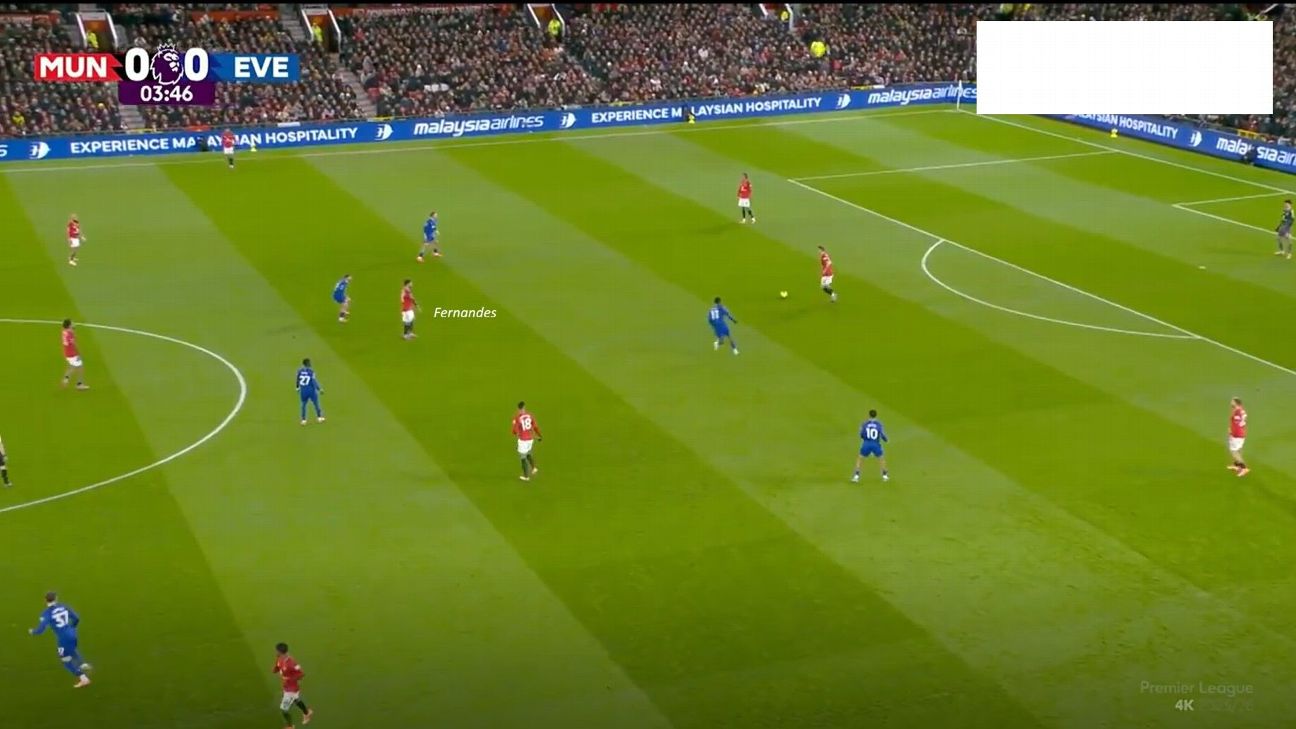
Even if Fernandes gets the ball in the above scenario, there are too many Everton midfielders surrounding him.
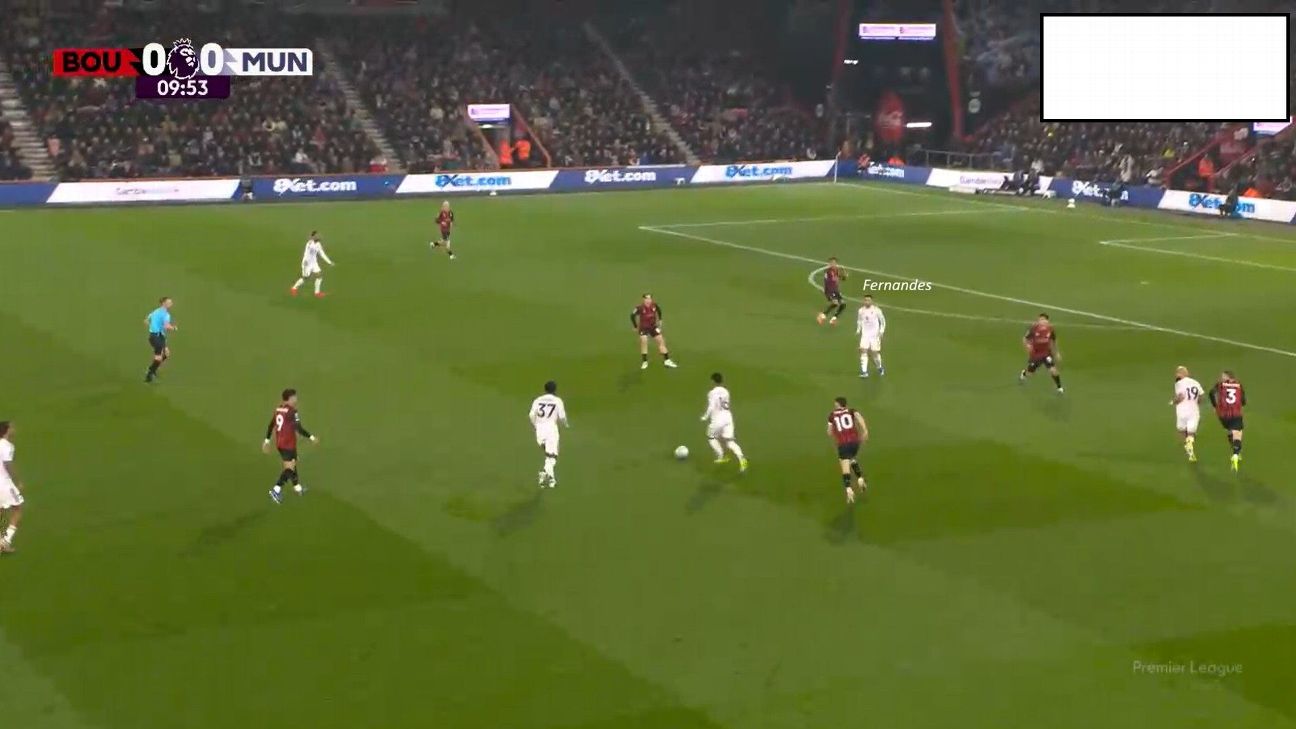
Compare that with his more advanced position against Bournemouth after Carrick’s arrival. Even in a crowded space, his presence attracts defenders and frees up other United attackers. You want him in these positions because he can use his quick thinking to play the ball to a teammate. When he plays deeper, the risk is greater than the reward, and he could lose the ball close to his own box.
Could Amorim have played him further up the pitch? Yes, but as the season went on, the only change he made to his 3-4-3 system was trying to go more direct and hop on second balls — not exactly suited to Fernandes’ strengths.
With Bryan Mbeumo, Matheus Cunha and Fernandes in attack, often at times, any one of the three forwards drops to help the build-up. The dynamic rotations in the attack give Fernandes his coveted “free” role.
His assists under Carrick came from a strikingly similar range. If you look at the goals from below, they both come from him finding Cunha in behind from an extremely wide position.
It’s a testament to his qualities as a player; opponents think that because he’s wide and so far from goal, he can’t hurt them, which couldn’t be further from the truth. It’s difficult to mark against because you don’t want to instruct a defender to close him down in such an awkward space.
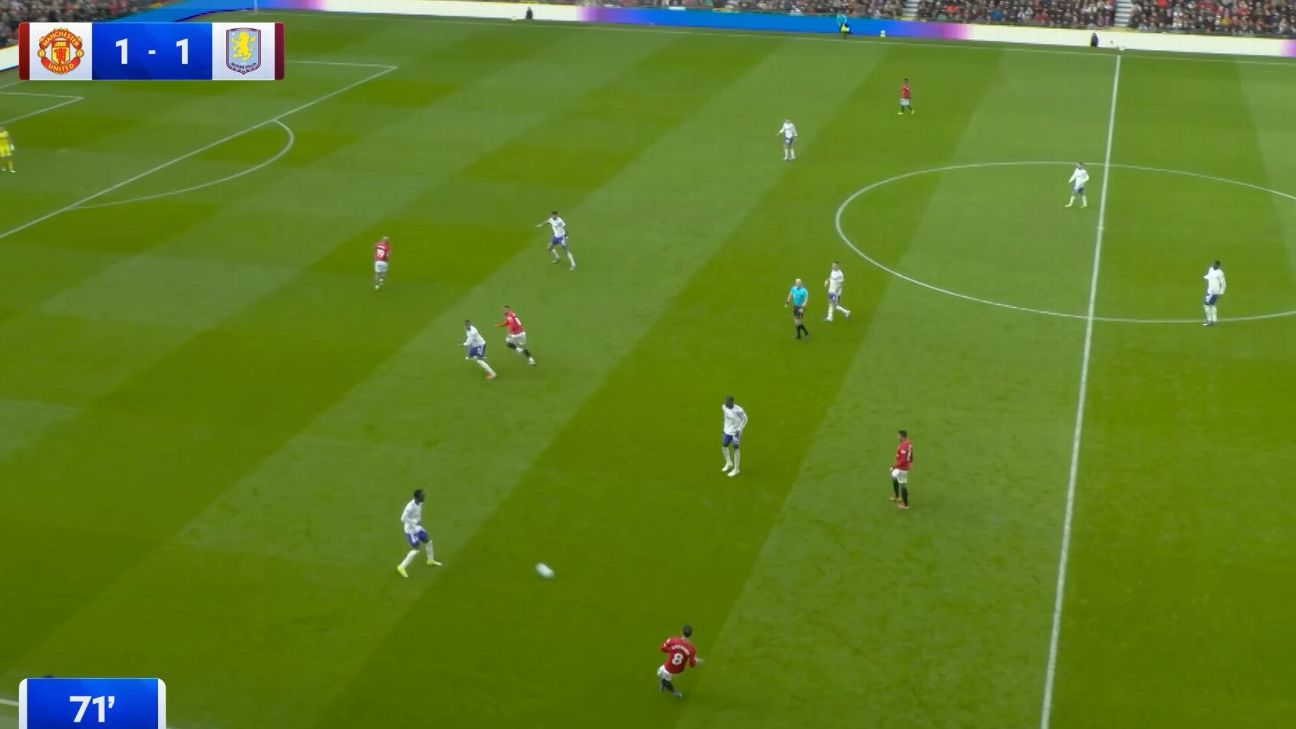
There are a heap of players in the way for the Portugal international to hit his man, but that doesn’t deter him. This is what United get by simply moving him closer to goal: unlocking the unique magic moment that only he can provide.
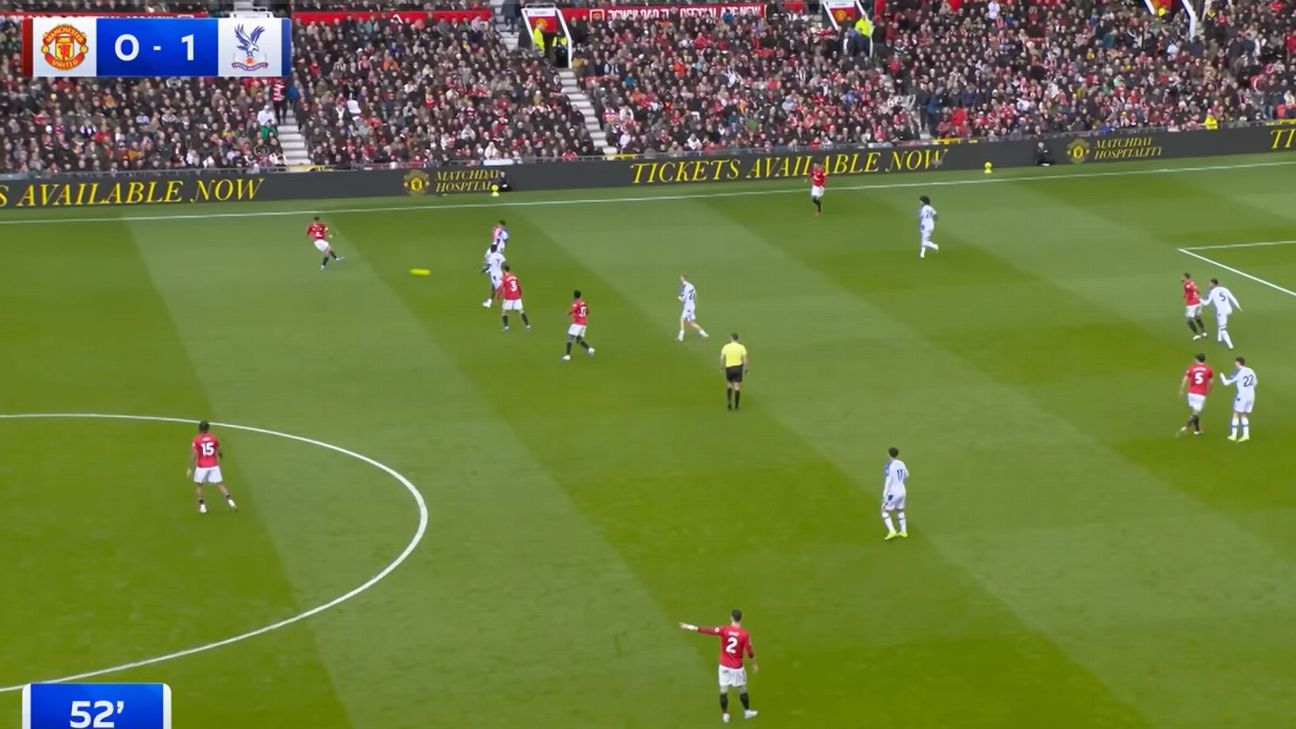
Previously, when the ball fell to him in his own half, he might have tried a quick pass in behind. But after his stint in central midfield, we’re watching him spray a pass wide or look to take an extra second to hold possession.
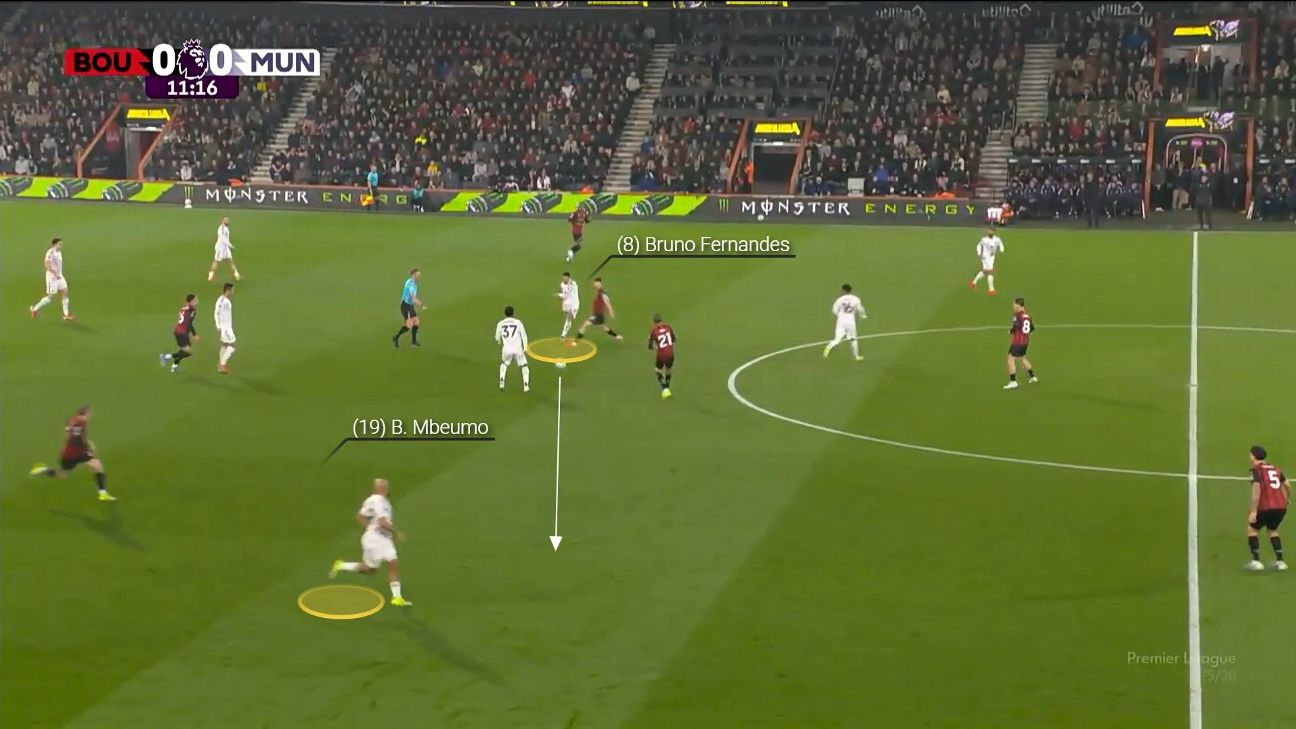
There’s maturity evident in his game now, harnessing his skills from both deeper and more advanced positions.
Why Fernandes deserves to be POTY
Now that we know how he has evolved this season, how has he evolved over the years? And is this the best we’ve ever seen from him?
Well, some of the stats (per Opta) definitely back that up.
He is creating a United career-best 1.3 big chances per 90 minutes and 4.5 chances per 90. This is also the highest percentage of successful passes ending up in the final third he has ever registered, even usurping his time under former coach Ole Gunnar Solskjaer from 2019 to 2021, which included his 2020-21 season of 45 G+A.
Interestingly, Fernandes is playing more passes than ever into the box while touching the ball the least since coming to Old Trafford. With the goal-scoring burden falling on the shoulders of Cunha, Mbeumo and Benjamin Sesko, this makes sense.
He continues to play a high number of forward passes, as well as the most through balls he ever has. And fewer touches in the opposition box combined with more assists per 90 (0.59) indicate that Fernandes finally has an attack around him that he can provide for.
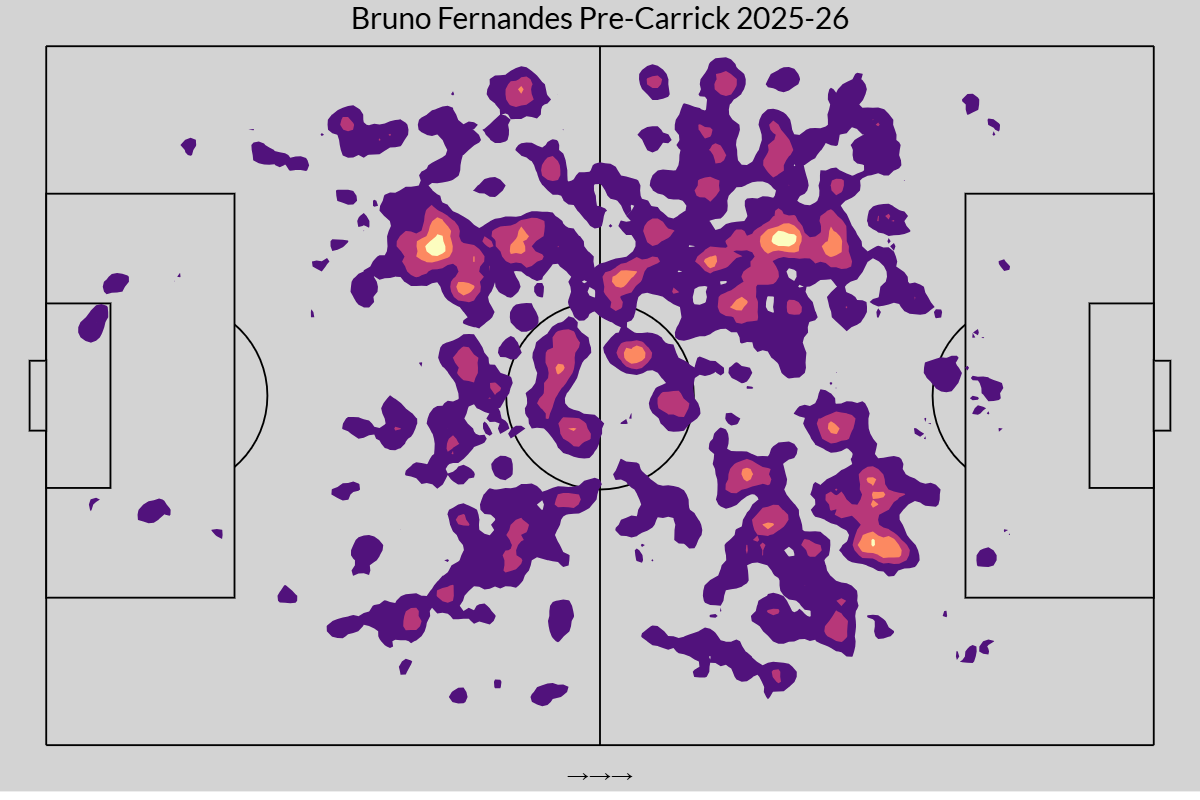
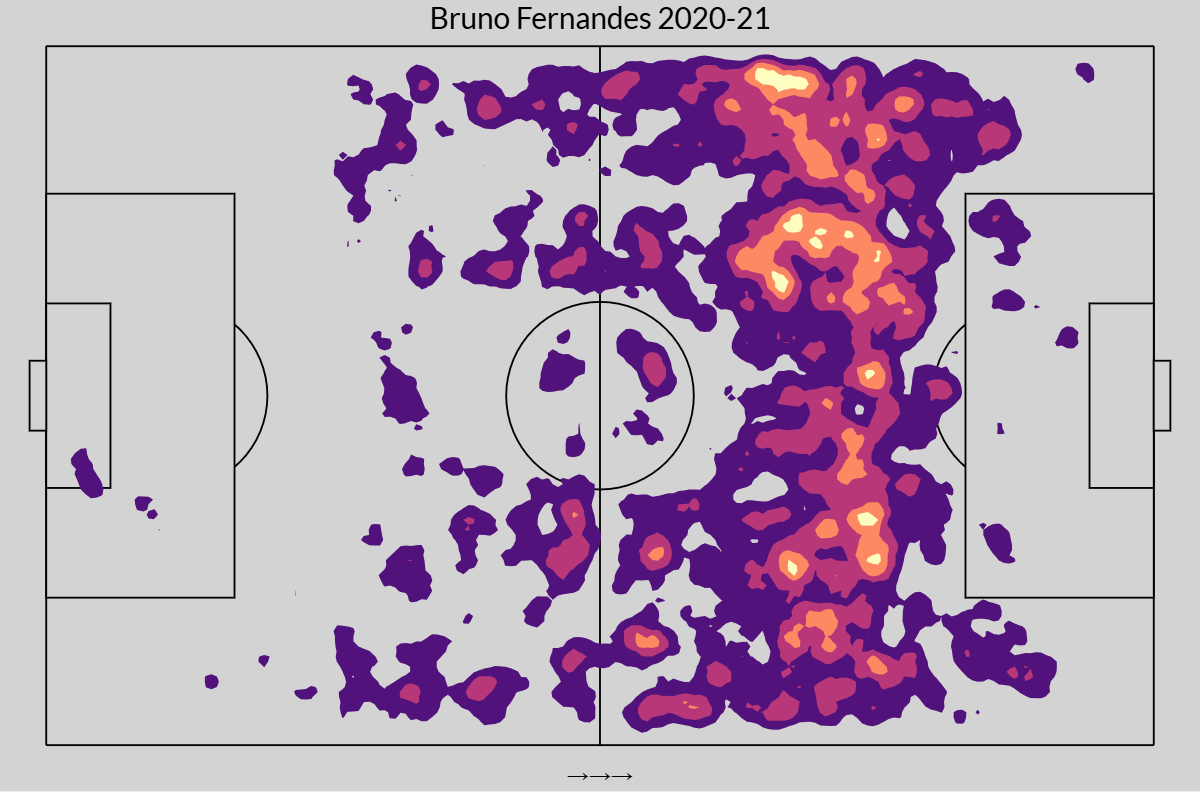
Predictably, his heatmap from this season pre-Carrick was all over the place.
Under Carrick, the areas further up the pitch that he likes to operate in shine brighter in yellow.
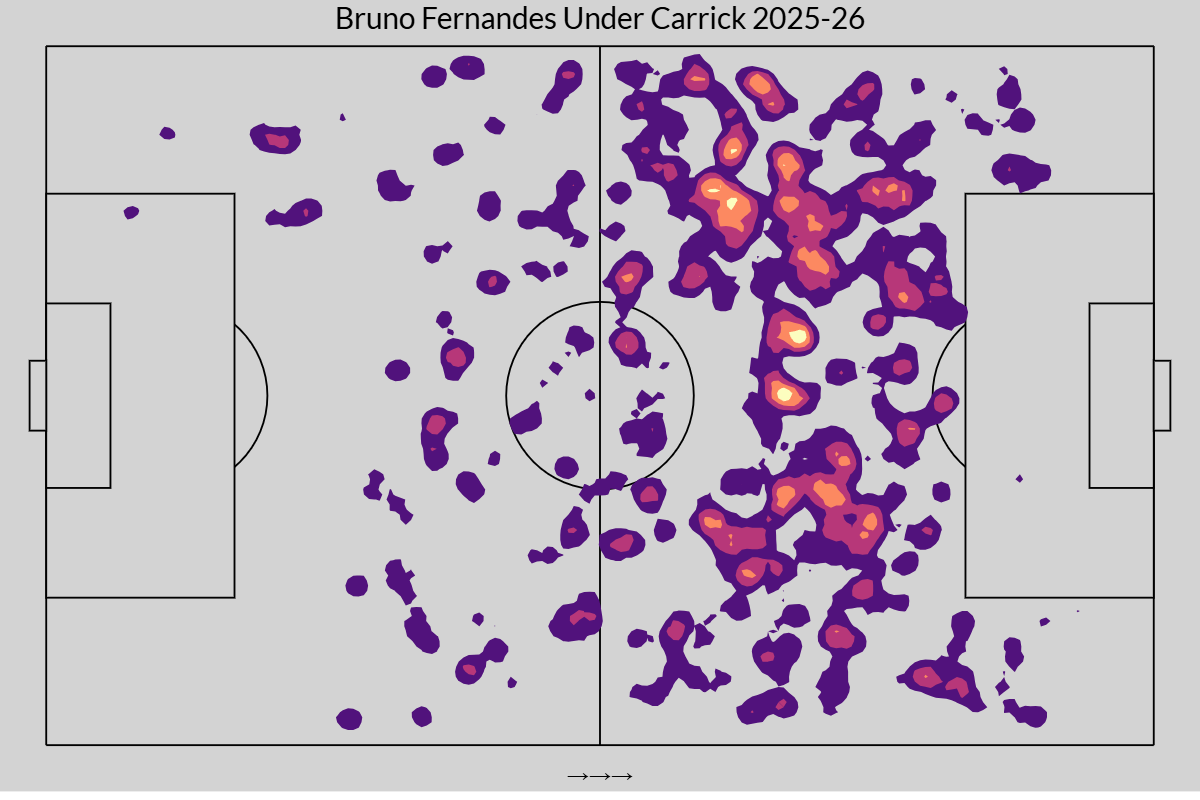
It also shows how he frequently peels left or right, where he can play a forward through on goal from the half-space — extremely similar to his 2020-21 season.
But how does Fernandes compare with other POTY candidates? Looking at some of the other players who have been tipped for the award, such as Dominik Szoboszlai, Declan Rice and Martín Zubimendi, gives an impression of why Fernandes would be a deserving winner.
In terms of forward passes, chances created and passes played into the box, Fernandes is well ahead. Only Manchester City attacker Rayan Cherki‘s creativity stats get somewhere close to Fernandes’, but Cherki has played more than 60 minutes on just 10 occasions this season — nowhere near Fernandes’ minutes. It also must be noted that Cherki has often played as a right winger and isn’t involved as much as Fernandes is in the buildup.
Keep in mind that Fernandes was playing further away from goal until January, when Carrick arrived. Even then, he is averaging more touches in the opposition box and more passes that end up in the final third than any of the other contenders.
The statistics indicate we’re seeing Fernandes at his creative best: making more and better chances than ever, and becoming more efficient in the process. He has become the orchestrator of United’s potent new-look attack.
Fernandes has always been a player who can influence matches, no matter how big the occasion. But now he has also honed the ability to control his dangerous precision. A feint here, a stepover there, blink twice, and he has found a yard somehow, then backs it up with a pass that finds a teammate perfectly.
He used to have three or four “bad” matches in a season, but adding a serene classiness to his creation has led him to be the standout performer in most of United’s matches.
The season has proved he can do it all, wherever he is on the pitch, and that’s why he is the Player of the Year.

