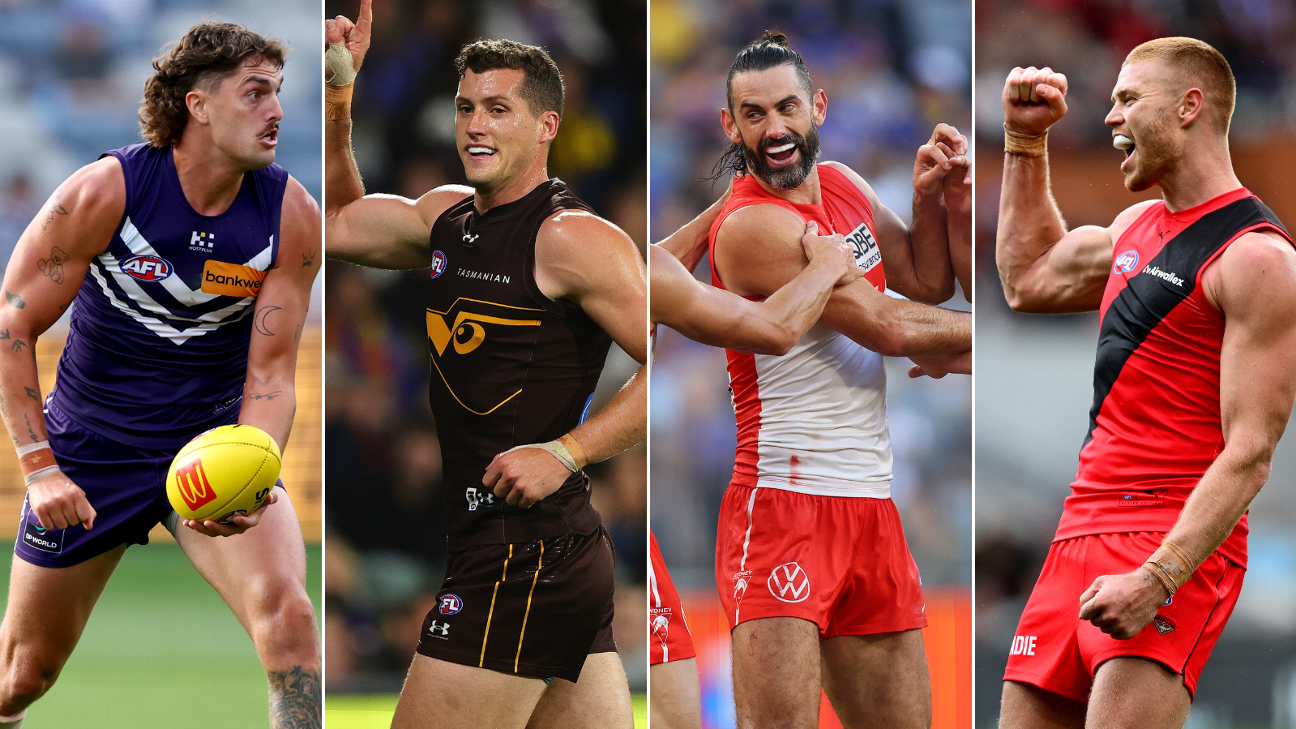
We seem to spend an inordinate amount of time discussing the importance and status of ruckmen in AFL football. Much of it is noise, but sometimes so much evidence gets dumped in your lap you can’t ignore it. Saturday was one of those days.
It began with Essendon breaking its victory drought, a key to which was a dominant midfield, and a key to that proving an inspired Peter Wright, largely freed from key forward duties and finding a new lease of life on the ball.
Not only were Bomber midfield mainstays Zach Merrett and Darcy Parish able to turn the clock back, but Wright’s revitalised competitiveness was able to neutralise Melbourne’s perennial weapon of Max Gawn.
Leading into the game, Essendon had the third-worst clearance differential ever recorded by any team through the first four rounds of a season. They not only came out on top this time 40-32, they scored 55 points from those stoppage wins, their most in any game since 2024. Wright was pivotal to that.
A little later, down the road at Norwood Oval, Sydney’s Brodie Grundy, up against another veteran of the craft in Jarrod Witts, with Mac Andrew offering some support, gave another masterclass in the influence a ruckman can have.
Like Fremantle’s Luke Jackson, who himself had been a key to his team’s nail-biting win over Collingwood on Friday night, Grundy became another de facto ground-level midfielder, with a stunning (for a big man) 12 tackles to go with his healthy disposal and clearance tallies.
Then, in the evening, as Hawthorn and the Western Bulldogs squared off, it was all about ruckmen present and ruckmen missing, the Hawks’ Ned Reeves and Lloyd Meek enjoying a personal picnic as the Dogs lamented the absence of their own ruck key in Tim English.
The numbers were brutal. Hawthorn won the hit-outs 64-17 and hitouts to advantage 21-3. That gave Jai Newcombe an armchair ride, the Hawk little man recording a career-best 14 clearances. The 52 points the Hawks scored from clearance was their second-highest tally across the past two seasons.
There’s an old cliché about big men not getting any smaller as the game goes on. Well, by the time the triumphant Hawks had stepped off Adelaide Oval, given what had also transpired earlier, ruckwork as an art and a still-crucial part of the game stood tall indeed.
It’s more than just observational, too. The numbers, more broadly, are pushing back against the notion that the ruckman is becoming obsolete.
Three big men sit inside the top 10 players in Champion Data’s 100X ratings so far this season — Ned Reeves, Brodie Grundy, and Marc Pittonet — compared to just one at the same stage last year, and none the year before. And teams are currently scoring from 29% of hit-outs to advantage, the highest rate in four seasons.
But what Saturday underlined particularly is that there is no longer a single blueprint for what “getting it right” actually looks like. Which extends beyond just the debate we had at the start of the season about who’d prosper and who’d struggle with the new centre bounce rules.
In Essendon’s win, for example, the significance was more about what being liberated from the goal face and on to the ball did for Wright’s confidence, a process which you could feel the beginnings of last week against the Western Bulldogs.
It’s no great revelation that the big man isn’t the most physical of players, and one who thrives, or shrivels, on confidence. But while Wright has done enough ruckwork throughout his career, even back in his Gold Coast days, more and more it feels like it’s the ruck contests and an around-the-ground role which are his true calling.
As a key forward, miss a couple of early shots at goal or go an extended period without much footy (which has been par for the course with Essendon of recent times) and Wright visibly diminishes.
At regular ruck contests, however, he is forced to compete, to be physical, and to be more mobile. It’s clearly working for him. And for the likes of Merrett and Parish at his feet. It was a statement notable, too, for the relative muting of the ruck might of Melbourne champion Max Gawn.
In Sydney’s win over Gold Coast, meanwhile, Grundy was giving a perfect lesson in the ruck as a de facto ground-level mid. Those 12 tackles were a career-high in nearly 250 games, the big man no longer merely a starting point for others, but a contributor in his own right once the ball hits the deck.
It’s the same profile Jackson has taken on for Fremantle, adaptable either in tandem with Sean Darcy or going solo. Never was that better demonstrated than in Friday night’s gutsy win over Collingwood after Darcy went down with concussion in the second quarter, in some ways Darcy’s departure becoming an unexpected blessing.
And back at Adelaide Oval, it was a double whammy, Reeves and Meek’s performances another big tick for the value of ruckwork, English’s absence leaving too much in the lap of 19-year-old debutant Louis Emmett and Rory Lobb.
The value of the ruckmen now is a multi-dimensional discussion. It depends on the type of ruckman teams have, the type and quality of midfield with which they’re working. And, of course, how well that combination functions once the tap is won, or the subsequent clearance, or indeed the tackle laid by the same guy who won the tap.
The only certainty in this on-going debate is that it will continue. But this weekend did offer a timely reminder that the question is no longer simply how important the ruckman is, it’s what kind of ruckman you need — and when.
You can read more of Rohan Connolly’s work at FOOTYOLOGY.

