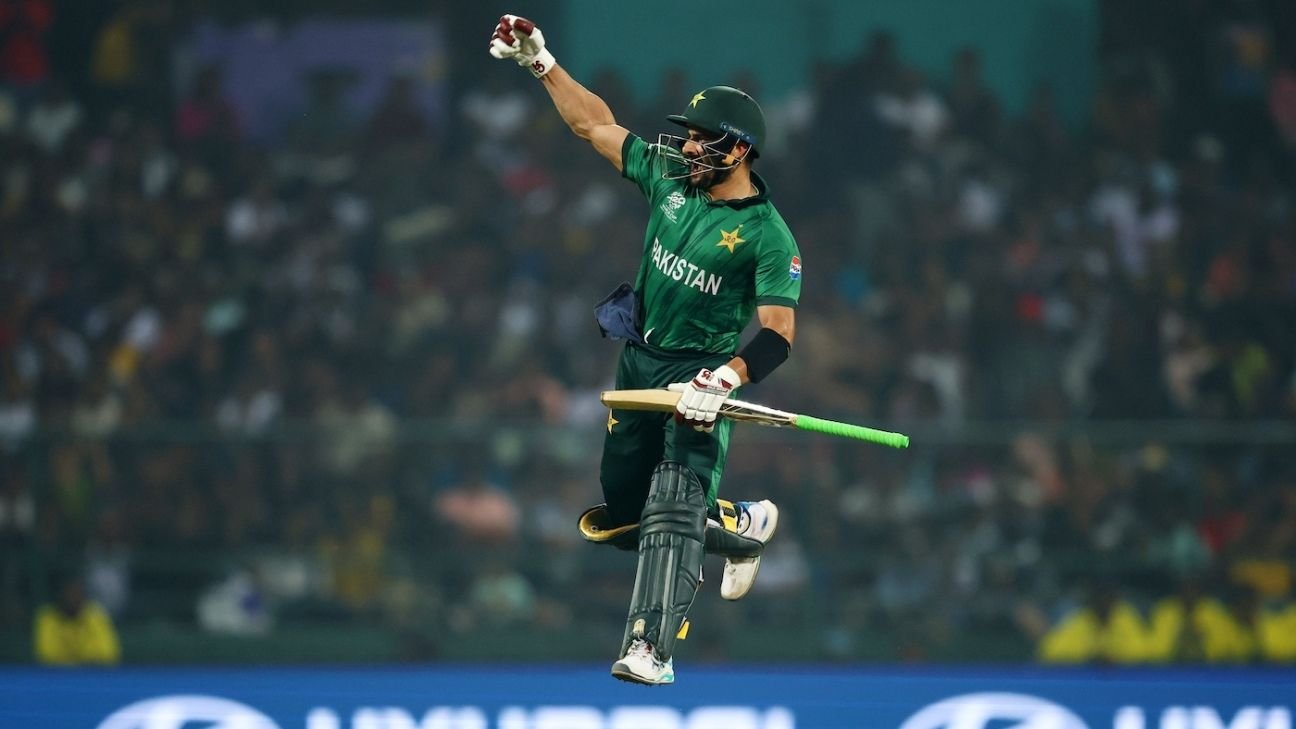
No batter has scored more T20 runs or hit more sixes than Sahibzada Farhan since the start of 2025. Since returning to Pakistan‘s national side in May last year, he has amassed 1219 T20I runs at an average of 35.85 and a strike rate of 140.92. He also set a record for the most runs in a single T20 World Cup, scoring 383 at a strike rate of 160.25 earlier this year, including two centuries, across six innings in Sri Lanka.
His international return followed a prolific domestic run, where he topped the National T20 Cup charts with 605 runs at an average of 121 and a strike rate just shy of 190. That earned him a call-up from Islamabad United for PSL 2025 as a replacement player, after he went unsold in the auction, and he finished as the leading run-scorer in the tournament for the season.
You really seem to be enjoying your cricket these days.
I [would] stress about my performances in the past and that did not help. I have started to enjoy cricket now and it is helping with the results. The seniors around me also advised me to enjoy my cricket.
What is it like to be with Multan Sultans this season, and batting with Steven Smith? You two seem to have good chemistry.
The environment of the team is nice. The owner, Gohar [Shah] bhai, is a former cricketer and he understands how to manage players, which is helpful for the youngsters in the side.
Steven Smith is a wonderful player and he has earned respect with his performances across formats. It is a big deal to open with him. I had only seen him on TV before. I am learning from him. He is relaxed and affable both on and off the field.
“My favourite sixes are the ones I hit against India in the Asia Cup. People started to recognise my six-hitting ability after that”
What are your conversations like with him? Do you plan together for oppositions?
Yes, we do. I tell him about Pakistan’s domestic bowlers – how they bowl in the powerplay and what plans they usually have for the left- and right-handed batters – as he does not know much about them. And he shares his knowledge on matters where I need support.
In the lead up to the 2026 T20 World Cup, you spoke about your desire to be the leading run-scorer of the tournament. How did you make it happen?
I had confidence [in myself] as I had been topping batting charts in different tournaments [for the last one year]. When I was not selected in the player draft for PSL 2025 I said to myself that I needed to do something different. I had been scoring a century in [the last two] National T20 Cups and I marked two centuries as my target for the 2025 edition. I ended up scoring three centuries to be the leading run-scorer, by the grace of Allah, and took my team to the final. I had even topped in a club tournament before this. Then I hit the most runs in the PSL after I was picked and I also scored a century there.
My performances were not limited to T20s. I had top-scored in the four-day [Quaid-e-Azam Trophy 2023] and finished the one-day [competition] in the top five [for Peshawar with 226 runs in eight innings]. I had runs behind me, and I wanted to score maximum runs to win games for Pakistan. Having that goal kept me focused.
What changed to bring you so many runs? Was it just hard work or was there also a mental shift?
I finished as the leading run-scorer across the last four seasons [of the National T20 Cup], but I was not considered [good enough] for [high-level] T20 cricket. After the first two seasons, Iftikhar Ahmed [Peshawar and Pakistan team-mate] had an honest conversation with me and said, “You cannot be playing with a strike rate of 132 as an opener.” I did not like him saying that and found it odd that he was criticising my low strike rate despite me scoring the most runs across two editions.
Abdur Rehman, our coach from Peshawar, also told me that scoring at a strike rate beyond 140 would be beneficial for me. I did not truly understand the logic behind it and thought that being the leading run-scorer should be significant in itself.
But I [slowly] realised I need to improve my strike rate and push it closer to 150. I began aiming to be the leading six-hitter in every tournament from that point. I started to practise power-hitting. I scored at 170-180 [492 runs at 178.90] in the next National T20 Cup [in 2023] and hit the most sixes [29 in 12 innings].
Then, in my last National T20 Cup [2025], I was again the leading six-hitter [with 40 in seven innings] and scored three centuries. I hit the most sixes [for Pakistan] in the Asia Cup and the T20 World Cup, and I think I am the leading six-hitter in the ongoing PSL as well.
You can score big runs, hit sixes, especially during the powerplay, and score at a better strike rate as an opener and I have been working on these for the last one year. There is a lot of effort behind my six-hitting. Asif Ali once said he hits 100 to 120 sixes each day, I also practise in a similar manner. I practise range-hitting with the new ball, old ball, and worn-out balls.
“Bumrah bowled slower balls, yorkers, bouncers. And he can swing the ball both ways. It is difficult to play him but you have to find a way to do it. Once you are able to do so, the other bowlers seem easier to play”
Did you also have to put in work in the gym to improve your power-hitting?
Gym is essential for power-hitting and it plays a crucial role in increasing the frequency of sixes. Sometimes you see the ball going the distance even after hitting the bottom of the bat, and that happens because of the power and strength built in the gym. I have been doing strength training since my early playing days.
There is a ground next to my academy in Peshawar where I practise range-hitting. It helps me understand how far I am hitting the ball against pacers and spinners. You cannot do that in the nets. And in the nets you often end up in arguments with the bowlers whether a certain shot was a six or a four. I hit a 100-metre six in the recent T20 World Cup. It was because of all the work I have been doing behind the scenes.
You have hit the most sixes in T20 since the start of 2025. Were you always such a prolific six-hitter or did you develop that ability recently?
I have always had the ability. But I had been playing first-class and one-day formats as well in the previous seasons, where you have to rein yourself in. The T20 tournament is played at the end of the season, so I did not hit many sixes previously. Recently my whole focus has been T20 cricket, and as an opener I decided to approach it how others around the world were doing. You will see me hit many more sixes in the coming days.
When do you know you have made a clean connection with the ball?
I trust my skill. I hit the ball with full force when it is in my range – there are no second thoughts in my mind. I am very clear that I have to hit it, because if you [are in two minds] your body doesn’t generate that momentum.
If I get consecutive balls in my zone, I go for it. You must have seen in the last innings [against Rawalpindiz in Lahore] that I hit two sixes to bring up my half-century from 38 and I hit another ball in my zone for a six.
Which has been your favourite six so far?
The ones I hit against India in the Asia Cup. People started to recognise my six-hitting ability after that.
How do you prepare for a match?
Our [Pakistan] team analyst Talha [Ejaz] bhai provides us videos of opposition bowlers. I study those videos the night before a match and often go to his room for detailed analysis on the bowlers. He has vast experience at this level so I try to benefit from it, to understand how bowlers bowl at different stages and what variations they use.
In the nets [on the eve of a match], I bat as I would in a match, so my body is ready. I plan to attack and dominate the opposition’s spearhead so it unsettles the other bowlers.
Is that why you attacked Jasprit Bumrah in the Asia Cup?
It is not only Bumrah. Their other bowlers, Axar Patel and Kuldeep Yadav, are also some of the best. It gives you confidence when you hit a good bowler, as I hit him [Bumrah] earlier in the innings [in the first match in the tournament between the two sides].
He gave me a tough time at the start. He bowled slower [balls], yorkers, bouncers. And he can swing the ball both ways. It is difficult to play him but you have to find a way to do it. Once you are able to do so, the other bowlers seem easier to play.
Did you find it difficult to pick him, since Pakistan and India do not play against each other that often?
I found it difficult in the first match.
He is famous for his yorkers and can bowl them at any time, so I was ready for that. I was very focused when facing him. Everyone is extra focused when it is India-Pakistan.
My experience of playing tape-ball cricket helped me. I have faced bowlers with weird actions who bowled slower ones and yorkers in tape-ball cricket. So that helped me.
Pakistan cricketers get a lot of criticism. How do you cope with it? You were personally criticised for not being good enough for international cricket at one point.
The best way is to perform on the ground and let the bat do the talking. The same people will start to see positives in you. I cannot and will not respond to criticism. A month before I scored the most runs in the PSL [in 2025] people were saying I was not good enough for international cricket, but then their opinions changed. We should not shy away from criticism and should not take it negatively. We enjoy when we are praised. It is part of being a cricketer.
There is a video doing the rounds on social media from last year, from the day after the PSL 2025 draft, in which you went unsold. In it you said you would continue to work hard to earn your place back in the national side. It is natural for players to lose motivation after being ignored consistently. How did you keep yourself going?
I am a bit different. I vent my anger in the nets and gym when I fail.
I did not expect to be overlooked by the PSL teams because I had been the top-scorer in the T20 format for three years. I was the [second] highest run-scorer for Lahore Qalandars in the last PSL and finished among the leading run-scorers in 2024 [11th with 266 runs in eight innings]. I had scored three fifties at a good strike rate.
I thought I should have been the first choice for the teams, considering the quality of the players who were picked that night. But it is something that was not in my hands. This is franchise cricket and the teams have the right to pick whomever they want.
I called my academy bowlers right after the draft that night and told them to report to the nets at 6am next day and I started my preparations for the National T20 Cup. My coach at the academy made that video and he said, this video will remind you of your hard work during tough times.
I never lose hope. By the grace of the almighty, I am able. This cycle will continue. I have the opportunity to go back to domestic cricket and top the charts if I am dropped again. It is a huge deal for me that I have been able to top the batting charts for four consecutive years. There are players who top in one season and fade away.
I cannot thank Allah enough for the last one year.
You mentioned earlier your conversation with Iftikhar Ahmed about the need to improve your strike rate. You often finish your innings with a middling strike rate because you consume too many dot balls. Are you working on that aspect?
No player is complete and there is always room for improvement. I can hit sixes but I have an issue with strike rotation. There are players who can rotate strike but cannot hit sixes.
I am working on how I can steal singles with soft hands, as [Mohammad] Rizwan bhai and Babar [Azam] do, with our batting coach. They have worked on it and they have confidence to run singles in front of the fielders. I have an issue with running, so I fear that I may get run-out. I am working on it. It cannot be solved in one series and will take time.
Actually, it is something I never developed. I have a reputation of being a hard hitter and fielders in domestic cricket stand at the edge of the circle anticipating that I will hit the ball [there] rather than taking a single.
As you said, I hit the first ball for six but end up playing the next two, three balls as dots. You will see less of that in the next series. It may not vanish completely, but there will be less of it.
Do you think you slow down when you are reaching a fifty or hundred?
It depends on the situation. You can look for a single if you are on 99 after you have won the match for your team already. Scoring a century in a T20I is a big honour. I took a single for my hundred in the T20 World Cup [against Namibia] and it became a big issue. We were certain to win that match. I was heading towards a record as nobody [from Pakistam] had scored a century in the last 12 years [in the T20 World Cup] since Ahmed [Shehzad] bhai, which is quite odd.
[The thought of slowing down for a milestone] does cross a player’s mind. You can call someone selfish if they score a single when your team needs a six, or three or four runs, to win.
People will soon see me hit boundaries in the nineties as well, and I hope they will appreciate that. I often score my fifty or hundred with a boundary in domestic cricket. Players in the dressing room come to the balcony when I am in the late forties or nineties because they anticipate a big hit. You will see that happen in international cricket as well.

