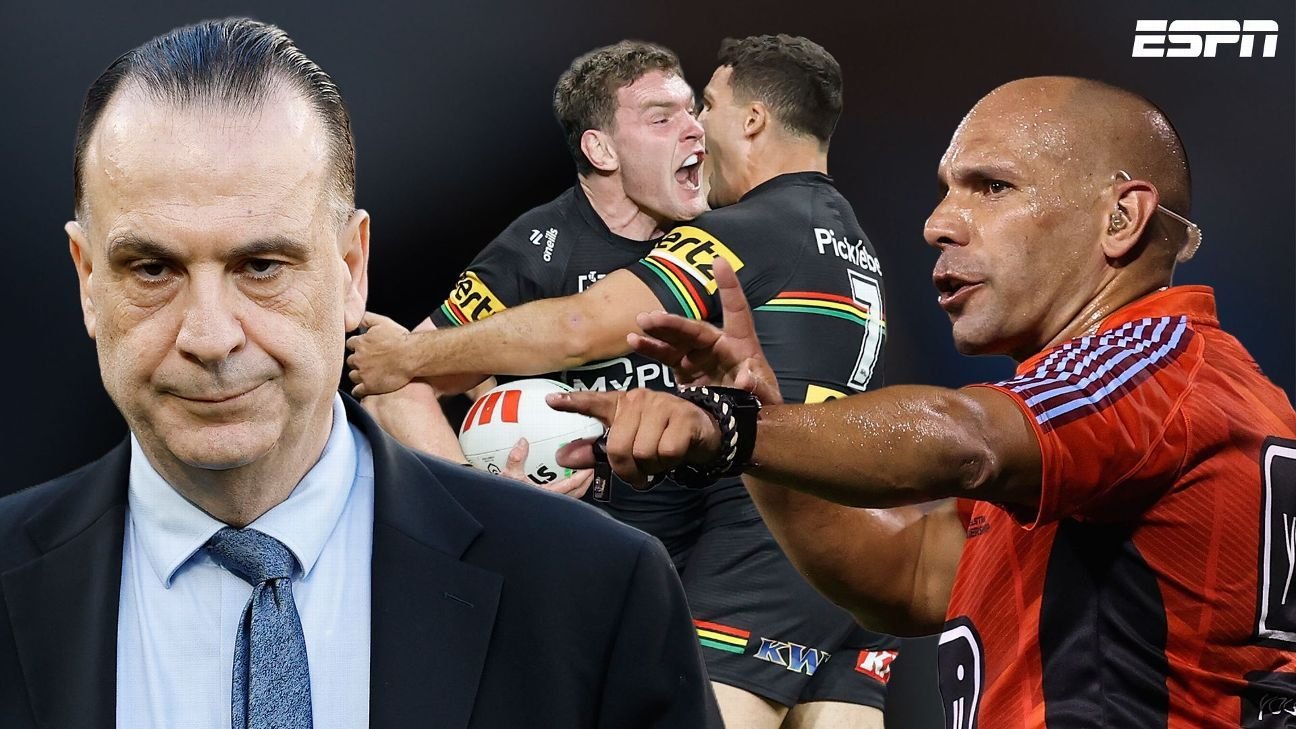
Our ESPN rugby league experts just happen to span three generations of passion and fandom. With the NRL charging ever onwards, and a team based on the moon certainly not out of the question, we pause to ponder; where does the game we all love currently stand?
To ensure that we’re not just presenting the old man yelling at the clouds perspective, we turn to our resident Z, Y and X generation representatives.
Was rugby league much better in the good old days? Is the game better than it has ever been? Are there things that could be tweaked to make the NRL even better?
The NRL returns to Perth next year with the resurrected Bears. After that the PNG Chiefs enter the competition in 2028. There are already talks about a fifth Queensland club and beyond that we could very well be headed to the moon! Is the NRL expansion outpacing the rate of talent development? Do we have the players or even the fans to allow this expansion to be successful?
GEN X: During the Super League war, the number of teams playing in the two competitions ballooned. The quality of play inarguably suffered and the two-league model was clearly unsustainable. After that, the NRL was formed and the number of teams consolidated. We lost the Perth and Adelaide markets, but the league was more competitive and successful. There is no hiding the fact that the NRL’s finances depend heavily on television and gambling contributions and both of those benefit from there being more games. The playing standard may drop, but that will eventually even itself out across the clubs.
– Darren Arthur
GEN Y: One of the most telling things so far in the 2026 season has been how much a few injuries have derailed teams. Even the Melbourne Storm, whose depth has always been one of the most impressive aspects of their roster construction, have found it tough after losing a couple of players. I think this tells us pretty clearly that as we expand to an 18th team and then beyond, having a healthy team is going to be even more important than it already is. In saying all of that, expansion is an absolute must and particularly in the case of Perth, will open up another market for junior players. That will take an entire generation for the NRL to reap the rewards, but it will pay off in the long run.
– Matt Bungard
GEN Z: Right now, the elite end of the competition remains strong, but depth is where the strain begins to show. Expansion will inevitably stretch rosters thinner, placing greater emphasis on development systems. Pathways in Australia and New Zealand are producing talent, but not at a rate that comfortably supports multiple new franchises in such a short window. PNG adds an exciting, untapped market, but it too will need time to consistently produce NRL-ready players. There’s also the question of fan engagement. Perth and PNG offer genuine growth opportunities, but sustained success will rely on competitive teams and strong local identity. Expansion works best when new clubs are immediately credible, not perennial strugglers.
– Isaac Issa
For the game to be successful, especially considering the plans for expansion, the on-field product has to be as entertaining as it possibly can be. The NRL clearly believes that the game is better when it is quicker. The introduction of the “six again” call has made play faster, with fewer stoppages, but has it made the game better or worse?
GEN X: As the old man yelling at the clouds, I feel obliged to say that the ‘six again’ call has been one of the worst rules ever introduced to the greatest game of all. The ability for referees to completely control the tempo and momentum of a game, takes the result out of the hands of the players. That annoying little bell sound is always greeted with moans as the fans realise that a gallant defensive stand is almost certainly about to be overrun by an arbitrary decision to keep the attacking team going. It is literally possible to make the call or ignore the opportunity to make the call at every single tackle. The referees should not have that power at their fingertips. Go back to awarding penalties, which can be properly scrutinised.
GEN Y: Faster doesn’t mean more exciting. More points doesn’t mean more entertainment. And, most importantly, having the ball in play for longer periods of time is not some golden goose that automatically makes the game better. The current regime have made a lot of rule changes, some completely without reason, but no policy is more tied to them than the ‘six again’. I hated it when it was brought in, thinking it would be used cynically in defence by clever teams, and lead to a lower quality game due to exhaustion and both of those things were immediately proven to be correct. The NRL would never admit to being wrong about anything, so instead it was quietly peeled back every year after the embarrassment that was the 2021 regular season. It was extremely shocking to see that after 2025 was the best year in a little while, that those in charge saw fit to try and re-insert set restarts more frequently instead of removing them completely. The only difference between 2026 and five years ago is that people like me who were critics were the minority then, and are the majority now.
GEN Z: The introduction of the ‘six again’ rule has reduced stoppages and increased fatigue, leading to more open passages of play. At its best, this has created a more entertaining spectacle — more line breaks, more points, and more moments that translate well to broadcast and social media. However, the trade off has been a noticeable shift away from traditional structures. Defensive systems are under constant pressure, and some argue that the balance between attack and defence has tilted too far. There are also concerns around player fatigue and injury risk, particularly as the game continues to get quicker without a corresponding reduction in workload.
The referees cop a lot of flack for their mistakes. The bunker was introduced to help cut down on the errors, but fans often lament that those working the video review system are just as likely to mess up as the blokes with the whistles. Is the quality of officiating at crisis point?
GEN X: For as long as sport has existed, the match officials have been copping the blame for results that may have been influenced by their errors, whether actual or perceived. I’m of the old school view that you play to the whistle, the referee is always right, and you have to perform well enough to overcome any mistakes he might make. Sure, the referees can always be better, but they will never be perfect. I’m more concerned by the rule changes they are handed that give them too much influence on a game, see my “six again” whine above.
GEN Y: I’m of the opinion that when a referee makes a mistake, he’s human, as we all do. You don’t demand the sacking of players for throwing a forward pass, or call them corrupt if they drop the ball, so let’s give referees the same grace. Having said that, there’s no real excuse for any video officials in sport to get things wrong, and the bunker needs to be doing better. But the real issue comes with the number of referees we have. Go back and watch pre-COVID games from the two referee era – the ruck is cleaner, and the ten metres better enforced. It’s a complete contradiction for the NRL to be obsessed with making the game faster and faster, but citing costs as the reason for going back to one referee, who now looks completely overwhelmed most of the time. I would love for us to have two refs again but there doesn’t appear to be a lot of groundswell behind the idea.
GEN Z: Part of the issue lies in the complexity of the modern game. With faster rucks, more fatigue and more grey-area situations, referees are making more decisions under pressure than ever before. The bunker, while helpful in theory, has not always delivered the clarity it promised. That said, “crisis point” may be an overstatement. The standard of officiating is not collapsing, but the perception of it is. And in a sport so driven by fan engagement, perception matters just as much as reality.
The NRL is heading towards a new broadcast deal, with talk that the game could be carved up between the highest bidders. Picture your Monday Night Football being broadcast by Stan, your usual split between Nine and Fox for the rest and maybe State of Origin exclusive to Channel 10. How delicate is the balance between the game making the most money it can out of the deal and the quality of the fan experience?
GEN X: It has taken me some years to get used to my Kayo streaming, even recently they have for some reason changed the feature for flicking between streams. When games are broadcast on Nine and Kayo, I choose my broadcast based on my preferred commentators. The absolute last thing I need is to have to pay Netflix an extra $10 a month for a sports option to see Monday night games. The NRL has to ensure it doesn’t alienate its fan base.
GEN Y: One thing fans should never care about is how much money a sport makes. It’s weird when fans of movie franchises talk about box offices, it’s weird when fans of musicians talk about comparative album sales, and any footy fan who cares whether or not the NRL TV deal is worth a few more million than the AFL one is particularly weird. The NRL will never be in any sort of financial jeopardy, it’s simply too big to fail. The next broadcast deal should be about two things; the quality of the broadcast and ensuring it’s visible to the largest possible audience. The A-League essentially died in the eyes of casual sports fans the moment the product left Fox Sports and became buried behind the paywall of a streaming service that nobody has. The NRL is much more popular than the A-League, of course, but it would still be disastrous for the weekly broadcast to be splintered across multiple streaming services and networks in the way that American sports are. We simply don’t have the audience to sustain a business model like that, and the NRL owes it to the fans to, hypothetically, not sell one game a week off to Amazon Prime or Netflix.
GEN Z: It’s a really fine line. The NRL obviously wants to get as much money as it can out of the next deal, and splitting rights across multiple platforms helps drive that price up. But if it goes too far, it starts to hurt the fans. If people have to jump between Stan, Nine, Fox Sports and whoever else just to follow the game, it becomes a chore, especially for casual viewers. And once it’s hard to watch, people start tuning out. Rugby league has always thrived on being easy to access, particularly through free-to-air. Lose that simplicity, and you risk chipping away at your audience.
The ARL, run by Peter V’Landys has grand plans for taking rugby league to the world. On the back of the Las Vegas success, there are moves towards playing club games in cities all over the globe. What do you make of these ambitions?
GEN X: It is an inescapable truth for all businesses that you need to continually grow or you will eventually die. Apart from the NRL’s local expansion plans, the rest of the world sits as a very tempting source of untapped growth. Cracking the 300 million-strong sports-mad USA audience is nigh on impossible, but even minimal success equates to large numbers. Once again, broadcast rights and gambling revenue rule a lot of the thinking involved here. With sports betting running wild in the USA, there is a very big pie from which to grab a slice. Will we eventually see an international club competition? No, but exposing the game to the world audience has many other benefits.
GEN Y: This sport will never be popular in America, and I thought we were past trying to sell this dream to the handful of people still dumb enough to believe it. As I’ve written multiple times, the Vegas games have been a success, but not in the way the NRL wanted them to be. They’ve been successful because of the sheer number of travelling fans who’ve turned it into a pilgrimage to go and support their team – which is a fun thing to do! I’m all for a global round as long as Souths get to play in a nice city that I want to visit, but in terms of actual, sustainable growth, the real areas to focus on are the ones in Australia that don’t have NRL teams yet.
GEN Z: Rugby league’s strength has always been its tribal, community-based support. Taking games offshore can generate headlines, but it risks diluting that connection if overdone. The challenge will be striking a balance between innovation and tradition, expanding the game without losing what makes it unique.
Speaking of Peter V’Landys, his reign as boss of rugby league in Australia has been lauded as a great success. Do you agree and how long do you think he should stay in his position?
GEN X: Peter V’Landys is a very successful sports administrator, currently juggling successful tenures running both rugby league and horse facing. Do I agree with everything he has done? Certainly not, I think he tends to interfere too much with the very essence of what makes rugby league great. But otherwise, his efforts to see the game through the COVID crisis and his innovative mind when it comes to the game’s growth have to be admired. He can stay until someone better comes along, or he retires from exhaustion.
GEN Y: Some of the rules introduced by the current regime have been great! Two point field goals are awesome, the new bench rules with six players offering more flexibility in the event of head knocks and other injuries are common sense, and I’ve wanted a team in Perth for years. However, there’s other things where you just shake your head and wonder who is or was asking for this; the ‘six again’ call, as I already mentioned, changing the rules on short restarts, and those terrible kick-off rules that were thankfully struck down at the 11th hour. I cringe at all the pot shots he aims at the AFL and other sports, and the way certain people in the media hail him as an all-conquering hero, but it could always be worse, I guess.
GEN Z: While question marks around V’landys’ methods from a core rugby league lens have been a topic of controversy in recent years, his impact on the game from a commercial perspective is undeniable. The only caveat is that he can sometimes be too ambitious, which I believe is the only way any type of downfall for V’landys occurs. In saying that, he should remain in his position of power until that day comes, and not a second before.
Overall where do you think the game as a spectacle currently stands?
GEN X: I am still enjoying rugby league, apart from some minor frustrations centred around the rules and officiating. I do think we have drifted too far away from the glory days, which I consider to be the 1990s through to the early 2000s. The introduction of the 10-metre rule in 1993 made a huge difference to the quality of the game. Gone were the 4-2 grand final slog fests of the mid-80s, more open attacking football was facilitated by the extra space between the teams. The NRL seems to think faster is better, but I’m not so sure.
GEN Y: It’s tricky, because as I said earlier, I thought last year was a fantastic season. The quality of the game’s top players is as good as any other time in recent history, and I do enjoy that this season is throwing up some nice surprise packages like the Tigers and Cowboys. If we could remove set restarts (have I mentioned how much I hate that rule?) and bring back the second referee, I think we could see the highest level of footy to date.
GEN Z: As a spectacle, the NRL is in a strong position. The game is faster, more dynamic and more accessible than ever before. Broadcast quality is high, social media engagement is booming, and the league is producing moments that resonate beyond its traditional audience. However, there are underlying tensions. Expansion pressure, officiating debates, and concerns around player welfare all sit beneath the surface. The NRL is growing — but it’s also evolving rapidly, and not always smoothly. Right now, the competition sits in a compelling but delicate position – exciting, ambitious, and full of potential, but needing careful management to ensure that growth doesn’t come at the expense of quality.

