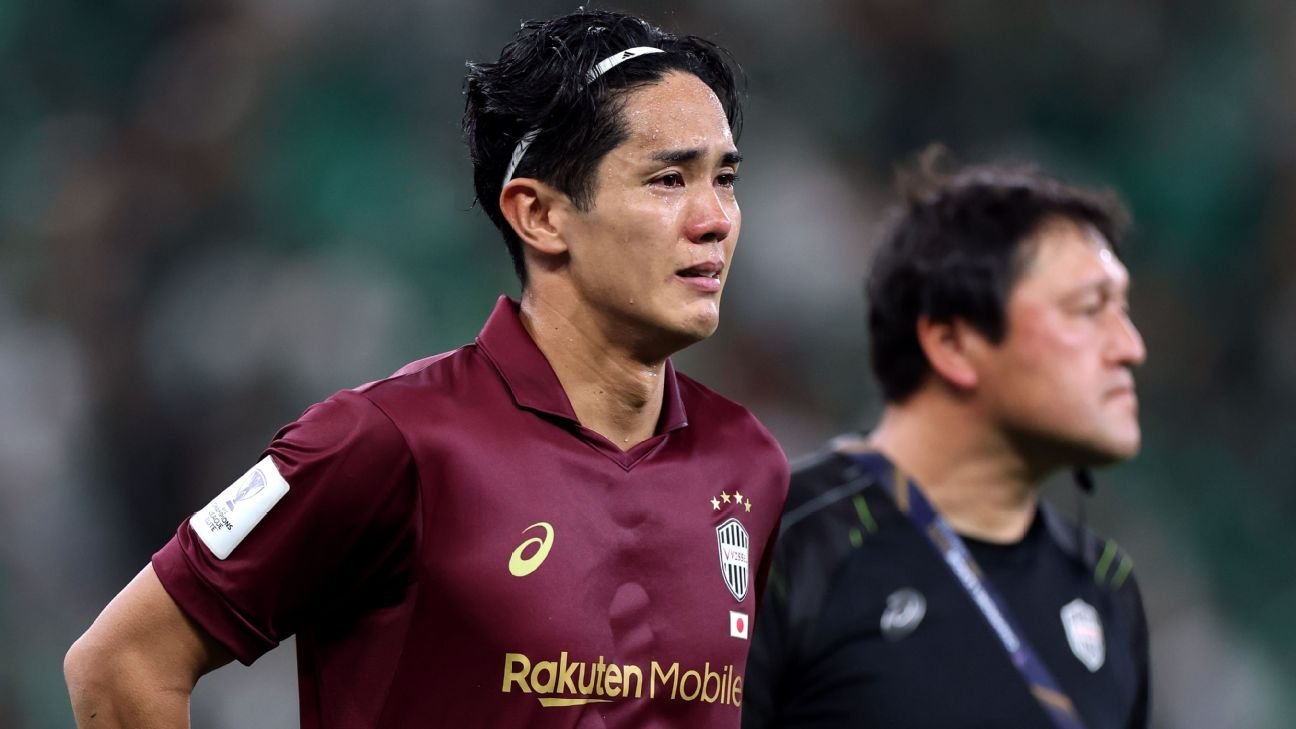
It was once more a case of so near yet so far for Vissel Kobe as the last four was again the furthest they would go in Asian football’s premier club competition.
Having reached the same stage back in 2020, Vissel were gunning to make it out of the semifinals of the AFC Champions League Elite on Monday evening and were even leading at halftime — only to fall to a 2-1 loss to Al Ahli following a stirring fightback by the defending champions.
And the scenes at the final whistle were enough to show just how much it would have meant for the J1 League outfit, who were looking to become the sixth different Japanese club to reach the decider — which would have been a new competition record.
Yuya Osako gazed to the late evening Jeddah sky in despair. Yoshinori Muto was unable to hold back the tears. Daiya Maekawa wore the look of a man who suspected his mistake was potentially the reason behind his team’s exit, but more on that later.
If anyone still suspected that continental glory was not high on the list of priorities for teams from Japan, Vissel’s sheer disappointment provided the perfect rebuttal.
Maybe a decade ago, there was a stronger argument behind that notion.
During those times, it was almost a guarantee that Japanese clubs would send second-string teams for midweek away games in Asia as they looked to keep their best players fresh for domestic action.
There is however a case to be made that the sides they put out were probably still strong enough to get a result. Or that these clubs were still confident enough in banking enough wins at home to advance to the knockout round.
It is also hard to ignore the fact that, since 2017, Japanese clubs graced six of the past eight finals — winning three titles in the process.
But a Japanese club being undermanned for an away fixture in the ACL Elite is now far less commonplace.
Only twice this season did Vissel Kobe really ring the changes for a continental tie. Once, early on in the campaign at home to Melbourne City, and then in the final league stage tie when they travelled to Johor Darul Ta’zim with their place in the knockout round already secured.
Even then, it was not a completely unrecognisable lineup with several regular first-teamers providing a level of experience.
Sanfrecce Hiroshima always fielded a starting XI close to their strongest in their run to the round of 16, allowing for rotation due to form and fitness, as did tournament debutants Machida Zelvia — who are remarkably still a chance to reach Saturday’s decider as they take on Shabab Al Ahli in the second semifinal on Tuesday.
Vissel were clearly desperate to reach the final, and even go one step further and become Japan’s seventh different champions of Asia.
After all, anyone in the squad who has been at the club since 2023 would have already won the two biggest pieces of silverware Japanese football has to offer, with all due respect to the J.League Cup.
Winning the J1 League is obviously the main target for any club each season. The Emperor’s Cup, which has been around since 1921, holds its own allure.
Vissel won their first league crown in 2023 and followed up with the double the following year. They need the J.League Cup to complete the domestic set, but it is clear winning the ACL Elite is the logical next step for them to take.
For many of their stalwarts, there was also a feeling this was potentially their best chance for one final taste of glory.
Muto and Osako, who combined brilliantly for the latter to score Vissel’s goal on Monday, have both had fine careers.
Osako spent seven seasons in the Bundesliga, where he was even Werder Bremen‘s top scorer in the league in 2019-20. Muto has played in the Bundesliga, Premier League and LaLiga — memorably scoring against Manchester United at Old Trafford during his time at Newcastle. Both have represented Japan at the FIFA World Cup.
But if there is one thing that eluded them while playing for some of Europe’s lesser lights, it was silverware.
Success has since followed their return home with Vissel. But with Osako now 35 and Muto 33, continental glory would have been the perfect highlight in the final chapter of their respective stories.
Then, there is Maekawa — the longest-serving member in the side and one of only three one-club men in their first-team ranks alongside captain Tetsushi Yamakawa and Daiju Sasaki.
As a loyal servant of the team, Maekawa would probably feel personally responsible for the loss to Al Ahli — as he flapped at a cross to allow Ivan Toney to score what proved to be the winner on Monday.
But he shouldn’t. Without him, Vissel would not have been there considering his heroics in the quarterfinals a few days earlier — where he made three excellent saves in extra-time to force the penalty shootout that they prevailed over Al Sadd in.
His efforts were all the more courage considering the concerning sight from just the previous weekend of him being stretchered off in a league game against Nagoya Grampus with his head and neck in a brace.
He can be blamed for that goal but not Vissel’s elimination, as a whole.
Perhaps the biggest sadness for Vissel stems from the realisation that they do not know when they will be back again.
They did not qualify for the 2026-27 edition of the ACL Elite based on their league finish in 2025. Even with the tournament’s impending expansion, it will probably still not be enough to include the fifth-placed side.
Vissel must win the one-off J1 100 Year Vision League — taking place until June as Japanese football transitions to an autumn-spring calendar — to guarantee an immediate return, although it must be noted that they stand an excellent chance given they are currently on course to reach the final at least, as they sit six points clear at the top of the West standings.
The extremely-competitive nature of the J1 League — widely regarded as Asia’s strongest domestic competition — means it is hardly a given that a team which graced the continental stage in one season will automatically be around again the following year, even one that reached the ACL Elite’s final four.
Kawasaki Frontale, runners-up to Al Ahli last season, deserve credit for being the exception — having featured in seven of the past ten editions of the ACL Elite.
But there are teams like Nagoya and Ventforet Kofu who have only been sighted once in that time. Even notable clubs like FC Tokyo and Cerezo Osaka only have two appearances to their names over the past decade.
Kashima Antlers, after winning the J1 League last term, will be making their return next season for the first time since they unsuccesfully attempted to defend their continental title in 2019. Kashiwa Reysol, also assured of their continental spot in 2026-27, have been absent since the previous year — when they even were relegated from Japan’s top flight.
Even Urawa Red Diamonds, the last Japanese side to be crowned champions of Asia in 2022, have not really come close to returning since — with league finishes of fourth, 13th and seventh, and going no further than the quarterfinals in the Emperor’s Cup.
Vissel could still go on to win the 100 Year Vision League and seal an immediate return to the ACL Elite.
For now, though, they will be undeniably crestfallen at falling short this season. That much was clear from the despondent scenes that followed Monday’s defeat.

