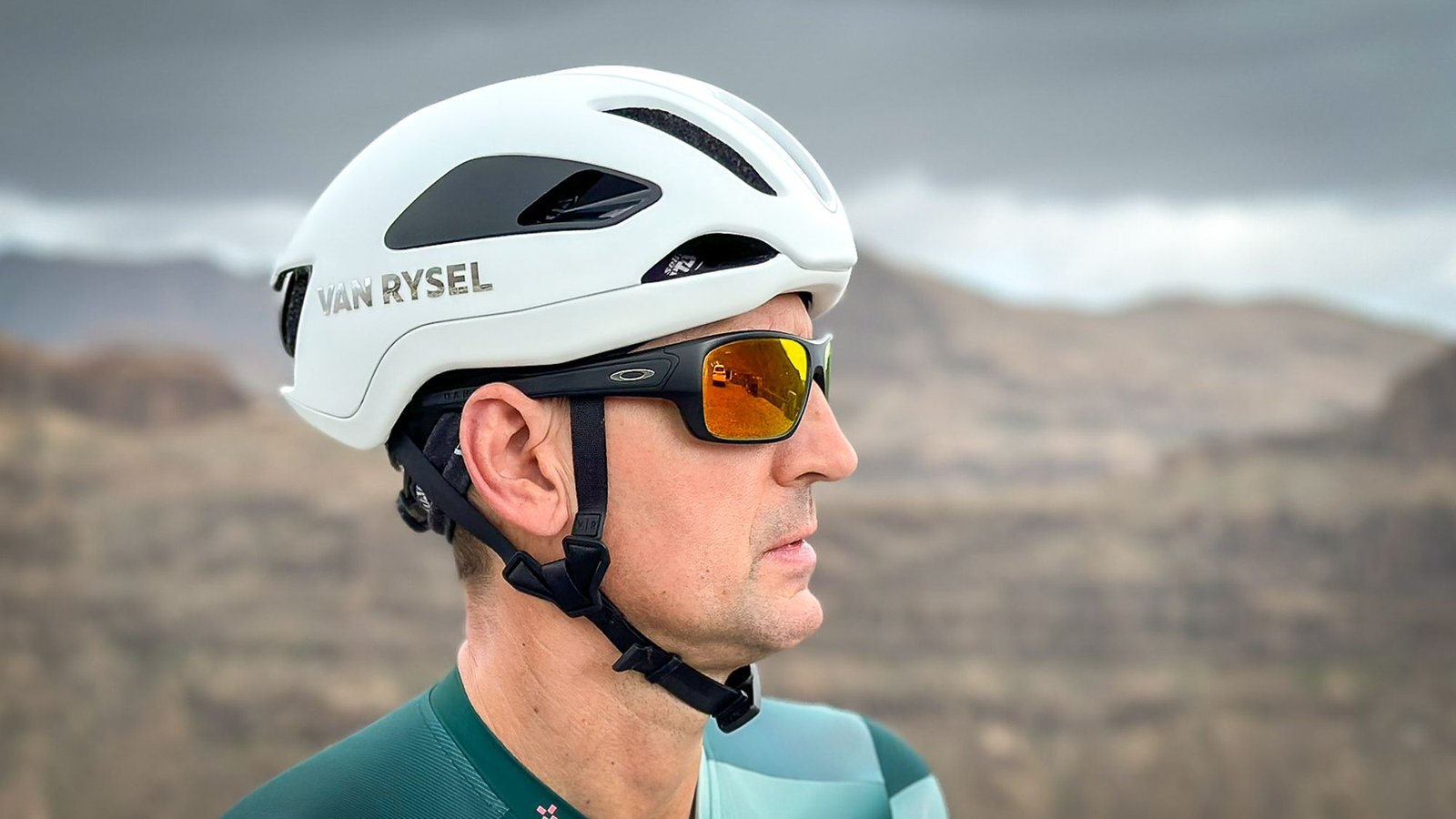
The RCR-F might just be the least expensive helmet in the pro peloton. The aero road helmet adorns the heads of the Decathlon CMA CGM team, and significantly undercuts the price of the lids used by most other teams. The semi-aero design offers a potentially sensible compromise between speed, comfort and ventilation, meaning that it can also be used for general road riding as well as high-speed racing.
It’s in the same vein as Rudy Project’s Nytron, Specialized’s Propero and the Abus Gamechanger, as well as a host of others from most of the major manufacturers. Typically, these offer a few watts in terms of drag reduction at the expense of cooling, weight and, arguably, aesthetics

The warmth of Gran Canaria posed no problems for the ventilated RCR-F
(Image credit: Kim Russon)
However, as with aero/semi-aero road bikes, the disadvantages are rapidly being eroded to the point where more of us might reasonably benefit from an easier passage through the air.
Construction
As the aero helmet in Van Rysel’s range, the RCR-F MIPS Helmet has a slightly elongated profile and fewer vents than a ‘standard’ helmet, but nothing too outlandish and looks very normal. There are five vents at the front, one large one just behind the crown of the helmet and three ports at the back. The two outermost holes are meant as sunglasses holders, although they will also let air in as well.

5 front vents and sunglasses ports provide good airflow
(Image credit: Kim Russon)
The cradle can be adjusted using the dial at the rear, and as the attachment points are well forward of the temple, so tightening it up helps it grip the whole head. There is some vertical adjustment at the back too, so the cradle sits securely around the occipital area.
There are two interesting elements to the straps (believe it or not!). Firstly, the junction under the ears uses a 2-piece plastic yoke to hold and separate the straps neatly, and secondly, the under-chin buckle is non-standard. I’m a bit embarrassed to admit how long it took me to work out how to undo the Fidlock clip, but once you know, it is incredibly easy to do and undo. Magnets guide the two pieces accurately together, so it is simple, even one-handed – ideal for triathletes looking to save another second or two off their transition.

The rear adjustment dial sits nice and low whilst the plastic yoke keeps the straps away from the ears
(Image credit: Kim Russon)
In addition to the basic safety requirements, the RCR-F also includes MIPS – Multi-directional Impact System. This is designed to help reduce stress on the neck, head and brain in the event of an oblique or glancing-type blow by allowing the helmet to twist around the cradle rather than transmitting the twisting force to the wearer. The system used by Van Rysel is MIPS Air Node, a lighter, better-ventilated version of MIPS.
The silver Van Rysel branding on the helmet is just made from silver stickers, so whilst smart enough when new, they might look quite tatty quite soon. On the other hand, removing them completely for a stealthier look would be very easy, or you could switch them around; ‘Van Rysel’ is also an anagram of ‘Sly Raven’, for example…
Available to buy in Ultra White /Smoked Black, White/Pink, Smoked Black and Green/Black (team colours). Sizing is S (52-55cm), M (55-59cm), L (59-62cm).
The ride
Testing helmets is always a bit of a conundrum – the one thing that a helmet must do above all else is the exact feature that I do not want to find out about: its ability to protect my head! As dedicated to my job as I am, I definitely draw the line at riding headfirst into traffic or lobbing myself at walls or trees, so we will all just have to take the word of the EN1078 certifiers for that one. Sorry.
I’m also in no position to test the helmet’s aero credentials, and neither does Van Rysel make any definite claims, but as the Decathlon CMA CGM team is using the RCR-F, it is safe to assume it isn’t too draggy or detrimental to their efforts. Van Rysel does say the helmet has been tested by Swiss Side, the aero specialists, but doesn’t provide any figures.

Testing was more about comfort than banging my head, fortunately
(Image credit: Kim Russon)
What I can tell you is that the RCR-F got off to a great start as the claimed weight of the product exactly matched the number on my scales – 300g. A first for me for sure. 300g is reasonable for a medium-sized helmet – no better, no worse. There are lighter helmets, but at the price and including MIPS, it’s fine.
It was also simple to adjust with the rear dial and felt very secure on my head, with no unwanted pressure. My head, I’ve come to realise, is rather round (if viewed from above), rather than oval-shaped, and some helmets do press on my temples. The RCR-F is not one of those and felt good on as well as looking OK too – not too bulbous or mushroom-shaped.
Spring weather in the UK isn’t too severe a test of a helmet’s cooling capacity, but luckily, I had a trip to Gran Canaria booked, where temperatures would hopefully be a little more challenging for the RCR-F.

Warm Canaries temperatures were a better test of the helmet than UK spring weather
(Image credit: Kim Russon)
Coastal highs of 28°C were no problems in terms of sweatiness, with the large front vents hoovering up sufficient air to prevent any issues, and even when slogging slowly up one of GC’s numerous climbs, I didn’t get any sweat running down into my eyes. In part, this will have been due to the ventilation, but also helped by the continuous brow pad, which soaked up any liquid before it could run into my eyes.
On fast descents, especially through the cool air at the top of Gran Canaria’s volcano, I could even feel the air being directed through the helmet, so as long as you ride everywhere at 50kph+ the RCR-F will definitely keep you feeling fresh…

Even on warm climbs, I never wished for a different helmet
(Image credit: Kim Russon)
Back home, in cooler conditions but on higher tempo rides, I still didn’t suffer from feeling overheated, sweaty or otherwise impeded by the helmet’s design. In fact, probably the only negative I can think of, which is true of all aeroesque helmets, is that scratching your head mid-ride becomes harder as there are fewer holes!
Van Rysel says that the sunglasses port has been designed to work with their VR Road 900 glasses, but they also worked brilliantly with my Oakley Turbines and Radars; in fact, I’d say that they were the most secure-feeling glasses’ storage I’ve used.
Value and conclusion
This is a weird one. As usual, Van Rysel offers a good product at a great price; there are not many aero helmets that I can think of for this kind of money, so the value is pretty good in isolation and when compared to other brands’ aero helmets. But their own RCR MIPS helmet is £50 cheaper at just £80, and it has more ventilation and less weight, assuming that you can bear to use a standard fastext buckle for the chin strap and forgo the aero tag. James Shrubshall certainly found precious little to complain about.
Arguably, the RCR is more relevant to the majority of riders than the £130 RCR-F, and I can’t see where that extra money goes with the more expensive helmet to be honest. Without meaningful drag comparison figures, it’s hard to know how much emphasis to place on the RCR-F’s likely speed advantage.

Aerodynamic, comfy and inexpensive – lovely
(Image credit: Kim Russon)
Ultimately, the RCR-F is a very reasonably priced, good-looking and comfortable helmet that should confer some aerodynamic gains. I’d happily wear it for general road riding duties, but I think that the much cheaper RCR probably might offer even better value for most of us.

