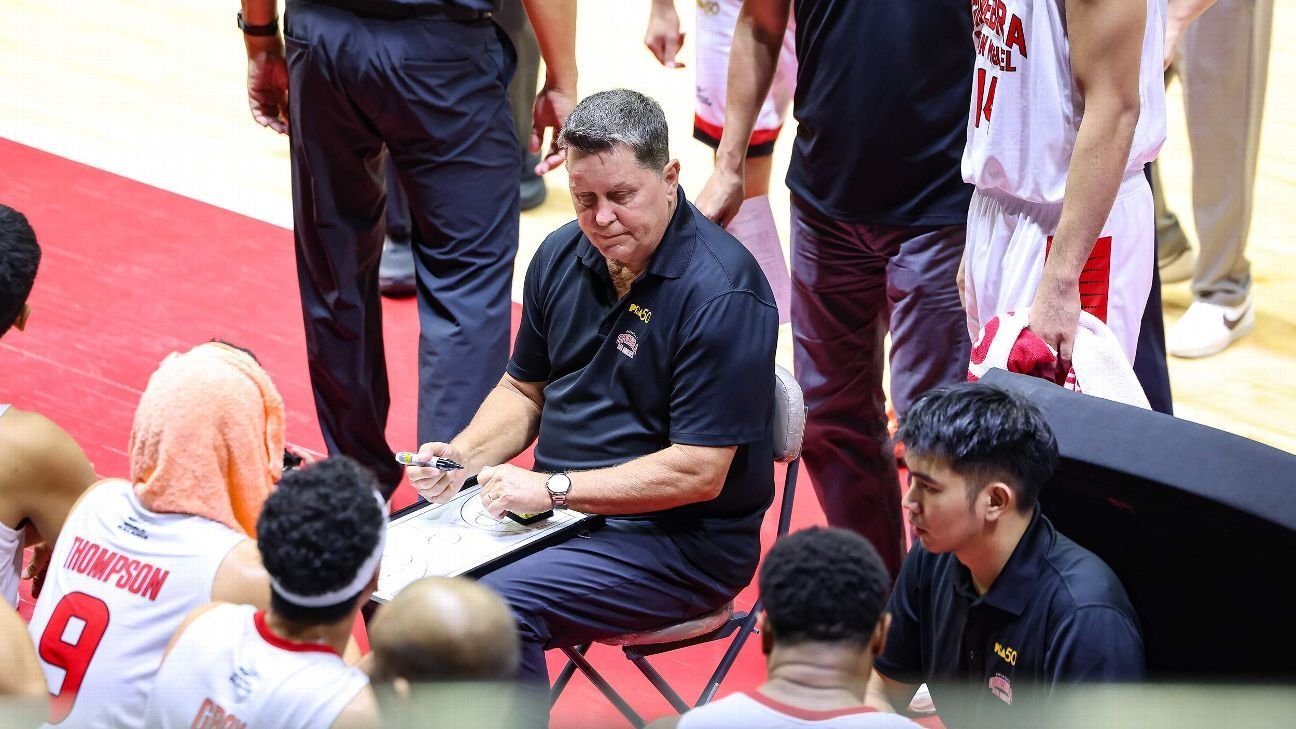
Winning has long been the standard for Barangay Ginebra under Tim Cone, but the glow of their 2022-23 Governors’ Cup title has since faded into a rare three-year drought — forcing the franchise to confront what needs to change to climb back to the top.
Cone, the PBA’s winningest coach, has built his legacy on the discipline and precision of the triangle offense — a system that has delivered championships through structure and execution.
But as the game continues to evolve, even the most time-tested philosophy has faced pressure to adapt.
Now, while the triangle remains at the core, Ginebra has begun to tweak its approach by speeding up reads, sharpening decision-making, and adding more intent to every option in an effort to keep pace with the demands of modern basketball.
Here are some of the aspects that Ginebra has adjusted to as they look to modernize their offense and work their way back into title contention.
Abarrientos has full control now
One of Ginebra’s biggest adjustments this conference has been handing RJ Abarrientos the keys as the starting point guard — a move that has reshaped the team’s offensive identity.
With him taking on a larger role as the primary initiator, the Gin Kings are playing with more pace and intent, flowing into actions earlier instead of relying solely on deliberate triangle entries.
The numbers back up his impact.
In nine games, the reigning Rookie of the Year has emerged as the third-best local scorer in the conference, averaging 21.6 points along with 3.6 rebounds and five assists on an efficient 61.3 true shooting percentage.
Beyond the stats, it’s his command of the offense that stands out by dictating tempo, organizing spacing, and consistently putting pressure on the defense.
Abarrientos thrives in reading the floor in real time, especially in pick-and-roll situations where he can probe the lane and force help defenders to collapse. Once that first line breaks, Ginebra can swing the ball to open shooters or attack rotating defenses.
And when possessions stall, his ability to create his own shot — whether off the dribble or at the rim — adds a safety valve that allows Ginebra to seamlessly blend their triangle roots with a more modern, guard-driven attack.
Emphasis on three-point shooting
Ginebra’s spacing has taken a clear leap this conference, driven by a more reliant scoring on three-point shooting. While the triangle offense has always generated perimeter looks, the difference now is intent — players are actively seeking these opportunities and taking them without hesitation.
That confidence has translated into results, with Ginebra ranking fourth in three-point efficiency at 35.8% while knocking down the second-most threes in the league at 12.4 per game on the third-highest volume of 34.8 attempts.
This combination of efficiency and volume has significantly altered how defenses approach the Gin Kings.
Opponents can no longer afford to collapse the paint or load up on post entries, knowing that any help defense can quickly turn into a kick-out three, which someone like Stephen Holt has capitalized with a 49% clip from beyond the arc on 5.4 attempts.
It forces defenders to stay attached to shooters, opening up wider driving lanes for guards and wings to attack closeouts and create additional pressure on the defense.
The ripple effect has been evident in Ginebra’s overall offensive output. With better spacing and quicker ball movement, the team has been able to sustain flow through swing passes and continuous action, keeping defenses in rotation.
Over time, those rotations break down leading to open threes, straight-line drives, or interior mismatches and has resulted in a conference-best 120.3 offensive rating, highlighting just how effective this perimeter-oriented adjustment has been.
Brownlee’s gravity to get double teams
Justin Brownlee remains the focal point of Ginebra’s offense, but his production in this conference tells a more nuanced story.
He’s still putting up elite numbers at 31.6 points per game, yet his efficiency has dipped — shooting just 29.9% from three and posting a 57.3 true shooting percentage, his first sub-60 TS% mark in his PBA career.
Even so, his presence continues to command defensive attention, often triggering double teams the moment he operates in the post or at the elbows.
Rather than forcing tough looks, Ginebra has adjusted by maximizing that attention through structure — particularly with the use of delay sets.
By initiating offense from the top, Brownlee is given space to read the floor, attack mismatches, or facilitate through handoffs. This not only diversifies his touches but also makes it harder for defenses to load up early, as they’re forced to guard him in space before committing help.
The real impact comes once the defense reacts.
Whether it’s a post touch or a delay action, Brownlee’s gravity creates immediate advantages, and Ginebra has become quicker in capitalizing on them.
The ball moves decisively to shooters, cutters, and secondary drivers, turning defensive pressure into open opportunities.
It creates a constant dilemma either to stay home and let Brownlee score, or send help and risk breaking the entire defense — and that tension continues to fuel Ginebra’s offense despite the dip in his individual efficiency.

