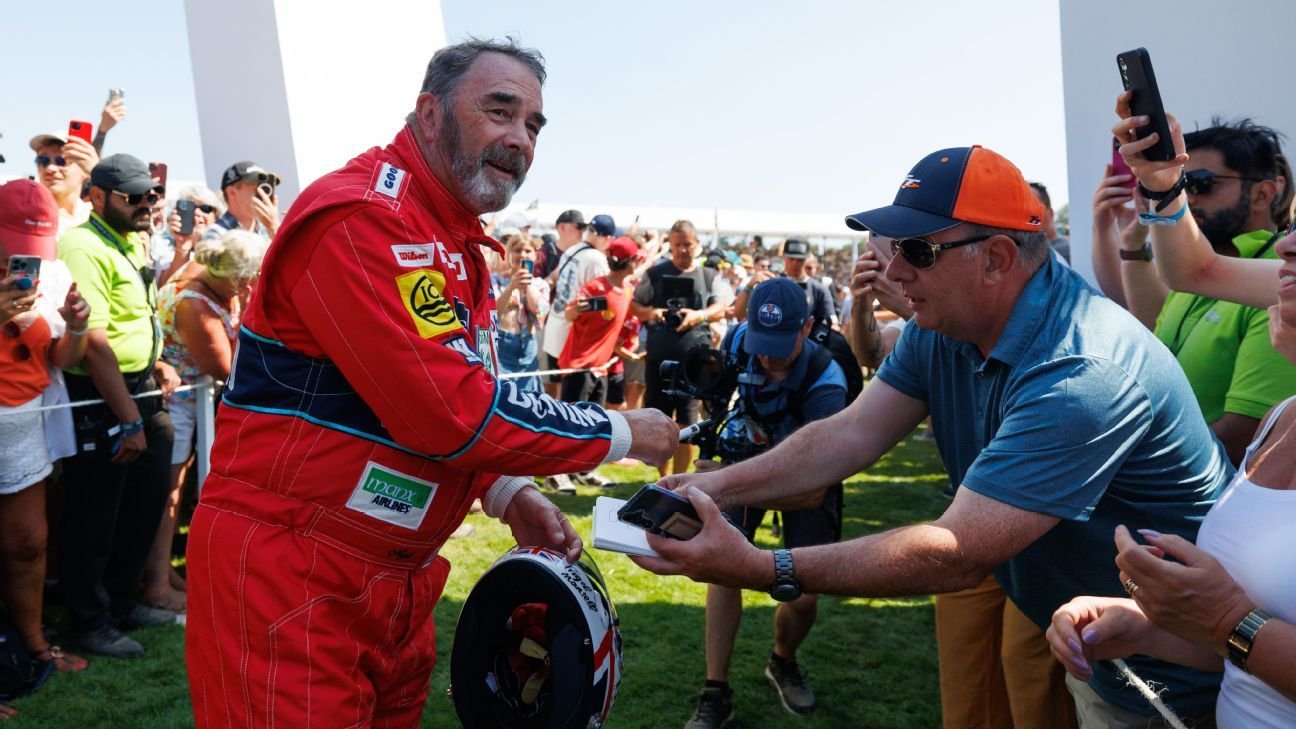
Former F1 world champion Nigel Mansell said he agrees with “grumpy” fans who dislike what he believes is an artificial form of racing under the sport’s new rules.
F1’s new regulations have been controversial, especially around the the introduction of new V6 hybrid engines and the new emphasis on battery power harvesting and deployment which has come with it.
That feature of the engines has created a new style of back and forth racing, with drivers now able to overtake more regularly thanks to the power boosts they have available to use around a lap.
Many of the sport’s biggest names have spoken out against the new rules, with Max Verstappen likening the sport’s new rules to Mario Kart and Fernando Alonso saying Formula 1 is now the “battery world championship.” Fan feedback has also been mixed about the new racing.
During the four-week break in racing caused by two cancelled Middle East races, F1 boss Stefano Domenicali suggested drivers should not criticise the sport’s new rules and insisted feedback from fans has been overwhelmingly positive.
– F1’s 2026 rule tweaks: What’s changed after driver criticism, and will it make a difference?
Mansell, who won the title in 1992 and was famed through his career for an aggressive racing style, sympathises with those who are not a fan of the sport’s new look.
“I might get shot for saying this, but sadly some of the overtakes are just totally false,” Mansell told Autosport.
“I mean, some of the overtakes look great and then you come out the next corner and then the car just blasts past you and the other car goes backwards because the computer is giving you the extra power not at the right time and the driver doesn’t control that obviously because he wouldn’t have employed it.
“I think it was Lando [Norris] who said, ‘well I didn’t want to overtake him going into the fast corner into the chicane, but I had no choice,’ I think coming out the corner he didn’t lean and then the car just blasts past him again going down the straight.
“I think you’ve got to be very careful because, forget me, it doesn’t matter about me, but the fans around the world, I know an awful lot of them are very grumpy and to be fair to the fans I agree with them.”
The lifting and coasting required by the new cars has been one of the biggest sticking points for critics.
Tweaks have been made ahead of the Miami Grand Prix to minimise the worst of it, especially in qualifying, but harvesting energy by going slower through corners is a fundamental part of the sport’s new regulations.
Much of the power deployment which follows is also dictated by the software within the cars, which is different manufacturer to manufacturer.
This almost resulted in a big crash at the Japanese Grand Prix, when Oliver Bearman‘s Ferrari-powered Haas approached the slow-moving Mercedes-powered Alpine of Franco Colapinto.
Bearman narrowly avoided contacted but crashed heavily into the barriers, although he avoided injury.
F1 boss Domenicali downplayed the severity of lifting and coasting in interviews with Autosport and The Race recently, suggesting drivers were having to do the same in the 1980s, which many purists point to as one of the sport’s golden eras in terms of pure racing.
– The good, the bad and the ugly of F1’s new 2026 regulations
– Miami GP: What we learned before F1’s break — and why Antonelli, Mercedes face U.S. test
Mansell, who made his debut in 1980 and raced through to the early 1990s, disagreed with Domenicali’s assessment and said the sport has been lucky to have avoided a worst outcome from the Bearman-Colapinto incident.
When that suggestion was put to him, Mansell said: “No, we didn’t [lift and coast]. If you lifted than coasted it was like feathering, feathering a throttle when you’re slipstreaming somebody and deciding not to overtake them, that’s saving fuel and feathering, that’s smart.
“Having to have a computer just take over the running of the car and harvest for the battery, that’s something totally different and we didn’t slow down 50 to 70 k’s going into the fastest corners. So it’s a bit of a stretch to compare that I have to say and you know, not that you’ve asked me, I do sympathise with the drivers enormously, I think it’s very dangerous at the moment and we got away with one terrible accident in Japan already, so that was luck, he could have been hurt really bad.”

