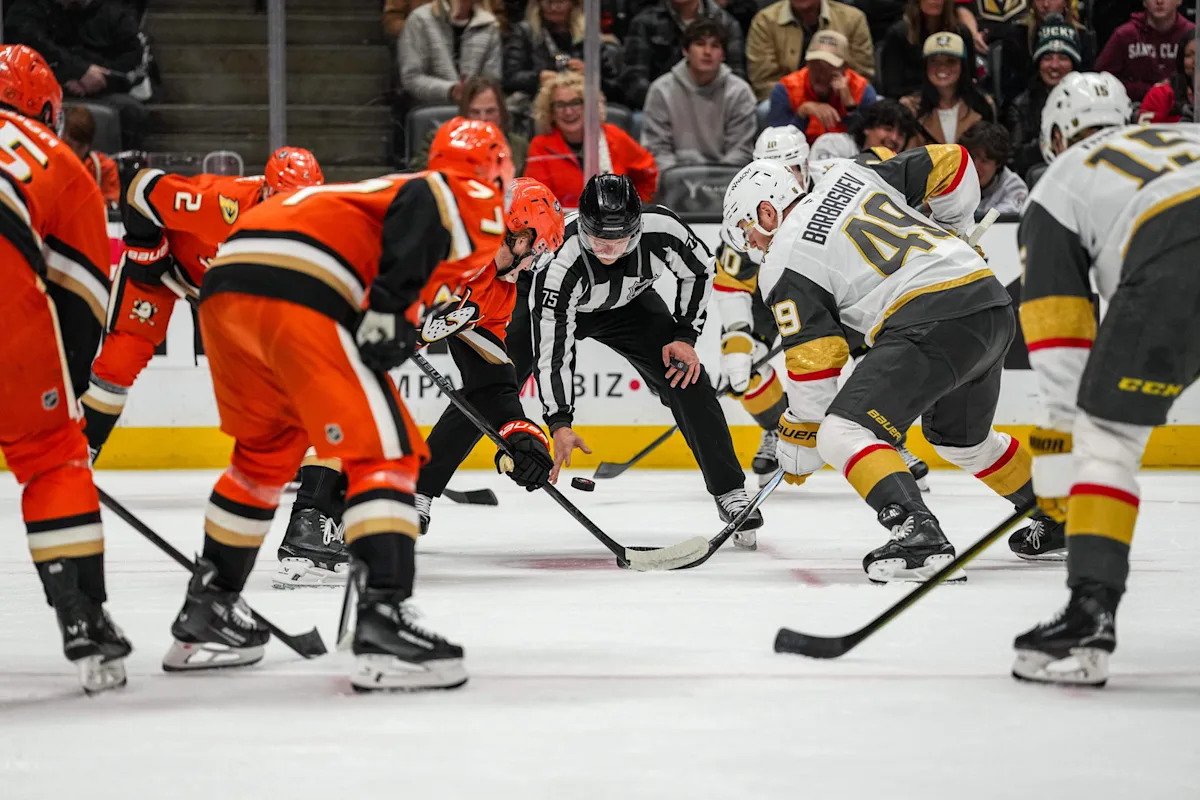
The Anaheim Ducks are through to the second round of the 2026 NHL Playoffs for the first time since 2017. They defeated the mighty Connor McDavid, Leon Draisaitl, and the perennial cup-contending Edmonton Oilers in six games.
They are one of the NHL’s final eight teams standing, and their next opponent will be the Vegas Golden Knights. The first two teams the Ducks will face after missing the playoffs for seven straight seasons are the two that represented the Western Conference in the previous three Stanley Cup Finals (Vegas in 2023 and Edmonton in 2024 and 2025).
Advertisement
Ducks to Face Golden Knights in Round Two of 2026 Stanley Cup Playoffs
Three Areas Key to the Ducks Round One Victory over the Oilers, Ducks Win Series 4-2
Though they are the newer franchise by 24 years, Vegas has only missed the playoffs once in their nine-year existence, while the Ducks have only made the playoffs once during those nine years (2017-18).
As was the case in the last round and will be the case for every playoff series, storylines are plentiful heading in. Let’s get into some from Anaheim’s perspective:
“We had a big dog,” Ducks goaltender Lukas Dostal said following their Round 1, Game 6 victory over the Oilers on Thursday. “We had a really, really good team against us.”
Advertisement
Every playoff opponent that a team faces during the course of a particular run is a good hockey team. They’re one of the final 16 left standing after the first 82 games of a regular season. Though all teams have the same goal heading into the playoffs, sometimes a team’s first-round opponent is one of the few true Stanley Cup contenders. The Ducks, whether by luck or their own doing, faced one to open the playoffs and will face another one in the second round.
The task only grows increasingly more difficult from here on out, as details are amplified, momentum plays a greater role, and hunger to win becomes more profound. Do the Ducks have what it takes to knock out another Goliath?
Ancient history now, but two members of the current Vegas Golden Knights roster, two players who currently have their names engraved on the Stanley Cup as part of their 2023 Championship team, are Anaheim Ducks draft picks William Karlsson (53rd overall in 2011) and Shea Theodore (26th in ’13).
Advertisement
In the height of their previous cup-contending window, the Ducks traded the 22-year-old Karlsson, along with a second-round pick and Rene Bourque, to the Columbus Blue Jackets for defenseman James Wisniewski on an expiring contract and a third-round pick.
Wisniewski played 13 games for the Ducks down the stretch of the 2014-15 season, sustained an injury, and wasn’t able to suit up for a playoff game during that year’s run to the Western Conference Final. He retired shortly after.
Karlsson had difficulty carving out meaningful offensive minutes in two seasons with Columbus, was selected by Vegas during their 2017 expansion draft, and has become one of the most reliable middle-six centers in the NHL for the better part of a decade.
Karlsson has made the Ducks pay ever since he was traded, scoring 29 points (16-13=29) in 39 career games vs Anaheim and, as mentioned, now has a Stanley Cup ring.
Advertisement
The Vegas Golden Knights’ expansion draft took place in June of 2017, just one month after the Ducks were eliminated in the 2017 Western Conference Final. In an attempt to keep their core together for another run or two at a cup, the Ducks traded the then 22-year-old Theodore to the Knights with the agreement that they would select defenseman Clayton Stoner in the expansion draft, allowing the Ducks to keep defensemen Sami Vatanen and Josh Manson, who were exposed.
Theodore has gone on to become one of the NHL’s best bona fide top-pair defensemen in the NHL, a key contributor to a Stanley Cup-winning team, and has scored 384 points in 581 games for Vegas, including 25 points (8-17=25) in 33 career games against the Ducks.
Players and organizations have since moved on, but the sting of losing such talent at young ages could rear its ugly head once again as the Knights and Ducks are set to face off in the playoffs for the first time in history.
The Ducks advanced through the first round of the playoffs relatively unscathed in the injury department. Troy Terry has been playing through a nagging injury for the better part of the latter half of the season, but played every game in the opening round despite not being on the ice for any practices or morning skates.
Advertisement
The Ducks did lose their captain, Radko Gudas, with roughly ten minutes remaining in Game 1 against the Oilers due to a lower-body injury. Drew Helleson filled in amicably for Gudas in Games 2-6, playing reliable hockey on the third pair, averaging just 8:33 TOI/G.
Every player will echo the notion that “everybody’s playing through something at this time of year,” but if the Ducks have any hopes of success in their upcoming round, those somethings that everyone has hopefully aren’t enough to force anyone out of the lineup.
Terry has appeared limited in flashes, but has found a way to remain impactful and productive, as he’s tied for second on the Ducks in scoring with eight points (3-5=8) through six games, including three points (1-2=3) in Thursday’s series clincher.
For the first time in history, the 2025-26 Ducks swept their season series with the Golden Knights, winning all three games and accumulating six points in the standings. Before this season, the all-time numbers have been dominated by Vegas, as they still hold a whopping 27-8-3 record against the Ducks.
Advertisement
Two of the Ducks’ three victories this regular season against Vegas came in overtime and in unconvincing fashion. In those three games, at 5v5, despite outscoring Vegas 8-6, the Ducks lost the shots on goal battle 84-66, the shot attempts battle 158-155, and the expected goals battle 7.09-6.54.
Famously, playoff overtimes are continuously 5v5, so the Ducks won’t be able to rely on their excellent 3v3 or shootout prowess in this series. Can they find other ways to defeat Vegas four times in seven games?
As mentioned, the Ducks and Knights have never faced each other in the playoffs, and aside from Vegas’ first year in existence, the two clubs have never been even good at the same time. Until now.
Advertisement
As divisional opponents, the Knights and Ducks play each other three or four times every season. The Knights have dominated those occasions, but playing each other in the playoffs up to seven consecutive times has the tendency to spark rivalries, as was the goal of NHL commissioner Gary Bettman with the institution of the current playoff format.
Anahiem’s core pieces are early in their careers. Mason McTavish is in year one of his six-year contract, Lukas Dostal is in year one of his five-year contract, and Jackson LaCombe’s eight-year extension begins at the start of next season. Young stars Leo Carlsson, Cutter Gauthier, and Beckett Sennecke are all on their entry-level deals, but are projected to be in Anaheim’s extremely long-term plans.
Vegas’ core, though significantly older, is locked up for the foreseeable future as well. Theodore is in the first year of a seven-year contract, Mitch Marner is in the first year of an eight-year deal, Jack Eichel’s eight-year extension begins next season, and Tomas Hertl has four years remaining on his contract.
Neither team projects to exit the playoff picture anytime soon, meaning this next series could bleed into future regular season matchups and potentially future playoff matchups, continuously fueling that passion and animosity that renders an endlessly entertaining product.
Advertisement
Dates and times for this series have yet to be announced, but the series will begin at T-Mobile Arena in Las Vegas, likely on Monday or Tuesday.
Takeaways from the Ducks 5-2 Win over the Oilers in Game 6, Ducks Win Series 4-2
Adjustments the Ducks Will Look to Counter to Avoid Game 7
Takeaways from the Ducks 4-1 Loss to the Oilers in Game 5, Ducks Lead Series 3-2
The Anaheim Ducks Approach to Having the Edmonton Oilers on the Brink of Elimination

