The first round of the 2025-26 NBA playoffs was full of strange and unexpected twists.
Two teams — the Minnesota Timberwolves and Los Angeles Lakers — advanced despite injuries to their leading scorers. Two more teams — the Philadelphia 76ers and Detroit Pistons — came back from 3-1 deficits. The Toronto Raptors delayed their eventual elimination by the Cleveland Cavaliers thanks to a game-winning 3-pointer that bounced high off the rim before falling safely through the net in Game 6.
The league calendar gives almost no time to rest and breathe after that first-round chaos. Following three Game 7s over the weekend, the second round begins Monday night at Madison Square Garden (8 p.m. ET, Prime Video) as the New York Knicks and 76ers renew their rivalry.
But it’s still worth taking a beat to reflect on the lessons of all that chaos before plunging headlong into the second round. Let’s explore 10 takeaways about how the first round’s strangeness unfolded — and how it will affect the rest of the playoffs and the offseason to come.

1. The bench matters
Conventional NBA wisdom holds that the depth of a team’s rotation becomes less important in the playoffs, as stars play more minutes and rotations shrink. That sentiment holds some truth.
But reserves still matter — and given the number of injuries in the postseason, those reserves become even more important, swinging games either off the bench or when pressed into emergency starting duty.
Minnesota eliminated the Denver Nuggets for the second time in three years in large part because of its backups, who stepped up after Anthony Edwards hyperextended his left knee and Donte DiVincenzo tore his right Achilles tendon. Ayo Dosunmu scored 43 points off the bench in Minnesota’s Game 4 win. And fellow Timberwolves guard Terrence Shannon Jr. didn’t play at all in the first three games, before scoring 24 points in his first career playoff start to help clinch Game 6.
For Los Angeles, which successfully navigated the absences of Luka Doncic and Austin Reaves to beat Houston, Luke Kennard was the main bench stalwart. He scored 50 points across the first two Lakers wins, beating his previous career playoff high twice in a row. Although Kennard regressed as the series continued, his hot start helped the Lakers gain the series lead before Reaves returned and relegated Kennard back to bench duty.
Also in the West, rookie San Antonio Spurs guard Dylan Harper came off the bench to score 27 points on 9-for-12 shooting in a comeback win in Portland, with Victor Wembanyama sidelined by a concussion.
Unfortunately, recent history suggests that injuries will continue to affect the playoffs. So expect more teams to require reserves to fill in as reinforcements over the next few rounds.
That’s good news for the Oklahoma City Thunder, most of all, because the defending champions have the deepest rotation in the NBA. Jalen Williams looked dominant through two games against the Phoenix Suns, before straining his left hamstring — but against an admittedly overmatched opponent, the Thunder scarcely missed a step without him. With Ajay Mitchell, Alex Caruso, Cason Wallace and Isaiah Joe all typically coming off the bench, the Thunder have plenty of replacements for their missing All-Star.
2. The Spurs are scorching the nets
One of the only big questions about the Spurs’ bona fides as a young title contender was whether they could make their 3s against playoff defenses.
So far, so good. The Spurs led all teams in the first round by shooting 41.8% from distance. Just about the whole roster was hot: With the exception of Devin Vassell — the team’s leading 3-point scorer in the regular season — every Spur with double-digit attempts had above-average accuracy in the first round.
Five games is a small sample, but that performance was the continuation of months of hot shooting for the Spurs. After Feb. 4, San Antonio ranked third with a 37.9% 3-point mark, with Stephon Castle and Harper showing particular improvement from distance.
It’s difficult to fathom how opponents will be able to slow the Spurs’ offense if Wembanyama is healthy and his teammates are knocking down open 3s.
3. New York is full of Knicker-blockers
Most of the discussion surrounding the Knicks all season has been about their offense. Is Karl-Anthony Towns getting enough touches? What happened to Mikal Bridges? Can Josh Hart knock down shots? How crucial is Mitchell Robinson‘s offensive rebounding?
But even with the offense-inclined Towns and Jalen Brunson as their stars, the Knicks are almost as potent on the other end of the court as they are on offense. In the regular season, they ranked fourth in offensive rating and seventh on defense. And out of 16 teams in the first round, they were second on offense and third on defense, with a defensive rating (103.8) that would’ve been the best in the league in the regular season.
The Atlanta Hawks found early success when CJ McCollum targeted Brunson, but by and large, they struggled to score against the Knicks. Atlanta scored at least 100 points in 31 of its last 32 games in the regular season, as well as in Games 1, 2 and 3 of the first round. But the Hawks failed to reach triple digits in each of the last three games, which were all Knicks wins.
In particular, the Knicks shut down Atlanta’s top two scorers because of the stout perimeter play of OG Anunoby, Bridges and Hart. In the regular season, Jalen Johnson and Nickeil Alexander-Walker combined to average 43.3 points on 47% shooting, but they fell to 33.2 PPG on 41% shooting against New York.
Looking ahead to the next round, Philadelphia’s Tyrese Maxey and Joel Embiid present very different challenges and playing styles than Johnson and Alexander-Walker. But the Knicks’ unsung stinginess should give them confidence as they attempt to reach the Finals for the first time this century.
2:22
Stephen A.: Knicks are going to the NBA Finals
Stephen A. Smith reacts to the Knicks’ blowout win over the Hawks and proclaims they will make the NBA Finals.
4. The Nuggets have a scoring problem
So much consternation around the Nuggets concerns their defense. After all, they were the 21st-ranked unit on that end, while they led the league in offense. And they’ve had a top-seven offense in each of the past 10 regular seasons.
But counterintuitively, it’s Denver’s offense that has been a bigger problem in recent postseasons. In the Nuggets’ three playoff defeats since winning the title in 2023, their offensive rating has fallen by double digits compared to the regular season, and they’ve ranked at or near the bottom of the league in that round.
Against Minnesota, Nikola Jokic and Jamal Murray had solid surface stats but substandard efficiency: Jokic shot just 45% from the field and 19% on 3s, and Murray shot 36% from the field and 26% on 3s. And Denver’s supporting cast was inconsistent at best.
This is an important point to understand, as Denver approaches a potentially tumultuous offseason. Given their personnel, the Nuggets might be tempted to put all of their focus on defense while trusting in the brilliance of Jokic and Murray to lift their offense to league-best heights. But the past few postseasons show that’s not good enough. Denver needs help on both ends to win another title.
5. Defense is hard but not impossible
Offensive struggles in Atlanta and Denver are symptomatic of a broader leaguewide trend. Just last week, I wrote about the scoring decline this postseason. But it’s a topic worth revisiting after the conclusion of the first round, because that decline only accelerated since my initial piece.
That’s an anachronistic trend in 2026. The league’s offensive rating has never been higher than it was this year, and points per game reached its highest level since the turbo-paced 1960s. It should be practically impossible for teams to go on long scoring droughts in this modern pace-and-space environment.
And yet, on Friday the Magic scored 19 points in an entire half, setting a playoff record, as they failed to close out the Pistons in Game 6. Hours later, Houston managed only 78 points in an elimination game. The next night, Boston went 0-for-9 on clutch shooting in its Game 7 loss to Philadelphia.
On the whole, after teams averaged 115.6 points per game in the regular season, they’re down to 106.6 in the playoffs. The 9.0-point decline would be the largest in any season in NBA history.
Whether that pattern continues through the remainder of the playoffs remains to be seen. But with elite defenses still alive in Oklahoma City, San Antonio, Minnesota, New York and Detroit, the remaining teams are showing that even in an offense-first era, defense can still win championships.
6. Oklahoma City’s offense is rolling
One team that didn’t have trouble scoring in the first round is the Thunder. The Suns ranked ninth in defensive rating in the regular season, and they were fifth specifically on half-court plays, per Cleaning the Glass — so it seems meaningful that Oklahoma City spent four games torching the Suns in exactly that situation.
No other team came close to Oklahoma City’s efficiency in the first round. The gap in half-court offensive rating between the Thunder (112.2 points per 100 halfcourt plays) and the second-best team (the Knicks, at 101.4) was larger than the gap between second and No. 11.
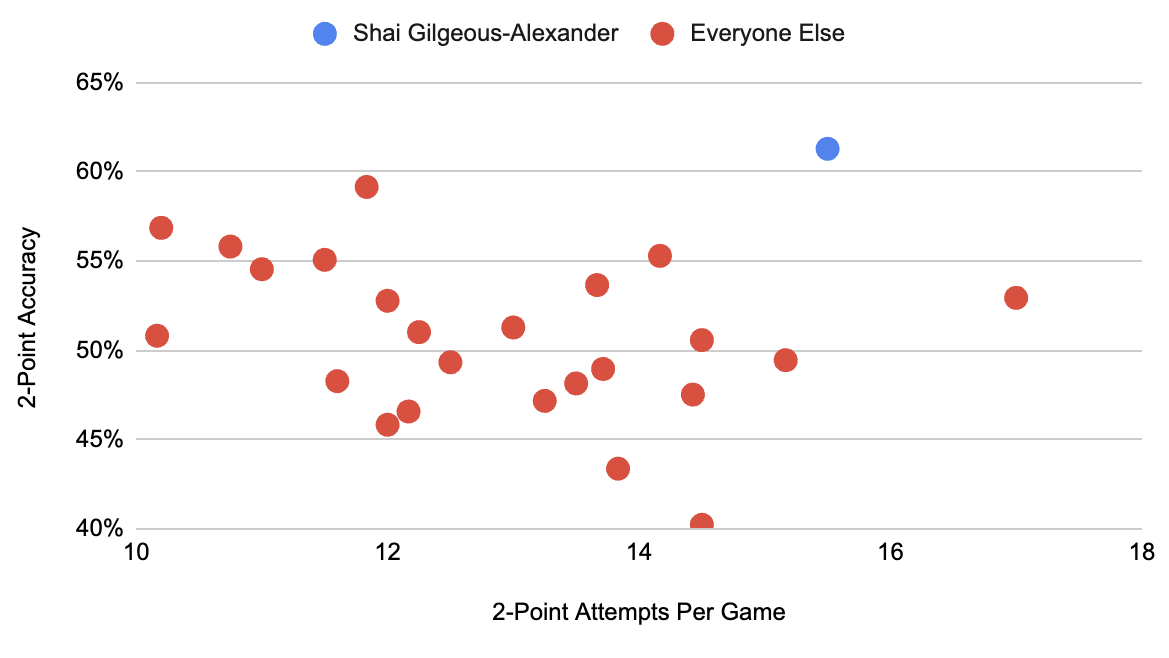
Naturally, much of that success comes from reigning MVP Shai Gilgeous-Alexander, who followed a record-setting regular season with similar production in the first round. Gilgeous-Alexander led all players with 33.8 PPG in the first round, and he shot an outrageous 61% on his 15.5 2-point attempts per game.
For context, the other 26 players in the first round who attempted at least 10 2-pointers per game shot a collective 50% on their 2s. Gilgeous-Alexander was 11 percentage points higher than that.
2-Point Shooting in the First Round
The defensively stout Thunder have always looked unbeatable when they can turn turnovers into fast breaks, but they’ve been vulnerable at times when the game slows down. But with Gilgeous-Alexander in rhythm like this, they also might be unguardable in the half court.
7. KAT needs the ball
Several veteran All-NBA big men enjoyed arguably the best playoff highlights of their careers in the first round. Rudy Gobert helped stymie Jokic. Embiid scored 34 points to win his first Game 7, after three previous losses. And Towns excelled on both ends, with a tactical tweak unleashing his playmaking and turning a 2-1 series deficit into a 4-2 win for the Knicks.
The tweak was simple: The Knicks gave Towns the ball more and let him distribute from the middle of the court. His on-ball percentage in those three wins ranks third, fourth and sixth out of 170 games he has played as a Knick, per GeniusIQ tracking.
But the results were profound: Before this postseason, Towns’ career high in playoff assists was five. But he exceeded that number three times in a row as the Knicks closed out Atlanta, with 10 in a triple-double in Game 4, six in Game 5 and 10 more in another triple-double in Game 6.
This exact approach might not work in the second round against Philadelphia, as the 76ers’ big men will present a stiffer challenge in the post than any of Atlanta’s smaller centers. But the general lesson — to keep Towns involved in the offense and let him both score and create, so Brunson doesn’t have to do it all himself — remains.
8. The Magic are in crisis
Two years ago, the Magic were on the rise. After adding Franz Wagner, Jalen Suggs and Paolo Banchero in the span of two drafts, they won 47 games — the franchise’s best record in 13 years — and pushed the Cavaliers to seven games in the first round. Few teams in the NBA, let alone the Eastern Conference, looked to have a brighter future.
But development isn’t always linear, and the Magic have yet to replicate that initial burst. Amid various injuries, they slid to a 41-41 record, play-in appearance and five-game loss in the first round last season, and — despite trading four first-round picks and a swap for Desmond Bane last summer — they stumbled to a 45-37 mark and another play-in berth this year.
Then came an apparent turnaround: Orlando nabbed the No. 8 seed with a blowout win over Charlotte in the play-in round, then took a 3-1 lead against the top-seeded Pistons. They were a win away from becoming the seventh No. 8 seed to win a round.
And then, as has happened so often over the past few years, the inconsistent Magic couldn’t sustain their success, due to a combination of injuries (in this case, to Wagner) and underperformance. The Magic lost Game 5, blew a 24-point lead in a historically inept Game 6 and were blown out in Game 7.
Defeating Detroit could have allowed the Magic to redeem an otherwise lost season. But now they face major questions, and potentially major changes, this summer; they’re already projected over the first apron next season, but not good or healthy enough to have won a single playoff series with this core. Coach Jamahl Mosley has been on the hot seat. Anthony Black is up for an extension. And Banchero and Wagner have always had a tenuous partnership, whose results have never matched the talent.
Other teams that lost in the first round, including Denver, Houston and Boston, could also do significant work reshaping their rosters this summer. But nowhere is that need more pressing than Orlando.
1:53
Pistons crush Magic in Game 7 to complete 3-1 series comeback
The Pistons take down the Magic in dominant fashion in Game 7 to take the series and advance to the Eastern Conference semifinals.
9. Detroit and Cleveland can’t feel comfortable
The good news for the two Central Division contenders is that they survived the first round. Now one of them is guaranteed to reach the conference finals.
But the bad news is that just about every concern about the two teams was magnified in their unexpectedly tricky first-round wins, casting doubt on their legitimacy as Finals contenders.
The Pistons fell behind 3-1 against the Magic, and while they deserve ample credit for their mental resilience in coming back — as well as for their typically stellar defense — they probably would have lost the series if not for Franz Wagner’s absence in Games 5, 6 and 7, or if not for Orlando’s sudden inability to make a shot down the stretch in Game 6.
Moreover, Jalen Duren‘s dramatic playoff regression is a huge concern as he prepares to match up against Cleveland’s star bigs, and the Pistons struggle to score when their No. 2 scorer is lost like Duren was against the Magic. After Cade Cunningham and Tobias Harris, no Piston scored more than 10.6 PPG in the first round. As a team, Detroit ranked last in 3-pointers, with just 9.7 makes per game.
The Cavaliers, meanwhile, struggled to put away the Raptors despite a talent advantage and several key Raptors injuries. Cleveland lost all three games on the road and trailed for most of the first half in Game 7, at home, before turning on the jets after halftime.
And while Jarrett Allen looked dominant at times, Cleveland’s star guards turned in oddly muted performances. Donovan Mitchell and James Harden combined for just 43.7 PPG (down from 48.4 in the regular season) on 44% shooting. That’s also a concern looking ahead, as Detroit’s defense is even tougher than Toronto’s.
So Detroit and Cleveland can breathe a momentary sigh of relief for avoiding a humiliating upset loss. But then they have to regroup and play better going forward, if they want any chance at a title run.
10. We’re on track for a titanic clash in the conference finals
If this first round was broadly defined by its strangeness, then it’s fitting to end these takeaways with the two series that didn’t fit that theme: Oklahoma City swept Phoenix, and San Antonio beat Portland in five games — with its only loss coming in a game Wembanyama left early.
This was the first year since 2014 in which only two first-round series ended within five games.
Oklahoma City and San Antonio ranked first and second in the regular season in wins and net rating, per Cleaning the Glass. And with respect to the Lakers and Timberwolves, who survived seemingly calamitous injuries to reach the second round, and to all four Eastern Conference teams in the playoff bracket, three of which stormed to first-round victories with three-game winning streaks, nobody else appears anywhere near the same lofty level as the Thunder and Spurs.
More strange surprises might arise as the postseason continues. But for now, a potential Thunder vs. Spurs conference finals looks like the top series to await over the rest of the playoffs.

