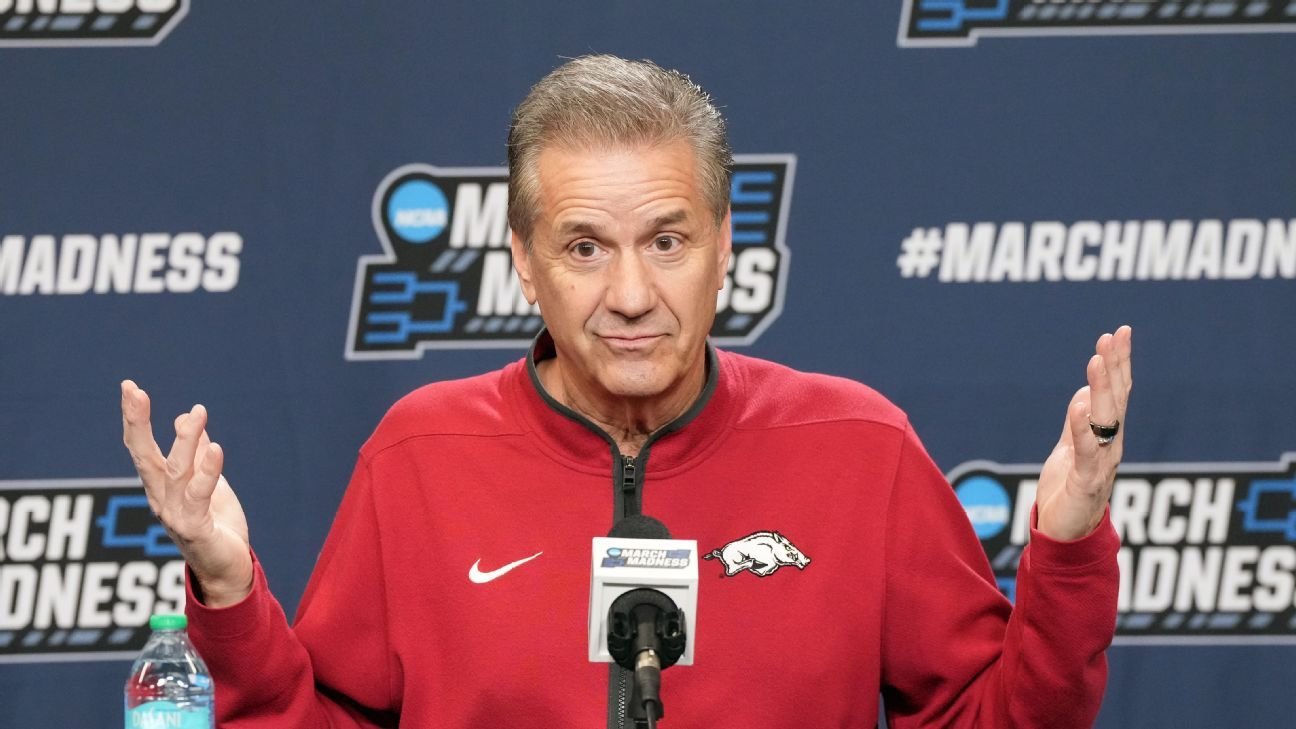
John Calipari has led four schools to a combined 25 NCAA tournaments.
He has been a mid-major underdog and the No. 1 overall seed. He has reached six Final Fours, won a national title and been bounced in the first round as a massive favorite. He has even found himself on the wrong side of the bubble a time or two.
He has known March in all of its Madness.
“This thing is special,” said Calipari, now Arkansas’ coach and former coach of Kentucky, Memphis and Massachusetts. “This thing is unique.”
It’s why, on Thursday, Calipari found himself expressing a bewilderment shared by many fans when the NCAA announced it was officially expanding the tournament again, this time to 76 teams, a move that requires more “play-in” games on Tuesday and Wednesday.
“I don’t know why you mess with something that’s working,” he told ESPN.
The stated reasons about increased participation ring hollow. The real motivation, as just about anyone in college athletics will tell you, is to appease the Big Ten and SEC, which want to assure their teams get in even as they’ve expanded their own ranks to 18 and 16 teams, respectively.
They got bigger, mostly for football, so now everything has to get bigger, even the hallowed basketball tournament. Commissioners were originally worried that having so many league teams meant that they would knock each other out during the regular season.
That hasn’t borne out — the SEC got 14 of its 16 teams into the 2025 tourney, after all — but here we are anyway.
The move doesn’t appear to be with the public, nor many of Calipari’s coaching peers, who worry about the calendar, the importance of the regular season or the risk of tinkering with the special chemistry, however hard to define, that makes this pursuit so great.
None of that matters. The battle is lost. Expansion is here. Curse and complain, but the consultants and bean counters won. Concern for the fans is always rare.
So now what?
Protect the mid-majors, says Calipari, despite having not coached such a school in a long, long time.
“Half of the additional bids need to go to the non-Power 5 conferences,” Calipari said. “You have to help the mid-majors.”
It’s the lesser-known brands and lower-budgeted teams, after all, that have long captured the public’s attention and made this a tradition unlike any other. Valparaiso. George Mason. Oakland and Saint Peter’s (sorry, Cal).
No one would remember that ball, after all, if Cinderella hadn’t shown up.
“You have to ask, why is this tournament so huge?” Calipari said. “Because of David and Goliath. And I’ve been both. I’ve won as David and lost as Goliath.
“That’s what I keep coming back to, if you are going to do this, if you are going to add all these games, it can’t be just to add more Power 5 conference teams,” he said of the ACC, Big East, Big Ten, Big 12 and SEC.
That sounds good, but this initiative came from the big guys. It stands to reason it will serve the big guys.
This needs to be structural. First off, the metrics used by the selection committee need to be less reliant on which schools you played, which greatly favors the Power 5.
“The Power 5 teams are going to have an advantage over non-Power 5 teams because they’re playing each other,” Calipari said. “It’s obvious.”
Second, once the field is set, the NCAA needs to lay out the matchups using a true S-curve, rather than the current system that prohibits two teams from the same league playing each other in the first round and often even deeper into the tourney. Let the big guys knock each other out.
“You get 14 teams from a single league, you’re going to play early,” Calipari said. “Too bad.”
And these Tuesday and Wednesday games, now 12 matchups featuring 24 teams, can’t become a mid- and low-major knockout round as the big guys sit and rest up.
College sports has long been about seizing power and finding revenue, not fairness or fondness. The bigger the leagues and the bigger the money, the more that proves true. The mindset of private equity — profit at all cost — feels like its new North Star.
Sometimes it’s difficult to know if the people in charge even like the sport, let alone understand it.
The NCAA tournament can’t just be about the heavyweights. It can’t just be about rich budgets and league memberships determining entry and placement.
It needs to be about High Point and FAU and the Miami University swim team showing up in Speedos to distract free throw shooters. If not, the whole thing gets a little bit worse and a little bit more empty, just so the coach of some 15-14 team gets his tournament bonus.
“That’s my opinion,” Calipari said. “But no one listens to me.”
Or, too often it seems, anyone else who loves college basketball.

