Rookie minicamps are underway for 22 NFL teams, while five other teams have already completed initial workouts with their new 2026 draft picks. So, we’re taking this opportunity to pick the best prospect-to-team fits, factoring in traits, schemes, playcalling tendencies and coaching staffs around the league.
Which top prospects landed in an ideal spot? How will some new playcallers utilize the versatility of their draftees? My list goes 15 players deep, starting with nine first-rounders and ending with one Day 3 pick.
Let’s kick it off with the cornerback the Chiefs selected with the top-10 pick they acquired via trade.
Jump to:
Round 1 | Rounds 2-4


Drafted: Round 1, No. 6
Why he fits: After trading Trent McDuffie and losing Jaylen Watson to the Rams, Delane fills a critical need in the Chiefs’ secondary. And he has the traits to make an immediate impact under coordinator Steve Spagnuolo.
Kansas City played man coverage on 52.3% of opponent dropbacks in 2025, the fourth-highest rate in the league. Delane thrived in those coverages (mainly Cover 1, Cover 0 and Cover 2 Man) in college as a press corner with the speed to match receivers vertically. Plus, he can jam and sink in Cover 2. This is an easy fit for the top cornerback in the class.

Drafted: Round 1, No. 8
Why he fits: Pairing Tyson with Chris Olave in New Orleans gives coach Kellen Moore two big-play targets on the perimeter. Plus, Tyson can line up all over the field and has the skill set to shake man coverage. That gives him even more upside with second-year quarterback Tyler Shough.
In Shough’s last six starts, he had over a 96 QBR on in-breakers and crossers. These are rhythm throws that cater to Tyson’s willingness to work the dirty areas of the field, along with his catch-and-run traits. Tyson can move the chains in critical moments and brings ball skills on isolation concepts.

Drafted: Round 1, No. 11
Why he fits: Cowboys defensive coordinator Christian Parker, who coached the secondary in Philly last season, can play Downs at safety in base packages. He has the play speed and high-level instincts to impact the game from depth or when running the alleys.
Downs can also star in the Cooper DeJean role — as a big safety — when the Cowboys are in a nickel defense. Downs can create disruption near the line of scrimmage, match in coverage and find the ball in zone. Downs had 22 run stops at or behind the line of scrimmage in three collegiate seasons, and I believe his on-the-ball production will elevate in the pros.

Drafted: Round 1, No. 13
Why he fits: The Rams’ QB room — and Sean McVay’s system — are both positives for Simpson. With Matthew Stafford returning as the No. 1, Simpson will have time to develop in an offense that fits his throwing style and mobility.
Simpson is a mechanically sound passer who can make the NFL-level throws. Plus, he can work the edges on boot and play-action. McVay will ask him to showcase that latter, as Stafford led the NFL with 75 attempts on designed rollouts in 2025.
Once Simpson gets his chance to start, look for McVay to give him more defined reads and movement concepts. He’ll be put in a position to see the entire field and deliver the ball on time.

Drafted: Round 1, No. 14
Why he fits: The Ravens upgraded their guard position this offseason with Ioane and free agent signee John Simpson. Ioane had a blown block rate of only 1.6% on 306 rushing snaps in 2025. He’s a physical mauler who can move defensive players at the point of attack and use his quick feet to pull/reach.
That works for new offensive coordinator Declan Doyle, who will bring elements of Ben Johnson’s run game to Baltimore — think zone and gap concepts. Plus, Ioane has the anchor to take on power rushers (two pressures allowed in 2025), keeping the pocket firm for quarterback Lamar Jackson.

Drafted: Round 1, No. 15
Why he fits: Bain’s rugged play style fills an immediate need for the Bucs on their defensive front. He can set edges versus the run game (54 tackles on designed rushes last season); he combines power and flexibility to turn the corner as a pass rusher (five sacks in the College Football Playoff).
In coach Todd Bowles’ defense, look for Bain to seize one-on-one opportunities, be used on loops/stunts and create interior matchups as a nickel/dime defensive tackle. This is a strong fit in Tampa Bay.

Drafted: Round 1, No. 24
Why he fits: Under new coach Todd Monken, Concepcion can play a similar role to Zay Flowers in Baltimore. An extremely sudden mover, Concepcion has the stop-and-start speed to create easy separation out of the slot. Plus, he can use that foot quickness to evade press coverage.
Monken can also scheme for Concepcion on manufactured touches, getting him the ball on screens, fly sweeps or backfield alignments. He should be a high-volume target with the ability to generate explosive plays.

Drafted: Round 1, No. 25
Why he fits: With Thieneman and free agent signee Coby Bryant, coordinator Dennis Allen now has two interchangeable safeties with strong ball skills. Specifically, Thieneman’s speed and range to track the ball deep give Allen more flexibility in the game plan to move late or disguise from two-high shells.
Thieneman can also spin down at the snap to cut on crossers in Cover 2-Man or patrol the underneath zones. The Bears get an upgrade — and a scheme fit — here with Thieneman, who had eight interceptions in college.
Drafted: Round 1, No. 32
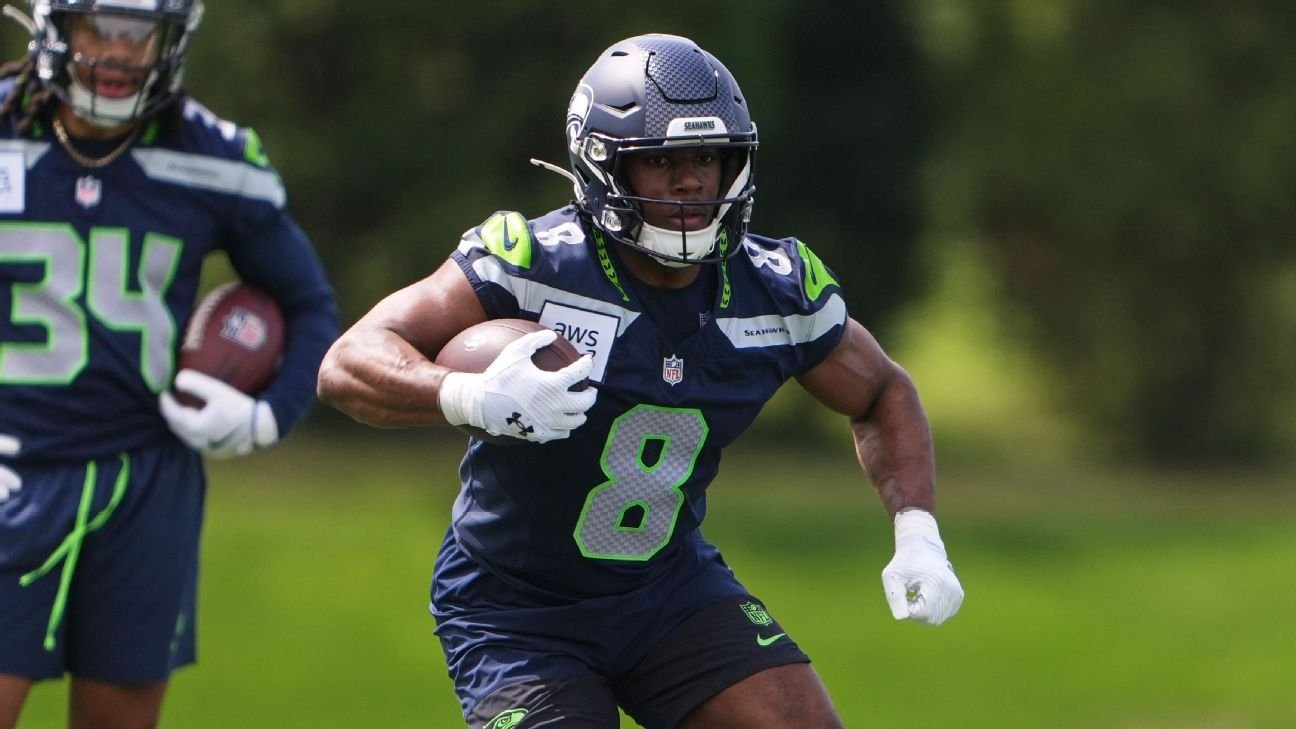
Why he fits: Seattle’s system under new offensive coordinator Brian Fleury should put Price in a position to produce as a rookie. Fleury worked under Kyle Shanahan in San Francisco, meaning the wide zone run game will be a foundational scheme. Price should fit well with that, as he has the vision and lower-body control to stretch the edges or puncture the interior gaps.
The main gripe with Price is that he lacked receiving totals at Notre Dame, recording 15 catches over three college seasons. However, he should get targets on screens and swings as a rookie.
0:32
What Jadarian Price brings to the Seahawks
What Jadarian Price brings to the Seahawks

Drafted: Round 2, No. 34
Why he fits: With more range than a traditional nose tackle, McDonald is a true run game disruptor. He used his foot quickness and power to make splash plays at Ohio State, leading to 17 tackles at or behind the line of scrimmage in 2025.
McDonald can boost the interior of coach DeMeco Ryans’ defense as an early-down defender, plus there is upside here as a pass rusher. He had three sacks in 2025 and should push the pocket while Will Anderson Jr. and Danielle Hunter work the edges.

Drafted: Round 2, No. 44
Why he fits: The best speed-to-power rusher in the 2026 class, Moore had 10 sacks in 2025 at Michigan. He walked offensive tackles back into the pocket on tape, showcasing immense striking power and leg drive.
This fits with the Lions, who needed a physical rusher opposite Aidan Hutchinson. Moore’s rookie value could be on third downs as a designated rusher out of sub-sets. But with Hutchinson drawing protection slides and chips, Moore can also produce early in one-on-one situations.

Drafted: Round 2, No. 54
Why he fits: With Dallas Goedert returning on a one-year deal, Stowers should be seen as the future No. 1 tight end for Philadelphia. But he should make an impact this season, especially in two-tight-end sets and as a situational matchup target.
At 6-foot-4 with a 45½-inch vertical jump (tight end record at the NFL combine), Stowers is built to stretch the seams or isolate as a vertical target when removed from the formation. He can also get loose after the catch, and that should create more high-percentage throws for quarterback Jalen Hurts. Stowers had 146 college receptions, and he’s still developing.

Drafted: Round 2, No. 60
Why he fits: Hill’s range and speed fit as a stack linebacker in new coach Robert Saleh’s defense. In addition to his ability to track the ball on the perimeter and strike blockers, Hill can impact coverage and pressure schemes. Look for him to match inside seams or roam the underneath zones in pass coverage.
Hill can also create ball production under Saleh, finishing with eight forced fumbles and three interceptions in college. In Saleh’s overload fronts, Hill can attack the interior gaps and edges through stunts. He had 17 career sacks at Texas.

Drafted: Round 3, No. 71
Why he fits: Williams will fill a slot role for Washington under new coordinator David Blough. He has the coverage awareness to find soft spots, and he uses his strong vision to slither past defenders after the catch.
Williams, who caught 207 passes over four seasons at Clemson, can make himself available to the quarterback at a high rate. He should be viewed as a reliable target for Jayden Daniels when the Commanders need to move the sticks.
Drafted: Round 4, No. 116
Why he fits: I went into Day 3 to write about Scott because he is a chaos creator who can thrive in Bowles’ defense as a slot/overhang defender. Tampa Bay had a defensive back blitz rate of 17.8% last season, the highest in the league. Scott had five sacks for Miami in 2025, so he could easily be used as a blitzer in 2026. Plus, he has the tackling range and short-area speed to close on the ball. He’s a high-energy defender who found a really good landing spot in Tampa.

