LAS VEGAS — I watched my smile begin to crack on the Teams meeting.
I could faintly hear my 6-month-old’s loud babbling from another room, as a new coworker offered some action items in a planning session for the story you’re reading now.
Advertisement
“I’m not sure how many photos and videos you took, but those would be great,” she said.
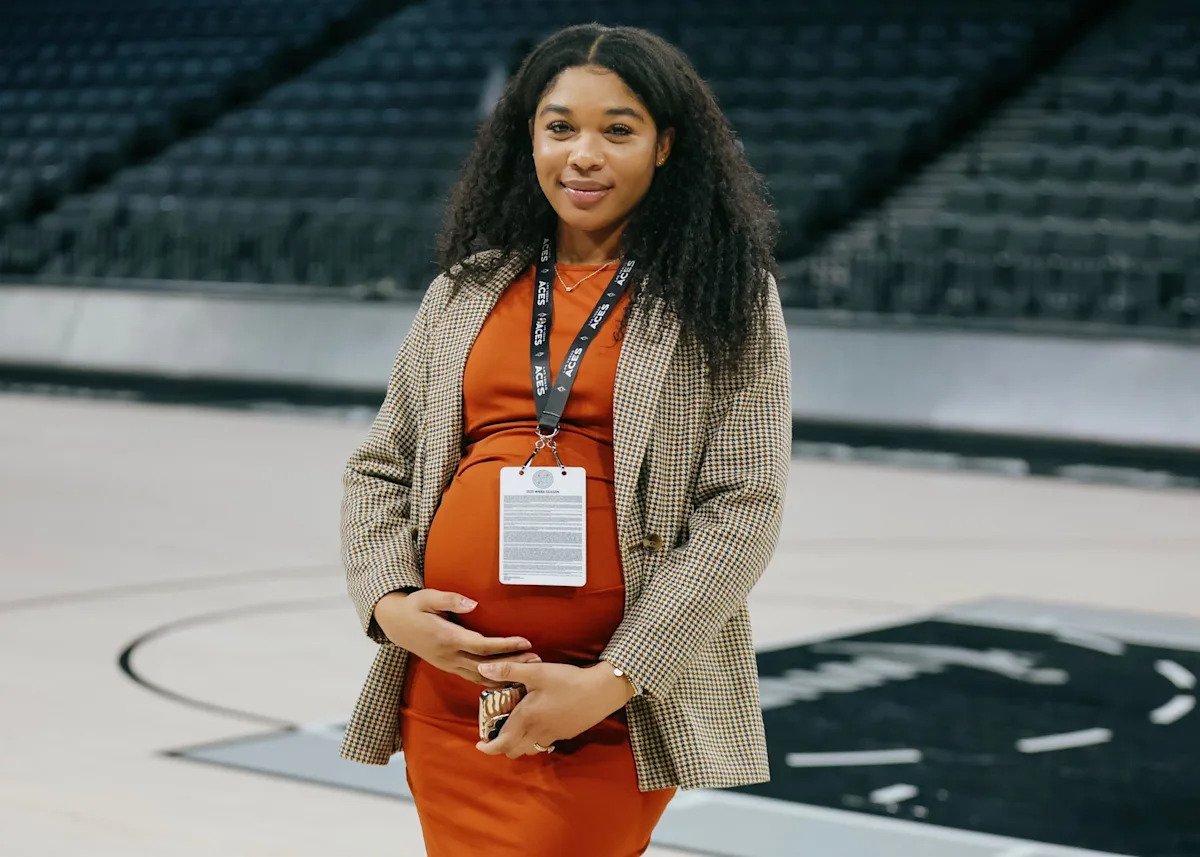
My mind began to race. How much did I document my experience working as a Las Vegas Aces’ beat writer during their 2025 WNBA championship run? I was pregnant from start to finish as I chronicled nearly every game of that historic season. The experience was empowering in many moments of connection with the league’s abundance of working moms in sports. I knew I had a few pictures and videos to share, but I wasn’t proud of some of them.
The difficult truth is I started hiding as soon as my belly began to show, and I did it for reasons I wish I could go back and change. Instead, I’m left remembering how I felt maneuvering to the back for a group photo with a bunch of my media peers while covering the WNBA Finals at 37 weeks pregnant.
It’s trendy for expecting moms to disappear from social media or creatively disguise their stomachs in photos until they welcome their babies. But I didn’t do it because I wanted to stockpile Instagram likes on a “hard launch” of my newborn. I did it, because I was scared about how the news would be received. The journalism landscape is competitive and demanding, and I’d been trying to prove that I’m cut out for it since I started writing for my college newspaper in 2019. I was terrified of how the perception of my dedication might change.
Advertisement
But then I found myself diagnosed with a pregnancy complication. Suddenly, I was confronted with a life-altering realization that opinions about my career did not matter as much as my baby’s life, my life.
The only thing ever truly at risk was our health. And that’s a problem far too many of my fellow women in sports have experienced firsthand.


‘You had so much potential’
I spent something like five months building the courage to tell my bosses I’d need to go on maternity leave − a waste of mental energy, as they were nothing but supportive.
My fears weren’t realized until I told one of my sports journalism peers, who immediately eulogized my hopes and dreams.
Advertisement
“I hope you’re kidding,” he said. “You had so much potential.”
Like a dagger through the heart. Yet somehow, I managed to smile and laugh through the rest of the conversation.
From that point of my pregnancy, I found myself answering and even volunteering answers about how I would maintain my level of work while pregnant. And once the baby was born? Of course, I shared, I would hurry back to my job as soon as possible.
How did I plan to advocate for myself and my baby? Did I know my risk factors for complications and the signs? No one ever asked me those questions.
The U.S. has the highest rate of maternal deaths of any high-income country, according to a 2024 international study by The Commonwealth Fund. Outcomes for Black women are the worst. We are three times more likely than white and Hispanic women to die from pregnancy-related complications, per the newest maternal mortality numbers released in March by the CDC.
Advertisement
I had preeclampsia, which is a persistent high blood pressure disorder that can develop during pregnancy or postpartum and put both mom and baby in danger. Black women are 60% more likely to suffer from preeclampsia while pregnant – and develop severe cases – compared to white women in the United States, according to the Agency for Healthcare Research and Quality.
Allyson Felix, my track and field Beyoncé, also had preeclampsia. Felix’s former USA teammate Tori Bowie was found dead at home from childbirth complications in 2023, and her autopsy cited eclampsia (seizures caused by preeclampsia) as one of the issues.
In an essay calling for more awareness of the maternal mortality crisis, Felix said she went from being unaware of the risks as a pregnant woman, to thinking she might not survive when it came time to deliver.
I was aware of the near-death experiences she and tennis star Serena Williams faced during their pregnancies. Even the real Beyoncé had preeclampsia.
Advertisement
Still, I landed in the same danger zone because I didn’t know enough about the symptoms. That left me vulnerable to being dismissed by doctors until one finally paid attention during a routine prenatal appointment a few hours before Aces’ exit interviews.
Swelling and high blood pressure readings were two of the concerns I raised before I was diagnosed. I was told on multiple occasions that swelling was an outdated symptom and not uncommon.
There were a few instances during my pregnancy where my blood pressure numbers were high, but those readings were disregarded due to discrepancies with the cuff or the fact that I was under 30 and otherwise healthy.
The doctor who caught it decided to order an extra test. But she didn’t wait for the results to schedule an induction.
Advertisement
I was waiting for Aces forward Kierstan Bell to speak when the doctor called me to tell me that there was protein in my urine, cementing my preeclampsia diagnosis and moving me to the top of the induction list for the same day.
Even though that doctor flagged my case as an emergency, the hospital where I was set to deliver eventually called to say they were full and would accommodate me when they had space. We waited for around 12 more hours until my aunt (family practice doctor turned hospital executive), mother-in-law (former ICU nurse pursuing a doctorate degree) and my mom (queen) had seen enough. According to them, my swelling had increased rapidly. I also began to complain about headaches and vision problems, not realizing they were symptoms.
Instead of continuing to wait, my advocates arranged for me to be rushed to the emergency wing of our delivery hospital, and I was admitted for monitoring until a delivery room became available.
We narrowly avoided a crisis, and sometimes I wonder how things would’ve unfolded if I didn’t have such keen family members advocating for my baby and me.
Advertisement
Power of women’s basketball
I received an apology for the comment my former co-worker made about my pregnancy ruining my career, and we laugh about it now, but I carried it with me to almost every assignment. From NBA summer league to a UNLV football spring scrimmage, I wondered if everyone in media was looking at me and wondering if I’d thrown my professional aspirations away.
The only time I could avoid that feeling at work was when I was fulfilling my duties covering women’s basketball.
Aces coach Becky Hammon waited until I was six months pregnant to even think about acknowledging the growing belly. “My back hurts,” she said after a long practice. “Mine too,” I said with a grin, poking my stomach out. Hammon’s eyes widened like an excited kid when she exclaimed “you’re pregnant!”
Advertisement
For the rest of the season, Hammon was kind enough to entertain side conversations. We talked about baby names and motherhood. I even learned she had a relative who was pregnant at the same time as me.
It wasn’t uncommon for a member of the Aces’ medical team to force me to sit down or drink some water when I was circling a court for sights and sounds or trying to find an interview subject.
I have a million memories like this that I’ll cherish forever.
I got parenting advice from A’ja Wilson’s mom and dad. I got delivery tips from Cheyenne Parker-Tyus and a postpartum text to “give myself grace,” both of which went further than you can imagine.
Advertisement
UNLV women’s basketball coach Lindy La Rocque sent me a message of support when she heard I was being induced. And before I returned from maternity leave, she reached out to check on my son and me.
All of the kindness I received doesn’t negate the reality that some people will never understand everything that comes with being a working mom. I understand that.
I still remember a coach calling me out by name during a full, recorded media scrum to welcome me back from maternity leave. He mentioned to everyone I took more time away from the job than I said I would.
The sting of this experience could have happened in any job. The comments, uncomfortable moments and general stigma that working moms can no longer be dedicated to their careers are universal. Even after years of women across the world showing people every day they can do both.
Advertisement
But every time I went to work on women’s basketball in Las Vegas, I was encouraged. That support even came in the form of an Aces staffer who quietly cheered when I shared my pregnancy news with her at the start of training camp, then made an early wager that I’d miss the team’s championship parade.
We revisited that bet a lot during the Aces’ tumultuous season. My side of the playful banter ranged from: “What parade?” to “I’ll deliver on the party bus.”
Ultimately, I didn’t welcome my son until the day before the Aces’ championship parade.
Freshly removed from a 24-hour drip of medication intended to prevent postpartum seizures, I watched a livestream of the festivities on my phone from a dark hospital room with the most beautiful ball of warmth sleeping on my chest. From my bed, I could see my window occasionally sparkling with tiny lights from the Las Vegas strip in the distance.
Advertisement
I don’t feel like I missed the parade.
Even better, I have reasons to celebrate every day now. I started a new national role this month where I get to tell the stories of all kinds of women in sports. And one day, I’ll get to tell my baby boy that he made me better.
In the meantime, my husband and I will continue to throw our own little parades whenever our son does something new.
This article originally appeared on USA TODAY: The season I covered the WNBA while pregnant — and nearly missed warning signs

