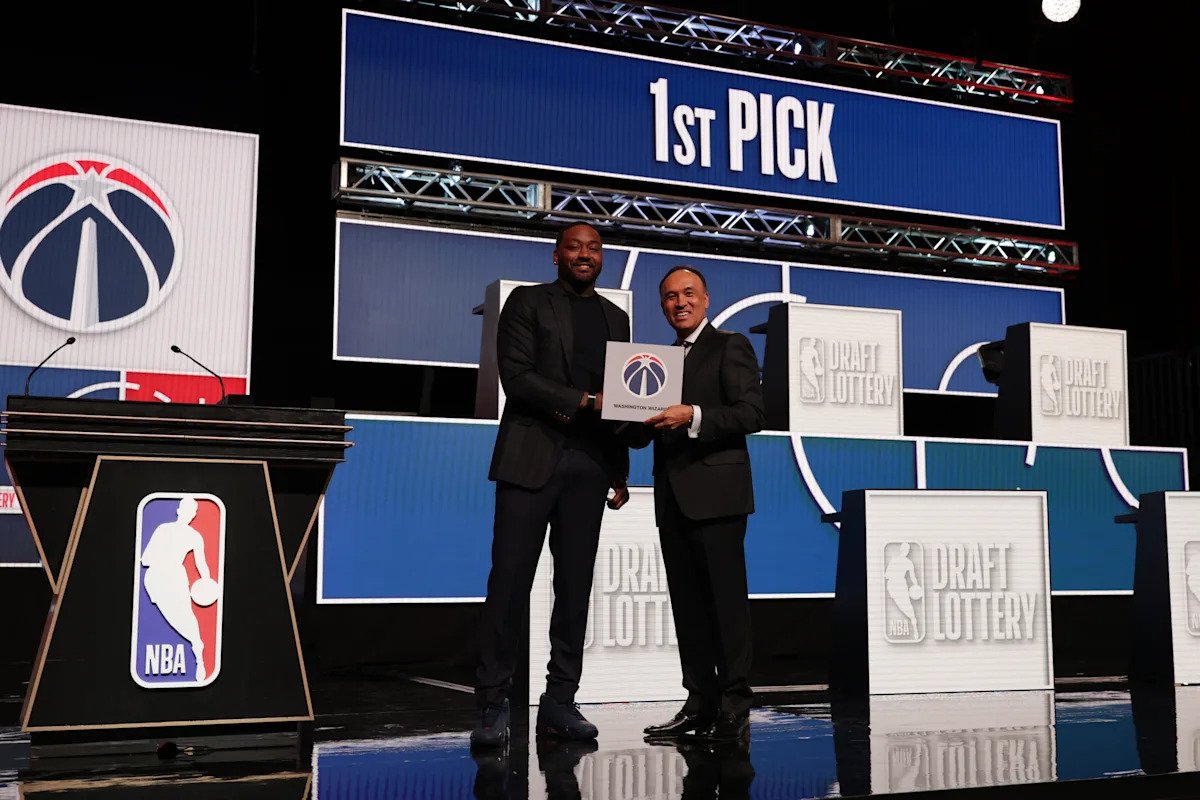
This NBA season was marred by tanking. One-third of teams showed little interest in winning games. The league even fined two of them for tanking. Then the lottery rewarded four of the most unapologetic tankers — the Wizards, Jazz, Grizzlies, and Bulls — with the top four picks.
Washington traded for Trae Young and Anthony Davis. Didn’t play them. Utah got fined for violating the player participation policy, and traded for Jaren Jackson Jr., but put him on ice after he played just three games. Memphis traded away JJJ, slow-played the return of its injured players, and demoted Rayan Rupert to the G League the morning after he had a 30-point triple-double. Chicago traded away its entire veteran core for a nonsensical roster with seven guards to free-fall out of the play-in straight into the lottery.
Advertisement
Under the current rules, those teams made the smart choice. This is a draft that was worth tanking for: BYU forward AJ Dybantsa, Duke power forward Cam Boozer, Kansas guard Darryn Peterson, and North Carolina big Caleb Wilson headline what could end up a tremendous class of prospects.
Let’s get to the winners and losers of the 2026 NBA Draft Lottery:
NBA Mock Draft 5.0 | NBA Draft Guide
Winner: Washington Wizards
The Wizards won 50 games combined over three-straight years — which was capped off by allowing Bam Adebayo to drop 83 points this season — and got a cosmic payoff with the first pick in the 2026 draft. It’s the third time the Wizards have had the first pick in the last 25 years. In 2001, they drafted Kwame Brown. In 2010, they took John Wall, who, fittingly, represented the franchise on stage.
Advertisement
Everyone expects the Wizards to take Dybantsa. And maybe they will. He slots in as a small forward on a roster that suddenly looks coherent: Alex Sarr anchoring the paint, Anthony Davis at power forward, Trae Young running the offense, Kyshawn George, Tre Johnson, Will Riley, and Bilal Coulibaly at the wings. Dybantsa is a connective two-way piece and has the potential to someday become one of the greatest scorers in the league. And in Washington, he’d have the support around him to develop without needing to be a Day 1 savior.
But hold your horses on this being a lock. One of the three teams behind them — the Jazz with the second pick, the Grizzlies at third, and the Bulls at fourth — could feel compelled to offer a haul to move up. Or the Wizards may simply prefer one of those other prospects. It’s not like every single executive or scout around the league believes Dybantsa is a better prospect than Boozer or Peterson. There is easily an argument to be made that Peterson is a dream fit in a backcourt next to Young, or that Boozer and Sarr could someday become one of the league’s best frontcourts.
Dybantsa is the favorite. The Wizards are winners because now they can take him and go home happy. But they will certainly turn over every stone. Their newfound optionality is the biggest win of all.
This is one of the most painful tanking outcomes in recent memory. The Pacers lost Tyrese Haliburton to a torn Achilles in Game 7 of the NBA Finals, then tanked this year, and set two separate franchise-worst losing streaks. And now, they lost their top-four protected first-round pick to the LA Clippers after it landed fifth.
Advertisement
Brutal.
It’s not the end of the world for Indiana. Ivica Zubac is a talented center who should pair beautifully with Haliburton and Pascal Siakam. Since the Pacers lose the fifth pick, they will instead retain their 2031 first. They still have a great roster that, if healthy, should contend in the East. And besides, the fifth pick is in a very guard-heavy range, and a guard is the last thing Indiana needs.
But still. All that, just to be rewarded with nothing.
Winner: Los Angeles Clippers
Indiana’s loss is a gain for the Clippers. After trading Zubac for Bennedict Mathurin, and James Harden for Darius Garland at the deadline, the Clippers are looking a lot younger. Landing the fifth pick opens up more reasonable paths than before.
Advertisement
Could the fifth pick mean a Kawhi Leonard trade is on the table? The Warriors made a run at Leonard prior to the trade deadline. The Clippers refused. But league sources expect the Warriors to be aggressive in pursuing a star player via trade this summer. With a chance to take a young guy in the lottery, maybe now the Clippers would be willing to listen.
The front office should. This team is no longer a contender. The window shut. It’s time to move on to the new era. Garland is 26. Mathurin is 23. Yanic Konan-Niederhauser is 23. Even Jordan Miller and Kobe Sanders have shown promise off the bench. Add a lottery guy (or two, if they flip Kawhi), and suddenly the Clippers could have one of the better young teams in basketball.
The Mavericks had the sixth-worst record in the league for most of the year, then won three of their last nine games and slid backwards into the eighth-worst record. The lottery gods didn’t reward the late stumble. Dallas dropped to ninth.
Advertisement
That’s a fine spot, really. There are quality guard prospects available who could spend a year learning under Kyrie Irving before someday running the offense alongside Cooper Flagg. There are a handful of long-armed forwards, too, which is the archetype that Mavericks president Masai Ujiri has historically loved. The new front office has plenty of good options available.
But the Mavs are losers because moving up in the lottery would’ve meant drawing from a higher tier of prospects, and Dallas is going to need one of them to someday catch up with Oklahoma City and San Antonio. Flagg can be the centerpiece, but he needs star running mates just like Shai Gilgeous-Alexander has in OKC and Victor Wembanyama has in San Antonio. The path to catching up just got a lot steeper.
The Grizzlies are running one of the most aggressive teardowns the league has seen in years, and the ping-pong balls just validated the entire strategy.
Advertisement
Memphis shipped Desmond Bane to Orlando last offseason for four first-round picks and a swap. Then they followed that up at the deadline by sending Jaren Jackson Jr. to Utah for three more firsts plus Walter Clayton and Taylor Hendricks. That means they have 12 total firsts over the next seven years, trailing only the Thunder and Nets for most in the league. And now they have the third pick, giving them the opportunity to pair another potential star with Cedric Coward, Zach Edey, Jaylen Wells, and a bunch of talented youth.
The one veteran still on the Grizzlies? Ja Morant. Memphis wasn’t able to find enough value prior to the deadline to pull the trigger on a deal. The Kings were the most connected team to Morant, but after they landed the seventh pick they’re in a range littered with guards. Perhaps, Sacramento will just draft one instead.
So, who’s left for Morant? Maybe Houston after getting pummeled in the first round. Maybe Minnesota, though salary matching would be just as much of a challenge now as it was at the deadline. Maybe the Heat, Magic, Nets, Raptors, or Suns talk themselves into Morant, though that’s just speculation.
No matter the case, the Grizzlies are in a position now to take a player third and continue building one of the best young teams in the league.
Advertisement
During the 2025 NBA Finals, the Pelicans traded an unprotected 2026 Pacers first back to Indiana for the 23rd pick in last year’s draft. Then on draft night, they packaged that 23rd pick along with their own 2026 first (with a Bucks swap attached) to move up 10 spots with Atlanta, where they selected Derik Queen at 13.
The Pacers pick they gave up? That landed at fifth this year, and it’s now owned by the Clippers. The Pelicans’ own pick? That landed at eighth, and is now property of the Hawks. When you tally it all up, New Orleans surrendered the fifth and eighth picks this year to draft Queen with the 13th pick last year. Five plus eight equals 13, so it couldn’t have happened any other way.
The deals barely made sense at the time. Haliburton was already dealing with a calf injury during the Finals — to the degree that his torn Achilles in Game 7 didn’t come as a complete shock — and the Pelicans gave up that 2026 pick anyway. Then on draft night, they gave up their own first even though their roster was clearly cooked compared to the rest of the loaded West — with a Bucks swap attached to it even though Giannis Antetokounmpo’s future was already in doubt.
Advertisement
It all looks even worse now.
Maybe it works out in the end. But Queen had a rocky rookie year. He shot 26% from 3, 38% on dribble jumpers, 37% on hook shots, 31% on floaters, and 55% on layups, per Synergy. He was even worse on defense. The Pelicans were a +5.3 when Zion Williamson and Trey Murphy shared the floor without Queen — pretty good! — and a -9.1 the moment that Queen joined them. Oof!
At least the Hawks didn’t move up to rub even more salt in the wound. But those two trades Pelicans executive vice president Joe Dumars made remain a total botch job.
Winner: Austin Ainge
Ex-NBA All-Star Carlos Boozer has worked in the Jazz front office over the past year. And now, Utah has the second pick in the draft — a prime position to draft his son, Cameron Boozer. If the Jazz had landed first, it seems highly probable that Jazz owner Ryan Smith — a BYU alum and donor — would have the team select BYU forward AJ Dybantsa. But now the door is open for Cam to land with the franchise his father spent his prime years and now works.
Advertisement
It’ll be interesting to see if Smith pushes to trade up to the first pick. Boozer is a bit of an awkward fit with Utah’s existing pieces. Both JJJ and Boozer ideally play with a true center, like Walker Kessler, who is a free agent this summer but could re-sign. But what’s that mean? Kessler at the 5, Boozer at power forward, JJJ at the 3, and Lauri Markkanen at shooting guard? Strange.
Maybe the true winner in Utah is president of basketball operations Austin Ainge, who worked in the Celtics front office for years while his father Danny Ainge (Utah’s CEO of basketball operations) made a habit of drafting high schoolers and college freshmen who were once top-ranked high school recruits.
Al Jefferson, Gerald Green, and Kendrick Perkins all came straight out of high school. Jared Sullinger and Avery Bradley were formerly top-ranked high school prospects who underachieved in college, then he nabbed them midway through the first round. Ainge also went against consensus when he took Jaylen Brown and Jayson Tatum too.
To be clear: Austin is not the same person or general manager as his father Danny. But Utah’s choices since Austin took over — Ace Bailey at five last year being the cleanest example — have struck a familiar tone: don’t overvalue 30-or-so games of inconsistent college production over the years of high school tape.
Advertisement
Maybe, just maybe, Utah’s guy has always been Darryn Peterson.
Loser: The Lottery Guards
After the top four, there are six guards that could get selected in the top 10: Keaton Wagler, Kingston Flemings, Darius Acuff, Brayden Burries, Mikel Brown, and Labaron Philon. There is no chance all of them do. Zero.
Anyone watching the NBA playoffs sees how high the threshold is for guards to find success at the highest levels of the playoffs. And of those mentioned guards, only Wagler is listed at taller than 6-foot-5. Could that mean some of these guards slip?
Look at how the board settled: The Clippers (fifth) just traded for Darius Garland. The Nets (sixth) drafted four guards last year. The Hawks (eighth) are happy with the CJ McCollum experience. The Mavericks (ninth) have Kyrie, and Ujiri has historically preferred big forwards. Maybe one of those teams ends up taking a guard anyway. But the Kings (seventh) look like the only team that very clearly has a job opening at guard.
Advertisement
My gut says some of the guards slip outside of the top 10, and we instead see bigger players move up: centers like Aday Mara or Hannes Steinbach, and forwards like Karim Lopez, Yaxel Lendeborg, or Nate Ament. These players just offer something the guards can’t: size that holds up in the playoffs.
Winner: Everyone Besides OKC
The one result every team didn’t want to see: The Thunder moving into the top four. Well, it didn’t happen. Crisis averted! The other outcome teams didn’t want to see: The Pacers keeping their pick. And that didn’t happen either. The two 2025 finalists got unlucky on lottery day — though, Indiana is feeling the pain much worse.
Teams currently contending are relieved that the four teams at the top — Washington, Utah, Memphis, and Chicago — are all in rebuilding situations. The Wizards, Jazz, and Grizzlies have all made some great picks in recent years. We’ll see if new Bulls general manager Bryson Graham can do better than Patrick Williams with the fourth pick. But all four of these teams are years from contending.
Advertisement
Adam Silver must be in a good mood, too. If OKC had moved into the top four, it’s a guarantee that fans, media, and teams would have begun raging. The backlash might have been so strong that the league office wouldn’t have been able to move forward with their 3-2-1 Lottery Proposal, which is a 16-team field with flatter odds and penalties for the three worst records. Crazy lottery results will be a far more common occurrence under that system. But the Thunder didn’t move up. Now the league doesn’t have to deal with that controversy while pushing for reform.
This week in Chicago at the Draft Combine, the league office will meet in person with the NBA’s general managers to further discuss lottery reform. They are expected to reveal tweaks to the existing proposal. Then later this month, owners will vote on a final plan. And in one year, we’ll be back at the lottery again, with some fans rejoicing, and others saying it’s all fixed.

