We’re covering four hitters today in our weekly skill versus luck factor piece — four veterans. One of those veterans has been producing well, while three others have had slower starts. To identify the players to discuss, we’ll use the Yahoo player rater for the past two weeks to provide a small sample to choose from. Besides those hot hitters on the player rater, we’ll discuss other hitters generating plenty of buzz throughout the fantasy baseball community. Unfortunately, a few of these highly drafted players haven’t met expectations so far.
We’re analyzing the advanced stats for five hitters to determine whether we should buy, sell or hold them moving forward.
Advertisement
Reach out if you have a player you would like me to examine on X/Twitter, @corbin_young21.
Mike Trout, Angels (96% Rostered)
Trout is on an early pace for 30+ home runs in 2026 for the first time since 2022. He has been pulling the ball more while hitting plenty more flyballs in 2026. That’s evident in Trout, who boasts a 45.1% pull rate and 52% flyball rate, both being 7-9 points higher than his career averages. If Trout maintains the pull-heavy, flyball approach, we might see his home run per flyball rate increase.
Trout rocks a 11.8% barrel rate per plate appearance in 2026, nearly over two points higher than his career average (9.7%). Not that we questioned Trout’s power, but it’s still excellent. Trout has been an elite option in points and on-base formats, with a .407 OBP throughout his career. However, Trout’s walk rate jumped to 20% in 2026, up from a career average of 15%, leading to a .410 OBP in 2026.
Advertisement
With the new Automated Ball Strike (ABS) System, some have speculated on hitters swinging less often. Hitters across the league have been walking 9.5% of the time in 2026, up from 8.4% in 2025. Similarly, hitters have been swinging about one percentage point fewer in 2026. This could be small sample noise or intentional, but Trout notably has a 36.9% swing rate and a 18.8% chase rate in 2026. The overall swing rate is similar, yet he has been chasing two points below his career norm (21.1%). More patience at the plate with his already loud contact supports the early-season success.
It’s easy to say Trout is good, but sometimes it’s fun to find out what a player could be doing differently. With Trout, he has been pulling the ball into the air more often while continuing to do damage. If you have Trout, this isn’t a sell-high moment.
Cal Raleigh, Mariners (99% Rostered)
After a player posts a historic season, their draft price rises the following year. We often question if a player can replicate or can produce close to their draft value. Unfortunately, Raleigh has been struggling early in 2026. It wasn’t fair to expect 60 home runs, but the brutal batting average (.161) in 2026 tanks Raleigh’s value. From a mindset standpoint, we could expect Raleigh to put pressure on himself to prove doubters wrong about whether he can replicate his 2025 numbers.
Advertisement
We mention that because Raleigh has been chasing more (37.9%) with a slight dip in contact rate (69.8%). For context, Raleigh chased pitches 32.9% of the time in his career, yet had similar contact rates (71.4%) in 2026 and his career (71.3%). Raleigh uses a pull-heavy (56.6%), flyball (60.4%) approach. However, there can be diminishing returns when a hitter pulls the ball into the air beyond a certain point. Raleigh’s flyball rate increased by a couple of percentage points from 2025 (57.7%), with a nearly identical pull rate.
That leads me to speculate on a possible stance or swing change. Raleigh’s stance was wider (29.3 inches) in 2026, compared to 2025 (24.8 inches). That’s the widest stance for Raleigh since 2023, when Statcast tracked batting stance data. Raleigh’s stance change has likely been impacting his ability for swing consistency, especially against multiple pitch types. Though we’ve seen Raleigh’s pull rate increase, it’s interesting to find his intercept point farther back from the front of the plate in 2026. Currently, Raleigh’s intercept point is four inches from the front of the plate in 2026, down from 7.5 (2025) and 9.7 (2024).
Cal Raleigh xwOBA by season. (Photo by Corbin Young/BaseballSavant)
Like the batting stance differences, Raleigh could be late on pitches and working through kinks in his swing, instead of being out in front like usual. That might be evident in Raleigh’s early struggles against fastballs (.269 wOBA, .295 xwOBA) in 2026, down from .423 wOBA (.405 xwOBA).
Advertisement
It should be mentioned, Raleigh was dealing with side tightness, causing him to miss a few games this season. Often, we think of obliques when we hear side tightness, which can be problematic for a rotational sport like baseball.
Play 2026 Soccer Pick ‘Em with FOX One and make your picks for the world’s biggest soccer tournament
There’s nothing fantasy managers can do other than be patient, since we know Raleigh can still crush the ball, though we’ve seen his 7.2% barrel rate per plate appearance dip from his career average (9.1%) after peaking at 11.3% in 2025. Expect Raleigh to turn it around because of his strong track record, especially with some actionable swing adjustments.
But as we’re wrapping up this article, Raleigh left Wednesday’s game with side tightness. There’s a chance the Mariners play it safe and put Raleigh on the injured list in hopes of being healthier for the rest of the season.
Advertisement
Fernando Tatís Jr., Padres (99% Rostered)
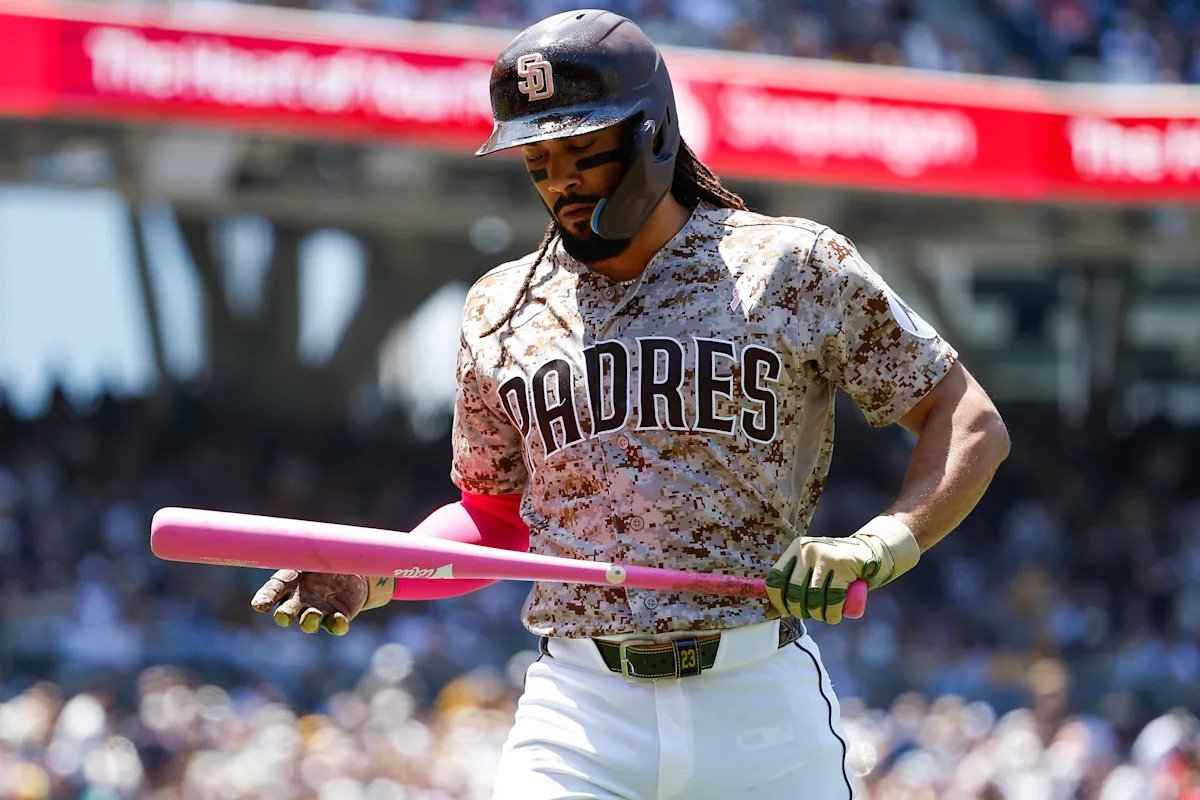
If you placed a bet on Fernando Tatís Jr.’s home run total in the middle of May, you most likely wouldn’t have guessed zero. Tatís’s pull rate has dropped to a career low (29.8%) with the most ground balls (52.2%) of his career. That’s significantly different from Tatís’ 41.8% career pull rate, with a 5-6 percentage point shift in his groundball and flyball rates.

Fernando Tatís Jr.’s rolling flyball and pull rates. (Photo by Corbin Young/FanGraphs)
Unfortunately, Tatís has been hitting more ground balls, aligning with a low, three-degree launch angle. For context, Tatís launch angle has been three times worse than his career norm.
Tatís’ 7.4% barrel rate per plate appearance in 2026 is the same as 2025 (7.4%). He consistently crushes flyballs and line drives, evidenced by a 96.5 mph average exit velocity on flyballs and line drives (No. 30) in 2026, like 2025 at 97 mph (No. 13). Furthermore, Tatís’ 105.1 mph (No. 11) EV50 in 2026 has been slightly better than the 2025 numbers (103.8 mph). Theoretically, we should see home runs coming soon for Tatís, with the exit velocity metrics showing there hasn’t been a significant decline.
Advertisement
From an earned value standpoint, Tatís’ 10 stolen bases have been helping his profile. Tatís has been running more often, with a 28% stolen base opportunity rate in 2026, up from his career average (21%). Tatís should reach 30 stolen bases in 2026, likely heating up for 20+ home runs soon. The low launch angles have been a problem, but the exit velocities haven’t. Watch for Tatís to continue crushing the ball when he elevates it.
Buy low on Tatís if possible.
Rafael Devers, Giants (93% Rostered)
It pains me to see Devers struggling to begin the season after touting him as a points-league asset. Devers has the lowest walk rate since 2019 and the lowest OBP since 2018, not including 2020. He was an on-base machine via walks and extra-base hits. It’s probably safe to trust Devers’ track record, but let’s see if there have been any skill changes.
Advertisement
Devers’ 71.9% contact rate has been similar to recent seasons, yet below his career average (74%). Meanwhile, Devers’ swing and chase rates haven’t shifted from his career averages. However, Devers has been chasing more (32.5%), up from 25.5% (2025), yet that’s similar to his career norm (32.6%), so maybe 2025 was the outlier chase rate. The Giants’ home park ranked last in Home Run Park Factors for left-handed hitters, tying them with the Diamondbacks’ home park on a three-year rolling average. We’ve seen Devers lower his pull rate to 33.6% in 2026, down from 37.7% (2025). However, Devers was using a pull-heavy approach (44.8%) when he joined the Giants last season.

Rafael Devers rolling barrel/PA by season. (Photo by Corbin Young/BaseballSavant)
One slightly alarming metric is Devers’ 104 mph EV50 (No. 17) in 2025, dropping to 101.4 mph (No. 86) in 2026. That aligns with his 5.2% barrel rate per plate appearance in 2026, dipping by four percentage points from 2025 (9.2%). For context, that’s a career-low barrel rate for Devers in the middle of May. If Devers’ barrel rate remains low, that translates to average instead of near-elite power skills.
That’s not what fantasy managers expected from an investment in Devers.
Advertisement
The Giants have been the second-worst team in wRC+ (86), with Devers contributing to the problem. I expect Devers to turn it around, but the runs and RBI could be an issue with a poor lineup. We probably won’t see 90-100 runs and RBI for Devers, which means he’ll need a massive power spike, yet the terrible home park makes that unlikely.
Be patient with Devers, though we might be nearing panic mode if the Giants’ lineup continues to be awful and Devers doesn’t heat up.

