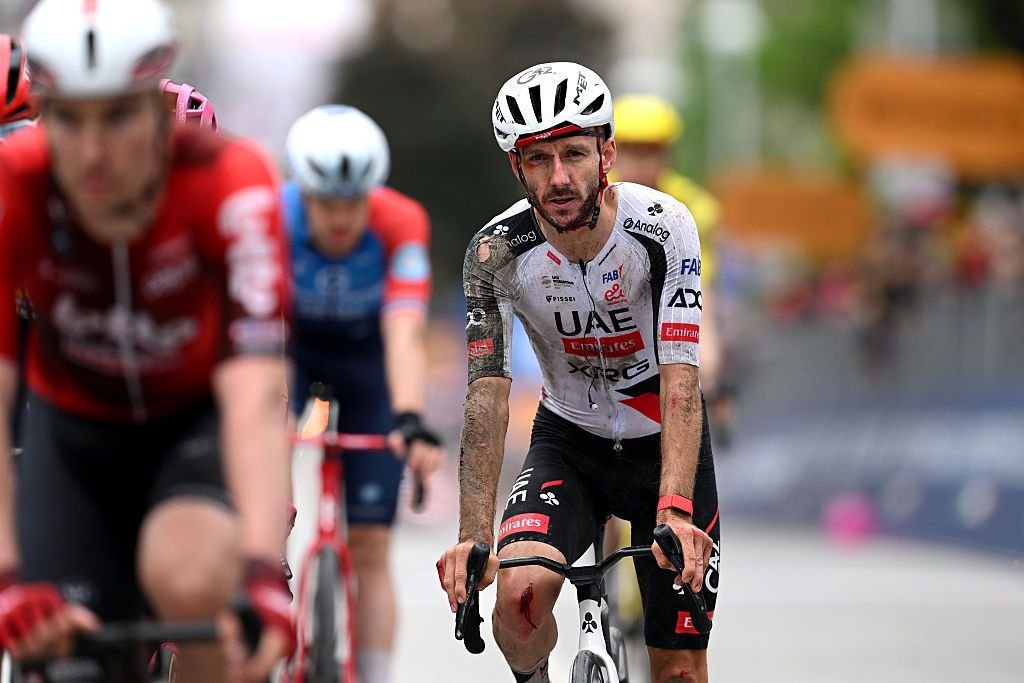
Speaking on their Watts Occurring podcast this week, Geraint Thomas and Luke Rowe questioned UAE Team Emirates-XRG’s decision to race the wet opening stages of the Giro d’Italia on Continental’s GP5000 TT TR – the time trial-oriented version of the GP5000 line – after a Stage 2 crash took down Adam Yates, Jay Vine, and Marc Soler.
“We all know they’re faster. They are faster. They always use them,” Rowe said. “But they do have less grip… The first guy down was a UAE guy. He lost both wheels. You also question the decision making there.” Thomas agreed, noting that Ineos had themselves drifted toward TT tyres in road races over time. “I don’t understand that decision making, mate,” Rowe added. “I really don’t.”
UAE pushed back firmly. “We don’t feel it was a tyre issue,” a team spokesperson told Cycling News. “The riders have been using TT tyres for a long time. We think it was just because of the wet and the speed.”

The instinct that a TT tyre must mean less grip is a strong one. It’s also, on the current Continental range, harder to support than it once was.
The GP5000 TT TR and the more widely raced GP5000 S TR share the same BlackChilli compound. They share the same Lazer Grip shoulder pattern. The differences are structural rather than surface level: the TT runs a two-ply sidewall against the S TR’s three, with marginally thinner tread on top, making it lighter, more supple, and faster rolling. The rubber meeting the road is the same rubber in the same pattern on both tyres.
Another common assumption is that the limited tread on TT tyres has an impact on grip. This is a position that many of us absorb from learning to drive a car: wide, flat-fronted contact patches inflated to around 30psi means that at motorway speeds, they can aquaplane.
But bike tyres – at 28 or 30mm and 70psi – are very different. Continental’s own technical pages put it pretty bluntly: bicycles are not susceptible to aquaplaning in any realistic riding scenario. The tread on a race tyre is there for cornering deformation and, increasingly, aerodynamic trip effects, not water dispersal.
Given both the Continental options discussed share the same tread, it wouldn’t be fair to suggest this was an assumption at play in the What’s Occurring podcast, but it is a point worth making for the general public.
What does cost a rider grip when wet is a compound’s behaviour when cold, the surface itself (diesel, dirt, shiny cobbles), and the lean angle asked of the rubber. Stage 2 probably had a generous helping of all three. So did the cobbled run-in to Naples on Stage 6. The tyre choice – GP S TR or the TT version – shouldn’t have made a difference.
Thomas and Rowe are riders of generational experience, and their instincts were earned in an era when “TT tyre” did indeed mean a harder compound and a slicker tread, with a measurable grip cost. That tyre is no longer the one UAE are racing on.

