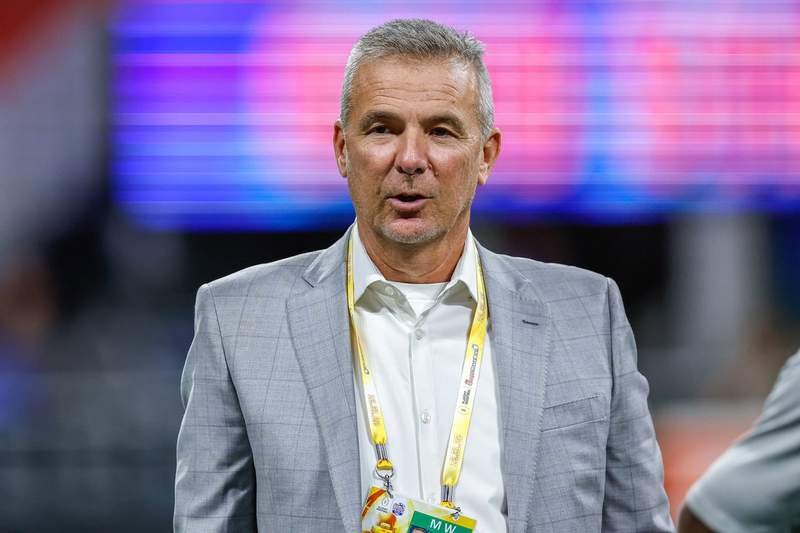
College Football’s NIL landscape guarantees almost unlimited money to athletes, subject to their market value. While the House v NCAA puts a $20.5 million cap on a program’s roster, reports highlight major blueblood programs’ rosters exceeding well over $50 million. Thanks to a little workaround, schools are directing their athletic departments’ money to fund NIL deals, bypassing the cap oversight entirely. Former OSU head coah Urban Meyer doesn’t like how this stuff continues to happen.
“I had about four or five athletic directors I know very well at some really big schools call me and say, ‘There are two ways that this is happening,’” Meyer said on hisTriple Option podcast, hosting NCAA president, Charlie Baker. “When you’re following rules, it’s called money laundering. They take money that is set aside. I’m just throwing out AT&T and Verizon. They pay the school a certain amount of money, and the higher-ups redirect part of that money towards a roster member.”
Advertisement
Let’s take former Cincinnati QB, Brendan Sorsby, as an example. When his transfer portal recruitment was heating up this year, two major schools (LSU and Texas Tech) appeared to be in the race to seal the deal. On the surface, Sorsby ultimately committed to Texas Tech for a reported $5 million deal. Behind the scenes, his commitment was one of the tensest and highest bidding wars in college football history.
It didn’t make sense at first. How can a school that had to build its entire roster in $20.5 million manage to give a single player $5 million? But one look at the potential deal LSU had on the table for Sorsby gave away the methods the program was employing. LSU had offered $3.5 million to Sorsby through their multi-media rights partner, Playfly Sports, whereas the school’s actual revenue-sharing payout was $1 million. Additionally, the deal also had a third “marketing agency” acting as a mediator.
According to Yahoo Sports’ Ross Dellenger, the $3.5 million NIL guarantee was also a backend deal that Playfly Sports struck with NILSU MAX. What’s NILSU MAX? It’s an entity that LSU Athletics and Playfly formed together, intending to “identify and secure NIL opportunities” for LSU’s student-athletes. Effectively, what programs are doing is transferring their own athletic department funds through entities like NILSU MAX to a third-party marketing agency, which in turn fulfills the NIL deal with athletes.
Advertisement
“The whole point of this was for us all to be playing by the same rules, but we are not,” Cincinnati head coach Scott Satterfield said in July. “We are not playing by the same rules, particularly this past spring when everybody is apparently frontloading where others are having to now spend their [revenue-share] cap.”
Since the House vs NCAA settlement doesn’t restrict third-party agencies from contacting and roping in athletes for NIL deals, there’s nothing illegal in what the programs are doing. That’s what Texas Tech also did when it finally offered Brendan Sorsby. Although the deal remains undisclosed, the Red Raiders facilitated Sorsby’s $5 million deal through a combination of revenue sharing and a “significant investment” from apparel partner Adidas.
Urban Meyer opposes the NIL landscape altogether despite a built-in safeguard
Despite the programs employing marketing agencies, apparel partners, and third-party agencies to channel their revenue to their athletes, there’s still a safeguard against it. The House vs. NCAA settlement established the College Sports Commission and its clearinghouse, NIL GO, and tasked them with approving third-party NIL contracts. The 9-member commission, which is still in its infancy, should ensure that those NIL deals have a “valid business purpose” and not exceed an established range of compensation. For Urban Meyer, though, the whole NIL landscape is at fault here.
Advertisement
“The discomfort that gives me as a former coach. Like, wait a minute. Is there a way to get these collectives the hell out of there and have the university believe in a collective bar?” Meyer said. “The revenue share, I’m sorry, I think that’s really good. But get that other stuff NIL [out]. Get it out of there. That’s not the job of a coach and AD to fund NIL. That’s in my mind, that’s called the marketplace. And that’s called capitalism.”
Despite the CSC overseeing those NIL deals, reports point out that the commission has not yet approved deals like Brendan Sorsby’s. Of the deals programs like LSU have submitted to the commission, only one of them amongst them has been denied. The major hurdle the clearinghouse is facing is that not all Power-4 programs have signed to come under its oversight yet. And until that happens, even if the deals are denied, nothing would stop programs from filing lawsuits seeking injunctions.
Trending Articles
The post Urban Meyer Reveals Multiple ADs Raised “Money Laundering” Concerns as Roster Valuations Near $50M appeared first on EssentiallySports. Add EssentiallySports as a Preferred Source by clicking here.

