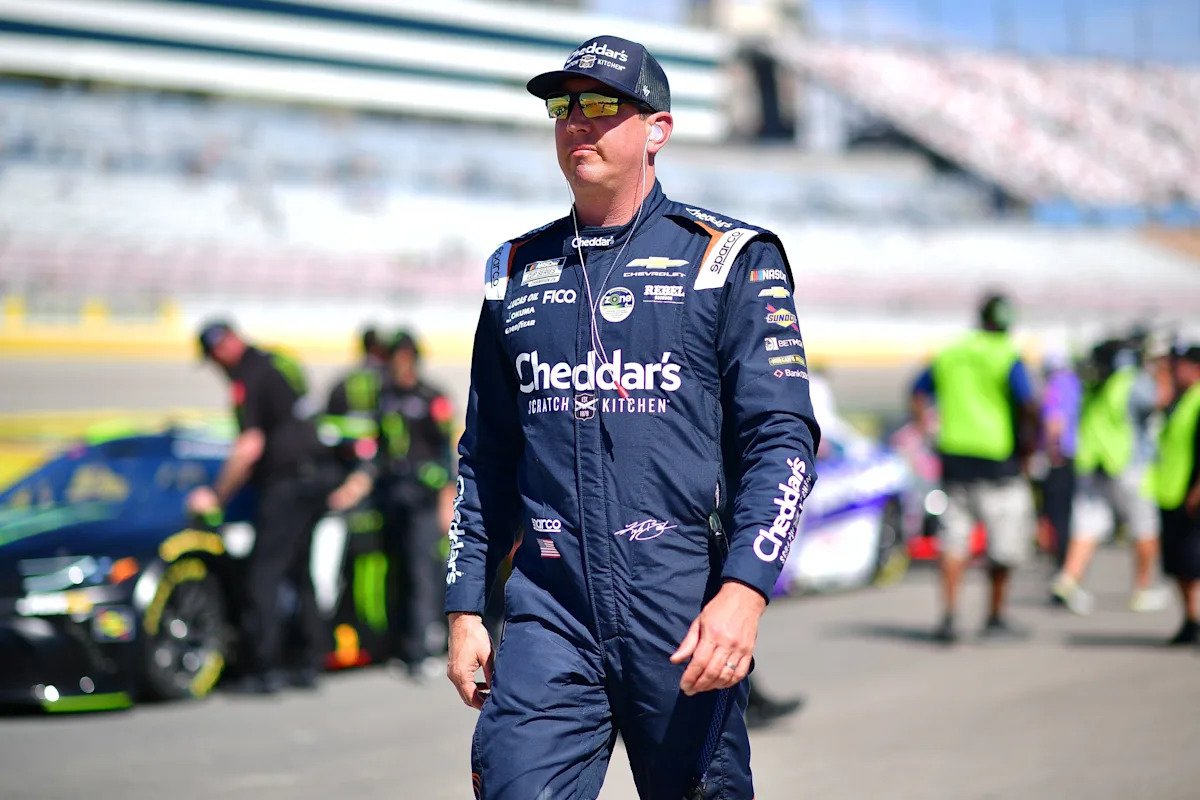
Kyle Busch spent 20 years being one of the most dominant drivers NASCAR had ever seen. Everybody knew he was going to be a first-ballot Hall of Famer. Heck, even NASCAR knew it. The sport called him a “future Hall of Famer” in the same statement announcing his death. The calls for him to be enshrined in the wake of his sudden death are growing.
There is just one problem.
Advertisement
Under NASCAR’s own rules, Busch isn’t eligible yet.
Busch, 41, collapsed at a General Motors facility in Concord, North Carolina on May 21. That was two days after the sport’s Hall of Fame voting panel announced the NASCAR Hall of Fame inductees for the Class of 2027. He died after severe pneumonia that progressed into sepsis. He was the first active NASCAR driver to die since Dale Earnhardt in 2001.
Now, the driver who had more wins across NASCAR’s top three national series has died before he was even eligible for its highest honor.
What happens now?


Why Busch is a Hall of Famer
Anyone who doesn’t follow NASCAR closely still knows Busch’s name. The sport runs three main national series. The Cup Series is the top level. Below it are the O’Reilly Auto Parts Series (formerly Xfinity Seris) and the Craftsman Truck Series. Most elite drivers focus almost entirely on Cup Series racing.
Advertisement
Busch did not.
He won 63 Cup races, ninth on the all-time list, and 234 races across all three series. That’s more than any driver in NASCAR history. He won Cup championships in 2015 and in 2019, both with powerhouse team Joe Gibbs Racing. He holds the all-time wins record in both the O’Reilly Series and the Truck Series. He was still racing, and winning, when he died. His most recent Truck Series win came less than a week before he died – May 15 at Dover Motor Speedway.
That Hall of Fame case is not it doubt.
The NASCAR Hall of Fame Rules
To be nominated for the NASCAR Hall of Fame, a driver must have competed for at least 10 years and have been retired for two years. Or, an active driver has to have reached age 55 to be nominated.
Advertisement
Under the normal process, the two-year clock would start now and he would be eligible for nomination in 2028 at the earliest and on track for induction as part of the Class of 2029.
That would be the normal timeline, if NASCAR doesn’t make a move.
The question is whether there should be an exception.
The calls for Busch to be enshrined immediately
Brad Keselowski, on of Busch’s fiercest on-track rivals for two decades, said what a lot of people in the sport were already thinking. “it’s very clear that Kyle is a first ballot Hall of Famer, and I don’t know why that needs to wait another year,” Keselowski said, calling for NASCAR to waive the waiting period and put Busch in immediately.
Advertisement
NASCAR CEO Steve O’Donnell didn’t commit to anything, but didn’t’ shut the door either. “I know that we put that on the list of ideas that we want to look at,” O’Donnell said. “Who knows, that could be something we look at.”
What NASCAR can do and why it’s complicated
The NASCAR Hall of Fame votes each spring for a class that gets inducted the following January. The Class just selected – Kevin Harvick, Jeff Burton and Larry Phillips – will be formally inducted on January 22, 2027. The next vote is not scheduled to happen until May 2027.
That give NASCAR roughly eight months to figure out how to handle this. There are three options on the table.
Advertisement
The first is adding Busch to the 2027 class alongside Harvick, Burton and Phillips. But some argue that night belongs to three drivers who earned their spots and have waited years for their moment. Harvick got 92% of the vote. Busch would overshadow that.
The second is a standalone induction. Waive the two-year rule and honor Busch separately, potentially timed around next year’s Coca-Cola 600 at Charlotte Motor Speedway, near his home and around the anniversary of his death. It’s a fitting tribute, but it requires NASCAR to rewrite its own rules on the fly with no framework for what comes next.
The third is waiting, let the calendar play out and let Busch’s nomination happen in 2028 and induction in 2029.


What has been done before
The closest comparison NASCAR has is Dale Earnhardt. His death in a last-lap crash at the 2001 Daytona 500 remains the most seismic moment in the sports’ history. Like Busch, his Hall of Fame induction was never a question.
Advertisement
But Earnhardt’s situation was different in one critical way. The NASCAR Hall of Fame did not exist them. It opened nine years after his death in 2010. The Motorsports Hall of Fame of America, a totally separate organization from the NASCAR Hall of Fame, received an immediate flood of calls demanding Earnhardt be enshrined right away. The board met and decided not to budge. They made his induction wait five years.
Other sports have made accommodations.
Baseball didn’t hesitate with Roberto Clemente. Just months after the Pittsburgh Pirates outfielder died in a plane crash on New Years Eve 1972, the Baseball Writer’s Association held a special election and waived the mandatory five-year waiting period. Clemente was inducted in March 1973.
The Hockey Hall of Fame waived its three-year waiting period for legends including Bobby Orr, Mario Lemieux and Wayne Gretzky. After Gretzky’s induction in 1999, the Hall tightened the rule, deciding only to bypass it under “certain humanitarian circumstances.”
Advertisement
The NASCAR Hall of Fame has inducted drivers posthumously before. Alan Kulwicki, the 1992 Cup champion who died in a plane crash in April 1993, and Davey Allison, who died in a helicopter crach three months later, we both inducted as part of the 2019 class. But, by then, both men had been gone for 26 years.
Busch was racing four days before he died.
This article originally appeared on USA TODAY: Kyle Busch NASCAR Hall of Fame: When and how he can be inducted

