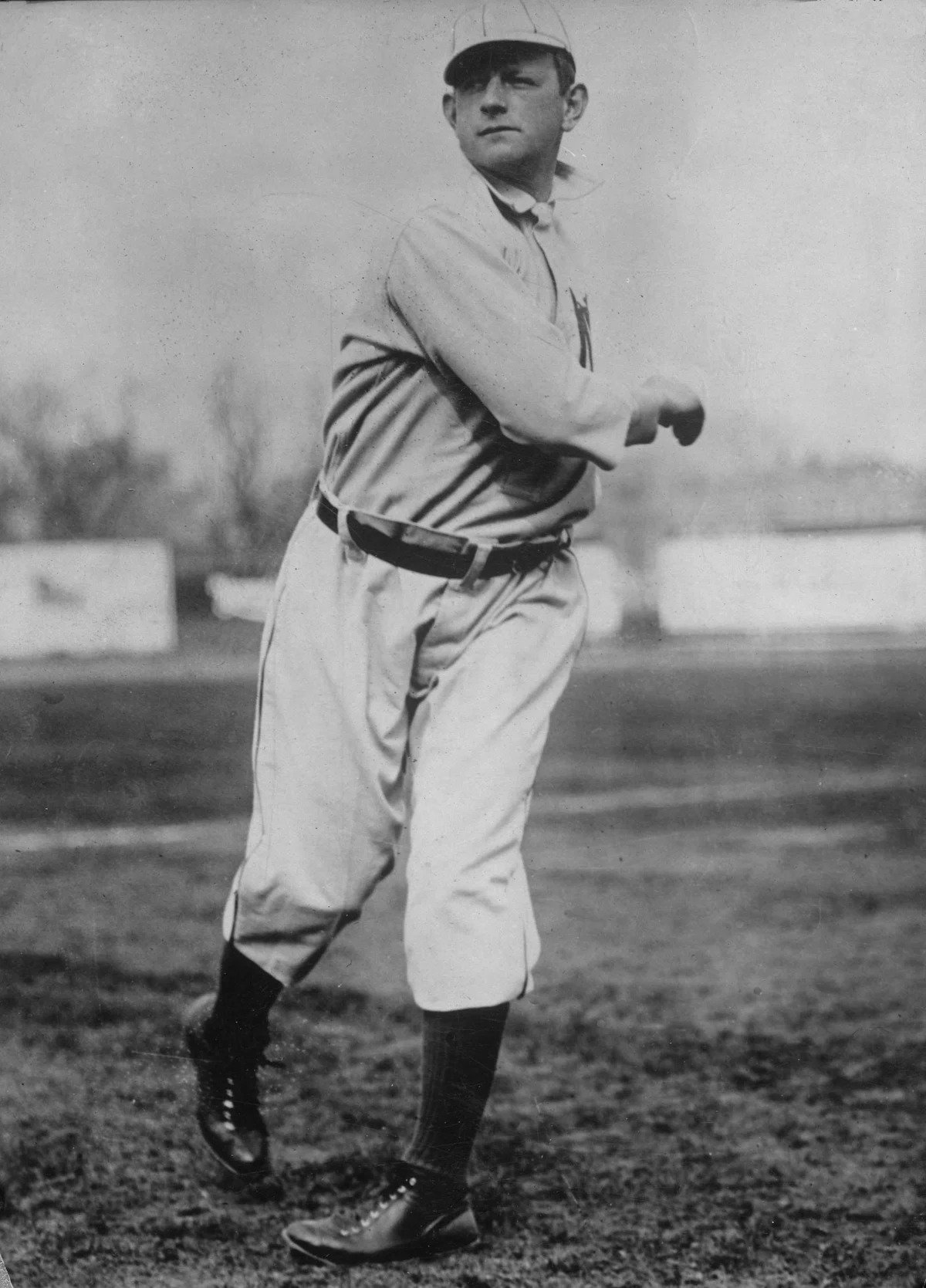
To many fans, Babe Ruth and Lou Gehrig represent the “beginning” of Yankees history, the first true stars whose performance at the plate kickstarted the first ever Yankees dynasty in the 1920s. But the Yankees did not emerge ex nihil when Ruth joined the team in 1920. Seventeen years prior, a new squad, named the Highlanders, introduced American League baseball to a city that had already had the Brooklyn Dodgers and New York Giants. In need of a star around which to build their team, the Highlanders brought in pitcher Jack Chesbro, giving him a $1000 signing bonus to defect from the Pittsburgh Pirates.
While he never won a World Series with the club, Chesbro goes down in history as the organization’s first-ever starting pitcher, and to this day remains the franchise record holder for wins a single season. On the strength of these accomplishments, we here at Pinstripe Alley ranked him 44th in our list of Top 100 Yankees.
Advertisement
Jack Chesbro
Born: June 5, 1874 (North Adams, MA)
Yankees Tenure: 1903-1909
Born in North Adams, Massachusetts, Chesbro got his start playing amateur ball in New England and upstate New York. He caught the attention of professional teams in 1895 while pitching for the Asylums, the ball club associated with the Middletown State Homeopathic Hospital, where “Happy Jack” Chesbro worked as an attendant. After that team folded midseason — not the last time it would happen before Chesbro made the majors — he bounced around the minor league circuit, pitching for the Albany Senators, Johnstown Buckskins, Springfield Maroons, Roanoke Magicians, Cooperstown Athletics, and Richmond Bluebirds, before getting picked up by the Pittsburgh Pirates in 1899. After a lackluster couple of months with the team, he was traded to the Louisville Colonels that offseason as part of a massive 16-player deal that included Honus Wagner…only to be reassigned to Pittsburgh later that same offseason when the Colonels went belly-up.
Chesbro spent three more years in Pittsburgh, helping lead the Pirates to consecutive NL pennants in 1901 and 1902. At that point, the new American League — founded just two years prior — began to offer higher salaries for players in order to entice them to abandon their NL contracts and sign with AL clubs. Offered $1000 to join the new team in New York, the Highlanders, Chesbro and his teammate Jesse Tannehill jumped ship, and after a truce was negotiated between the Senior and Junior Circuits, they officially became members of the new team.
On April 22, 1903, Chesbro took the mound in the Highlanders’ first ever, allowing three runs on six hits in nine innings, as New York lost to the Senators by the score of 3-1. He was largely effective in that first season in New York, winning 21 of his 40 appearances (36 starts) while posting a 2.77 ERA (112 ERA+), as he helped New York to a 72-62-2 record and a fourth-place finish.
Advertisement
His 1904 campaign, however, would go down in the history books. Armed with a new spitball and “slow ball,” Chesbro recorded 41 wins, which stands to this day as not only a Yankees record, but the modern Major League record (i.e., after 1901). Over the course of the campaign, he set a number of other franchise records, many of which took decades to be broken, and some of which likely never will: 51 starts, 454.2 innings, 48 complete games, 6 shutouts (still tied for ninth all-time), 14 straight wins (broken by Roger Clemens in 2001), 239 strikeouts (broken first by Ron Guidry in 1978). Between September 20th and the season’s end on October 10th, he made nine starts, tossing 124 innings in September and October alone. Thanks to his efforts, the Highlanders finished with a 92-59-4 record, and came in second in the American League.
Unfortunately, he was also a major reason the team had to wait until 1921 before winning their first pennant. Matt tells the full story in his biography of Chesbro from the Top 100 series posted above of the final inning between the Boston Americans (the future Red Sox) and the Highlanders (the future Yankees) in a before-the-Rivalry matchup on October 10th:
While Chesbro got two outs in the ninth, he had also allowed a single to Lou Criger, who would move up to third after that. One strike away from getting out of the inning, Chesbro uncorked a wild pitch on a 2-2 count, allowing Criger to scamper home and take the lead. The Highlanders couldn’t answer back in the bottom half of the inning, giving Boston a 3-2 win and the pennant.
In the days and years after the game, there was plenty of debate on who was at fault for the wild pitch. Chesbro’s wife published accounts after the pitcher’s death that stated that the pitch should’ve gone down as a passed ball on catcher Red Kleinow instead. Either way, what’s done was done and the Highlanders had come up short.
Perhaps unsurprisingly, Chesbro never lived up to that 1904 campaign ever again, as the wear and tear on his arm almost certainly took its toll. Even so, he remained the ace of the Highlanders’ staff through 1909, when he was released after posting a 6.34 ERA in nine appearances; he signed with Boston, made one appearance — perhaps uncoincidentally, against the Highlanders — before getting released again. While technically part of the organization through 1912 — Boston’s contract with Chesbro included a clause in which he was returned to the Highlanders if he was released before Opening Day 1910 — he never played professional ball again, as he refused to report to the minor leagues. While he did play a little bit of semi-pro ball after his career, he retired to his farm in New England (with one brief foray into coaching in 1924).
In addition to his pitching success, Chesbro does have one other claim to fame: the introduction of the suicide squeezeto Major League Baseball. Although the squeeze play seems to have existed at the collegiate level in the 1890s, Chesbro mistakenly interpreting the “bunt” sign as the “steal” sign while on third base; when Chesbro scored on the accidental play, the Highlanders manager allegedly took note of it and put it in the playbook.
Advertisement
Chesbro passed away in 1931 due to a heart attack while working on his farm, and would be inducted into the Hall of Fame fifteen years later by the Veterans’ Committee.
See more of the “Yankees Birthday of the Day” series here.

