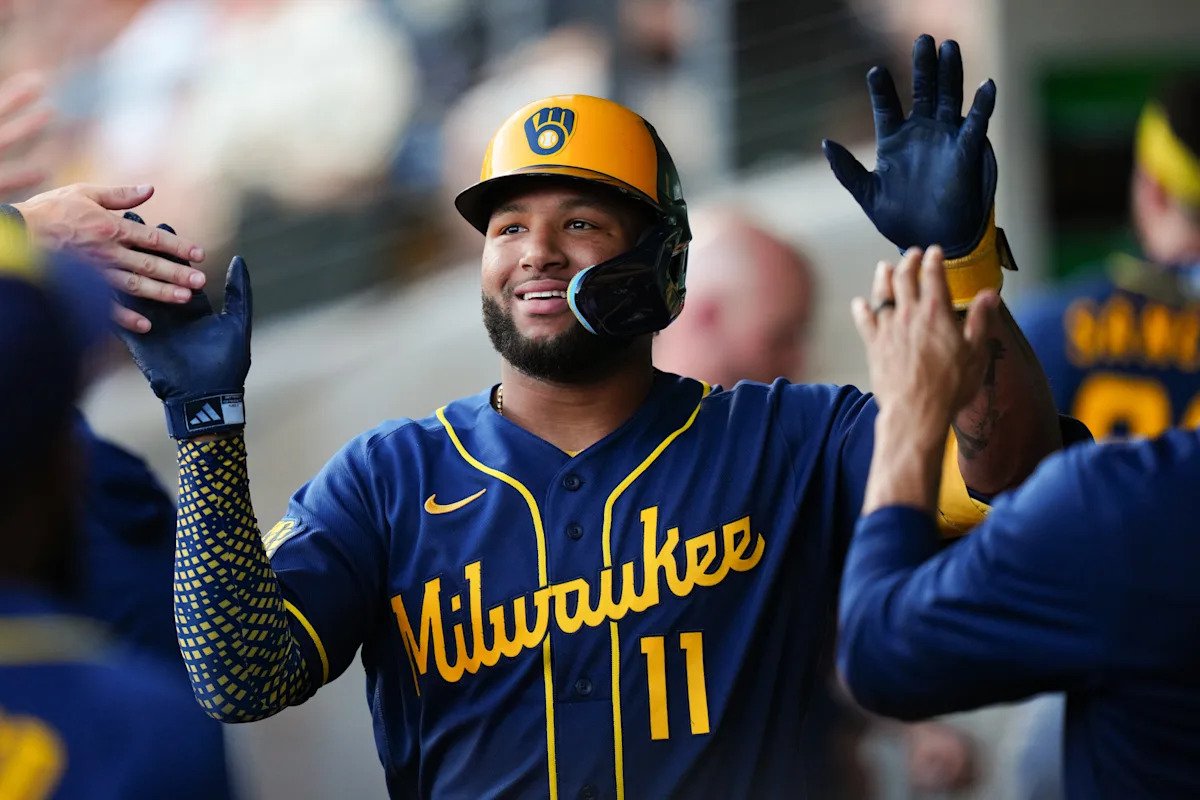
The theme of this week’s article on hitter skills and luck factors is about players with exciting tools for fantasy baseball. Typically, when we’re thinking of toolsy players, we’re talking about power and speed. Some of these hitters have been making adjustments to their profiles or earning more playing time. Meanwhile, other hitters have been showing similar skills.
Do the skills support the outcomes, or have they been fortunate? Should we buy, sell or hold these hitters for the rest of the season?
Advertisement
Jackson Chourio, Brewers (99% Rostered)
Jackson Chourio has been steadily providing 20+ home runs and 20+ stolen bases in his first two seasons. He is on pace for another 20/20 year this season. That said, Chourio’s .383 BABIP is inflating his batting average (.304). For context, Chourio’s BABIP is over 60 points above his career norm.
Chourio’s 77.3% contact rate is consistent with his career averages. However, his swing rate is down by four points (45.7%) with a 10.4% swinging-strike rate that’s within 1-2 percentage points below his career average. That makes Chourio a better option in leagues with batting average, though he is solid in OBP or points leagues.
Chourio tends to use an all-fields approach, which impacts his home run production. His 29% pull rate is down by six points, with an uptick in batted balls toward the center and opposite fields. However, Chourio is hitting more flyballs (41%) than his career average (36.2%), though it’s similar to 2025 (39.4%). A better and more consistent launch angle should help Chourio to barrel the ball more often, which is evident in his career-best 9.9% barrel rate per plate appearance.
Advertisement
There could be more home runs coming from Chourio, which might present a buying opportunity to be a step ahead of the projections.
Chourio hasn’t been caught stealing in five attempts, with a 13% stolen-base rate. He uses his near-elite Sprint Speed (89th percentile) to convert a high percentage of his steals while running often. If Chourio’s barrel rate helps the home runs go above the previous norms and he converts nearly all his stolen base opportunities, there is an upside scenario for him going 30/30 this year.
Don’t sell high based on the BABIP, because tools exist for more upside.
Pete Crow-Armstrong, Cubs (98% Rostered)
Through April, Pete Crow-Armstrong hit three home runs, stole six bases and posted a .241 batting average. Since May 1, Crow-Armstrong has been heating up, with eight home runs, eight steals and a .265 batting average. From the beginning of April through May 22, the Cubs moved Armstrong toward the bottom third of the lineup. Since May 23, Crow-Armstrong has been back in the leadoff or second spot in the lineup.
Advertisement
Through April 2026:
-
15.5% swinging-strike rate
Since May 1 (2026):
-
11.6% swinging-strike rate
Crow-Armstrong has been making more contact by chasing and whiffing less often since May 1. Though it’s only a one-month sample, Crow-Armstrong is making significant swing decision changes that should help his floor and consistency as a hitter. It has been reflected in Crow-Armstrong’s season-long 37.9% chase rate being 2-3 points below the career norm and his 68.6% zone swing rate dipping by over eight percentage points. The rolling averages below show a visual of those recent swing decision changes.
Pete Crow-Armstrong 15-game chase, zone swing and contact rate rolling average. (Photo by Corbin Young/FanGraphs)
From a power standpoint, Crow-Armstrong is swinging the bat harder (74.7 mph), up two mph from 2025. Furthermore, Crow-Armstrong’s 7.3% barrel rate per plate appearance aligns with his career norm. If he continues to make more contact and barrel up the ball, he can go on a home run binge.
Advertisement
Crow-Armstrong boasts a high 28% stolen base opportunity rate, which is 10 points below his career average. He typically converted 81% of his stolen base chances throughout his career, but it’s at 73% this season. I would expect his stolen base conversion rate to shift toward the career average.
There was skepticism about Crow-Armstrong’s fantasy outlook because of the plate discipline concerns. We’re seeing proof that Crow-Armstrong can make improvements in his swing decisions, but the question is whether he can sustain it. I’m leaning more on the optimistic side of things. Crow-Armstrong might not have a 30/35 season this year, but 25/30 is a likely outcome.
I would rather be early and buy into his swing-decision improvements, so he would be a target of mine if my team needed upside in the power and speed department, specifically in leagues with batting average.
Jarren Duran, Red Sox (96% Rostered)
Jarren Duran was sitting against some left-handed starting pitchers earlier in the season. Since May 1, Duran has been starting against all left-handed starting pitchers out of the leadoff spot. He has been unlucky with a .263 BABIP, which impacts his low .210 batting average. That’s a 50-70 gap between Duran’s career BABIP (.332) and batting average (.260). Besides Duran’s BABIP, he has been struggling to make contact.

Jarren Duran’s rolling BABIP, contact rate and o-contact percentage 15-game average. (Photo by Corbin Young/FanGraphs)
That’s been evident by Duran’s 66.5% contact rate and 15.8% swinging-strike rate. Both Duran’s contact and swinging-strike rate would be the worst since his rookie season. However, it’s worth noting that Duran’s 82.2% zone contact rate is over four points below his career norms. That said, Duran’s overall contact could regress back toward the career averages, especially since he has a career-low 41.1% O-Contact%, meaning he isn’t making as much contact outside the zone this season.

Jarren Duran’s rolling 15-game pull rates. (Photo by Corbin Young/FanGraphs)
Duran has been pulling the ball significantly more this season. His 44.1% pull rate is over eight percentage points above his career norm (35.5%). That coincides with Duran’s career-best pulled air rate (15.9%) after a 15.2% pulled air rate in 2025. All but two of Duran’s home runs have been toward his pull side with a 101.8 mph average exit velocity on pulled flyballs. That’s a helpful approach to pull the ball more, adding to his power ceiling with a career-best 7% barrel rate per plate appearance.
Advertisement
Duran runs often, with a 22% stolen base opportunity rate. He has been known for his speed (93rd percentile Sprint Speed) and athleticism, helping maintain a high stolen base conversion rate at 85% in his career. Duran’s speed and high conversion rate should help him reach 25+ stolen bases.
Assuming Duran’s BABIP regresses favorably and his plate discipline shifts back to the career norm, Duran should see his batting average be more toward .250 to .260. The most optimistic parts of Duran’s profile involve him pulling the ball more and hitting the ball harder. The likely scenario is 20/25, but there’s a ceiling for 25/30, as seen in 2024.
Bryce Eldridge, Giants (17% Rostered)
In Bryce Eldridge’s first two weeks (14 games), the Giants faced 13 right-handed starting pitchers. Eldridge started in eight of those 13 games, making us wonder about why the Giants called him up if they were going to limit his playing time as a strong-side platoon option. Since Eldridge’s first two weeks, he has been playing more regularly, including in five of six games against a left-handed starter. More playing time helps us have confidence in Eldridge’s tools, helping to produce fantasy value.
Advertisement
Eldridge has a high-end 79.8% contact rate and a 9.5% swinging-strike rate. He has an above-average bat speed (73.5 mph) and a 6.4% barrel rate per plate appearance throughout his MLB career. Eldridge is pulling the ball (42.3%), especially in the air, leading to an above-average 21.1% pulled-air rate. That’s optimal to hit more home runs, though Eldridge plays in the worst home park in Statcast Park Factors for home runs for left-handed hitters.
Eldridge had 70- to 80-grade power as a prospect, which has been showing up in his early MLB sample. There’s the potential for 25-30 home runs in Eldridge’s bat, though the home park will limit him. He has been fortunate, with a .358 BABIP boosting his .298 batting average. Most projections expect his BABIP and batting average to fall. However, Eldridge makes plenty of contact while hitting the ball hard, supported by his .299 xBA.
He has power, and thankfully, he has been playing more often, which means he should be a priority pickup in deeper formats. If fantasy managers stashed Eldridge, it’s positive to see him earning regular playing time.
Advertisement
Willy Adames, Giants (85% Rostered)
Willy Adames has been picking it up over the past month. Through April, Adames hit three home runs, zero steals and a .197 batting average. Since May 1, Adames has hit eight home runs, one steal and a .265 batting average. Adames has been striking out less, from 31% through April to 25.8% since May 1. Most of the underlying metrics were similar through April and since May 1, but it finally turned into production, hinting Adames was unlucky earlier in the year.
Adames’s plate discipline has been similar to the career averages, besides his zone swing rate dipping to a career low (65.2%). That coincides with Adames’ chase rate increasing to 32.4%. Both were 3-4 percentage points within his career averages. With Adames chasing more than recent years, it’s impacting his walk rate to a career low at 5.9% after a double-digit walk rate in three straight seasons (10-11%). Maybe Adames was pressing earlier in the season.
Advertisement
Meanwhile, Adames’ batted ball profile looks nearly identical to the recent seasons, with his high pulled air rate (26.5%). He continues to hit the ball hard and boasts an above-average barrel rate per plate appearance (6.3%). After scaring fantasy managers earlier in the season, Adames has been turning it around to put him on pace for 25-30 home runs and 7-10 stolen bases.
This is a case where we want to trust his extensive track record, especially if they have a stretch of being unproductive.

