The New York Knicks had been here before. As Jalen Brunson and his band of not-so-merry men stood at the top of this year’s NBA finals, they confronted not just the San Antonio Spurs, their foe on the court, but the very idea of what the Knicks themselves – as a team, as a franchise, as a symbol of New York City – could be. The team’s run to last year’s Eastern Conference finals was thrilling but had the aspect of an underdog romp, and ultimately ended in defeat. Was this the limit of what New York’s fans, Rabelaisian in their rages and saintly in their endless capacity for patience, could expect from their team? Brunson was dogged and clever but perhaps not quite elite, a Stakhanovite toiler in a league built for transcendent talents. Karl-Anthony Towns was elite but perhaps too soft, too sensitive, too “zesty” to carry a team to the NBA’s pinnacle. The questions hanging over the leading pair extended to a team forged in their image. The lineup was good; was it great?
Coach Mike Brown, in his first year with the franchise, had promise but no small amount of baggage, having landed at the Knicks after being dismissed by the Sacramento Kings following a horror start to the 2024/25 season. And then, of course, there was the weight of history: no title since 1973 and a litany of near-misses and false dawns in the intervening decades. New York had watched through the 1980s and 1990s as first Los Angeles, then Chicago (under the guidance of its own son, Phil Jackson, who won the 1973 championship as a Knick) propelled the NBA to global prominence, a narrative in which the Knicks filled the role of a dutiful punching bag. Hakeem Olajuwon’s block on John Starks to kill their hopes in 1994, the tragic heroism of Patrick Ewing, death by Tim Duncan in ’99, and all the fizzled promise of Carmelo and Stoudemire and Linsanity: the memories had faded but the scars lingered. The franchise was destined, it seemed, to remain forever on the fringes, a mournful witness to others’ joy. Could they do it? Surely they couldn’t: the curse of the Knicks had driven the fans, the team, the city itself to despair. Neurosis, not success, was hardwired into New York’s psychology. The center of the universe and the joke of the NBA: the city was Larry Fink off the court, and Larry David on it.
Advertisement
Related: Ecstasy and chaos grip New York City after Knicks win long-sought NBA title – in pictures
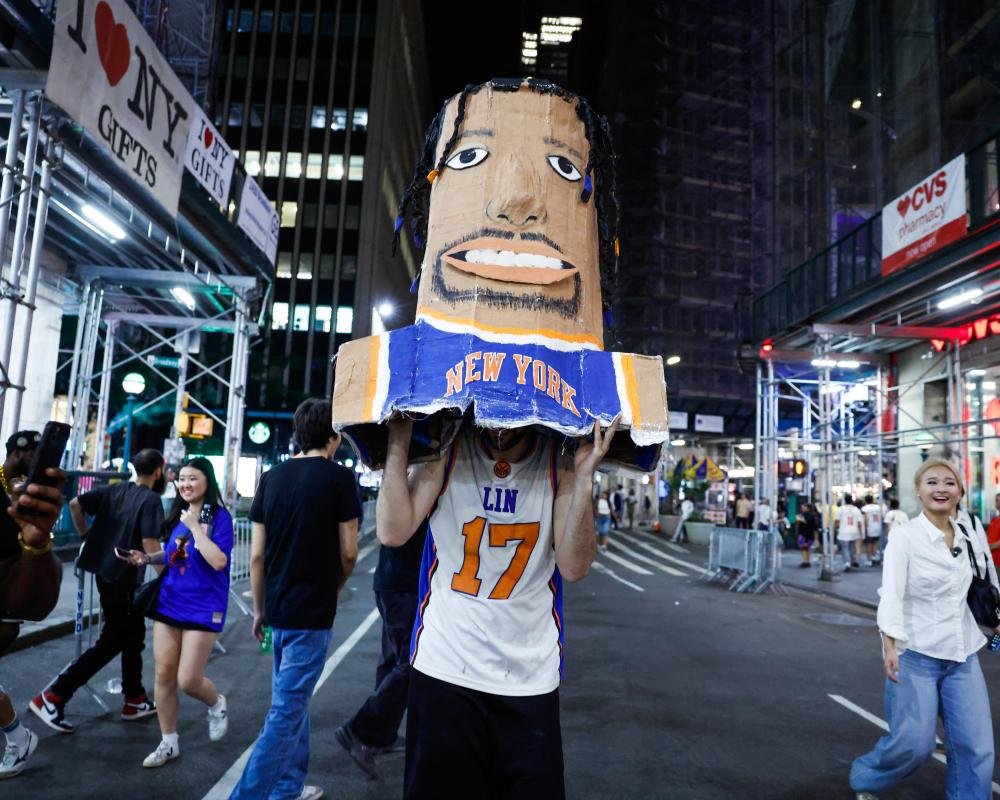
Could they do it? They could. Swatting away a half century of hurt, building on the inevitable momentum gathered from their historic comeback in Game 4, and riding their city’s early summer wave of boisterous (though possibly astroturfed) invention, the Knicks are NBA champions for the first time in 53 years. My Christian Dior, Knicks in four? Not quite. But 4-1 supplies an exorcising symmetry, mirroring the scoreline by which the Knicks fell to the very same opponent on their last trip to the finals in 1999. And the rhyme scheme is better this way: they got there in five, and the NBA is alive.
These were the second most-watched finals in NBA history – a testament not only to the size and cultural heft of the New York media market but to the rippling character of the entertainment on the court. Saturday night’s clincher distilled the series as a whole. The Spurs stormed to an early lead (as is their wont) and failed to hold on to it (as is their wont). Dylan Harper – finally given some time to run the play in place of the maligned De’Aaron Fox, the Spurs’ Game 4 scapegoat – hit a series of silky midrangers, and Julian Champagnie got into his groove from beyond the arc. Victor Wembanyama did what Victor Wembanyama does, which is cry and cajole and be much taller than everyone else. San Antonio’s divine linguine unfurled a volley of blocks, and then came those trademark second and third and fourth tips, which give Wemby the air of a stalled windmill or an unnailed Jesus, arms held out in supplication as the ball rebounds off his outstretched hands and cannons back towards the basket. At times Saturday night, as throughout these finals, he was tipping almost totally to himself, playing a game of one in the rare air above the rim. The Spurs’ lead stretched to 15 midway through the third quarter. The French star’s bullish pre-game predictions about a title in seven (“Everybody knows we’re gonna do it”) seemed on course to come true.
And then: San Antonio met their unsmiling assassin. Brunson went the full Bunsen, embarking on a historic second-half scoring spree to comprehensively incinerate the Spurs’ hopes of extending the series to a sixth game. Brunson was unanimously named finals MVP virtually the moment the game ended, and it’s no wonder: he had the highest-scoring finals series from a point guard in NBA history, and became just the second player in 50 years to record a 45-point closeout game in the championship-deciding series. Michael Jordan did it at the age of 35 in Game 6 of the 1998 finals, his last appearance for the Bulls; Brunson has done it at 29, and only a fool would bet against him replicating Saturday night’s outrageous punctuating stomp of a performance in future finals series.
Advertisement
Part of what makes these Knicks so fun to watch is how steely and unemotional they are, both on and off the court. Where other teams mince and peacock, they downplay and deflect. They’re a quiet team for a loud city: while Wembanyama was busy declaring “we’re gonna do it”, Brunson remained steadfast that the Knicks’ mentality going into Game 5 would be “zero-zero”. But amid all the “application” and “grit” – the two words that are usually thrown around to describe this champion ensemble – there’s a real craftiness there too, combined with an insatiable appetite for the game. More than any other title-winning team in recent NBA history these players love being on the court, and seem quite happy to make playing basketball the focus of their ambitions. They don’t dream of horses in Serbia or their next brand partnerships as they play; they dream of basketball.
Brunson is the soul of the team’s commitment, to each other and to the game, but he’s also something singular, a ball of gristle and will who blooms into grace and artistry just as you’re convincing yourself his game is all about graft. There’s a real density to his physique, which has offered a pleasing visual contrast over the course of these finals to Wembanyama’s reedy elasticity. The right shoulder – dropped and tucked as he barrels into the paint – and the left knee – raised with the delicacy of a drinking pinkie as he steps back to shoot – are Brunson’s main physical weapons, and he deploys them to devastating effect. Time and time again these finals we saw Brunson beaver and fend and bustle into the mix then pull back, the angles aligned to his satisfaction, for one of those impossibly high and gymnastic shots, the ball easing through the net as if with a sigh. This is the Jalen Brunson Guarantee: where there is bullying, there is also beauty.
Brunson, remember, is just 6ft 2in, and on court he looks even shorter. Much of his best offensive work in the finals was performed under the pressure of a double team and facing the attention of Wembanyama, who has more than a foot on him in height. A man of Brunson’s comparatively slight stature is not supposed to excel in basketball – in an earlier era perhaps, but not in the modern NBA, where the bigs handle the ball like point guards and the direction of physical travel is up, up, up. Yet here we are. A series that began with tremors of anxiety about how to stop a 7ft 4in freak of nature – and what it would do to the sport for such an outlandish and improbable talent to dominate the league for years to come – ends with the primacy of the human, the dogged, and the squat emphatically reaffirmed. The time of the short kings is upon us.
This was not a title built on the talents of one man alone, of course, but on speed in transition, blistering ball movement and a kind of sacrificial defensive commitment in the paint that recalled, at times, the very best of the Knicks’ brutish 1990s pomp. OG Anunoby, a fortress in defense, will best be remembered in these finals for his last-second tip to win Game 4, now destined to become the defining image of the Knicks’ historic charge to the summit. Towns, the No 1 pick in the 2015 draft who came to the Knicks in 2024, finally silenced the critics (of his game, of his voice, of his personality, of his everything) and picked up the title his rich talent deserves. Josh Hart is a noted menace under the glass but his best work these playoffs came from pushes in transition. In many ways he is the most violently lateral player in the NBA, a man whose guiding ambition seems to be to traverse the court’s 94ft of hardwood parallel to the ground. Some players glide across the floor; others juggle or dance or storm. Hart torpedoes. Mitchell Robinson played an important support role, receiving Wembanyama’s (now plainly incorrect) Game 4 taunt that he was “in” Robinson’s “head” and supplying the comic relief with his delightfully awful free throws.
Advertisement
Like Brunson, many of these players are around 30, and many of them have taken similarly winding paths – filled with doubt and public mockery – to basketballing nirvana. Can they stick together and build a dynasty? The back office arrangements are in their favor, but the recent history of the NBA, with no repeat champion since 2018, suggests it will be tough. The Spurs, with two recent first and second picks on the roster, are bursting with talent and youth. All they need is to figure out how to protect a lead, score in the fourth quarter and not pass into each other’s backs.
Related: ‘It’s euphoria’: New York City celebrates Knicks’ NBA title win after 53-year wait
After the gloom of the past few years – the negativity surrounding the league’s clammy accommodations with oil powers and private equity money; the “small town” finals featuring teams from Oklahoma City and Indiana; and the worries over tanking, the strategy by which franchises have tried to game the draft through regular-season failure – these finals brought a rinse of glamour back to the NBA. The series had the contrast of brilliant youth (San Antonio) against grizzled experience (New York); it had prodigious height (Wemby) and alien application (Brunson); it gave us TayTay, Hargitay and Chalamet in the front row, amped and activated into their LET’S GOs after every OG block and Landry Shamet three. In its hysteria, magnetism and sheer fizzing celebrity power, it reached back to the league’s halcyon days, summoning the tap and dazzle of Showtime and Jordan’s Bulls. More than just a basketball series, this felt like a cultural event – the type of thing that will define an era, or at the very least provide easy visual fodder for the documentarians in years to come. (“The 2020s: when fascism came to America, democratic socialism stormed New York, and the Knicks won their first title in half a century.”)
Most of all, this series had what the NBA has been quietly craving for five decades: a title for the biggest and baddest city in the land, a place with basketball in its blood and precious little silverware to show for it. This was a victory for holding on, for believing, for never giving up, for letting San Antonio implode. But it was also a victory for New York City – for all the fans who’ve spent decades living the particular psychodrama that is the Knicks, glued to the misery, resigned to the worst. A new sun is shining on pickup games across Elmhurst, Canarsie, Sheepshead Bay and Mott Haven. For years, the Knicks have watched as other teams and other cities write the NBA’s story. Now, New York ascends.

