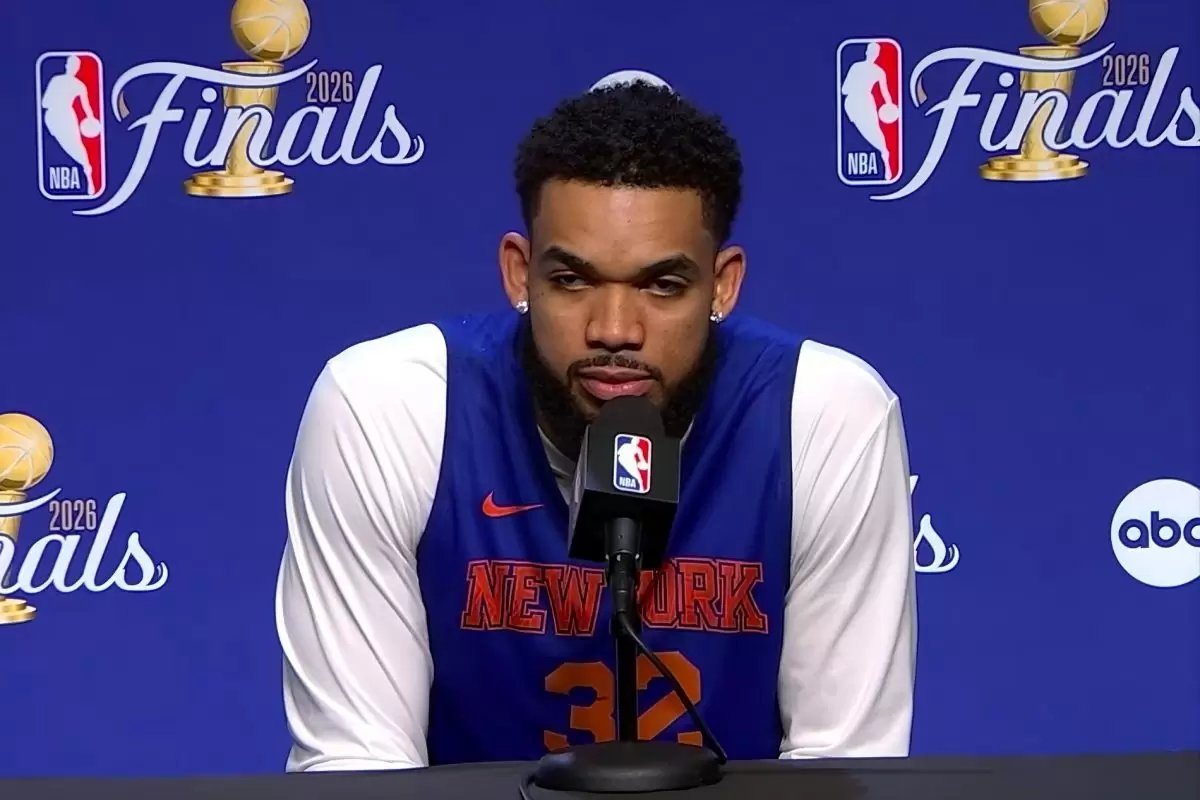
Half a century of grit, heartbreak, and praying for a savior at the Mecca. As the blue and orange confetti finally settled on the hardwood of Madison Square Garden, the roaring silence of a five-decade drought was replaced by a singular, undeniable truth: the story isn’t just about the hardware; it’s about evolution. And if we are talking about evolution, we have to talk about Karl-Anthony Towns.
For generations, Madison Square Garden stood as a cathedral of unrequited love. Since Red Holzman, Walt Frazier, and Willis Reed captured the franchise’s last NBA championship in 1973, New York basketball fans wore their loyalty like a badge of beautiful, exhausting suffering. Empires rose and fell across the league, yet the Mecca remained trapped in a perpetual cycle of high hopes and agonizing collapses. Every blockbuster trade was heavily weighed down by the crushing expectations of a fan base desperate for an interior anchor who could withstand the heat.
When the front office executed the seismic trade to bring Karl-Anthony Towns to Manhattan, the outside noise was deafening. Critics questioned his grit, defensive focus, and whether a seven-foot spacing big could handle the unforgiving lights of New York. But this transformation wasn’t a sudden, overnight pivot. The internal foundation of a professional had been laid long ago, in the cold gyms of Minnesota, under the watchful, demanding eye of Hall of Famer Kevin Garnett.
Learning How to Be a Pro
Years before Towns ever pulled a Knicks jersey over his shoulders, Garnett saw the blueprint of greatness hidden within the young center. “He’s the future,” Garnett told Brandon Scoop B’ Robinson back when KAT was first asserting himself in the league.
The Big Ticket recognized an immediate kinship, noting, “When he came into it, I see a lot of similarities in Karl to myself. If I could ever be an inspiration and lead him into that, I’ve always wanted to be that.”
The blueprint Garnett handed down wasn’t just about pick-and-pop spacing; it was about the brutal, everyday psychology of professional basketball. Karl Towns Sr. later confirmed on the Scoop B Radio Podcast that having KG in the locker room was the catalyst his son needed, stating flatly that “Garnett taught Karl how to be a pro.”
Towns internalized those lessons early on. “He continuously told me to be patient,” Towns recounted of his time working with the legendary forward. “Being patient on the court, everything will begin to slow down. I mean, just how to be a professional, how to be a professional in this game on and off the court. Just to do my best to lead, and that’s the biggest thing.” That patience and leadership, marinated over a decade of league battles, finally bore its ultimate fruit on the game’s biggest stage.
The Metamorphosis in the Trenches
While the regular season featured the historic, stat-sheet-stuffing performances that defined his career, his championship mindset fully crystallized in the first round of this postseason run. The Knicks were locked in a physical war of attrition against a relentless Atlanta Hawks squad. When New York finally clinched a hard-fought Game 6 elimination victory on the road, the relief was palpable, but Towns’ focus remained entirely unbroken.
Following that emotional Game 6 win, I asked Towns if any historical playoff matchups from his youth came to mind as he carried the interior burden for this franchise. He bypassed the modern spacing comparisons and pointed directly toward a more punishing era of basketball history.
“You grow up, you’re watching in my era, you’re watching the Lakers win with Shaq and Kobe,” Towns told Scoop B Robinson. Seeing him stand on the podium over the weekend and proudly holding the Larry O’Brien trophy aloft with tear-filled eyes, those words hit entirely differently. Evaluators always wanted him to strictly be a perimeter threat—a seven-foot sniper who stayed clear of the paint. But in the deepest trenches of this postseason, Towns tapped into that raw, inner-child fandom. He didn’t want to float; he wanted the Shaq moments.
He initiated contact, dominated the low block, fought through double-teams, and threw his body into the physical, paint-dwelling possessions that a championship demands. The lazy narrative that he lacked the internal toughness for the postseason was completely dismantled.
Full Circle: The Mecca Has Its Anchor
There is a profound, poetic beauty to how this journey has come full circle. From being labeled “the future” by Kevin Garnett to fulfilling that destiny in the heart of the Big Apple, Piscataway, New Jersey’s own Karl-Anthony Towns brought the gold back home to the city that needed it most. The long, fifty-three-year winter is officially over. The Mecca has its anchor.
The Big Apple is golden again.
“And for me as a big man, I just wanted to dominate the game like Shaq. Especially in these moments.” — Karl-Anthony Towns

