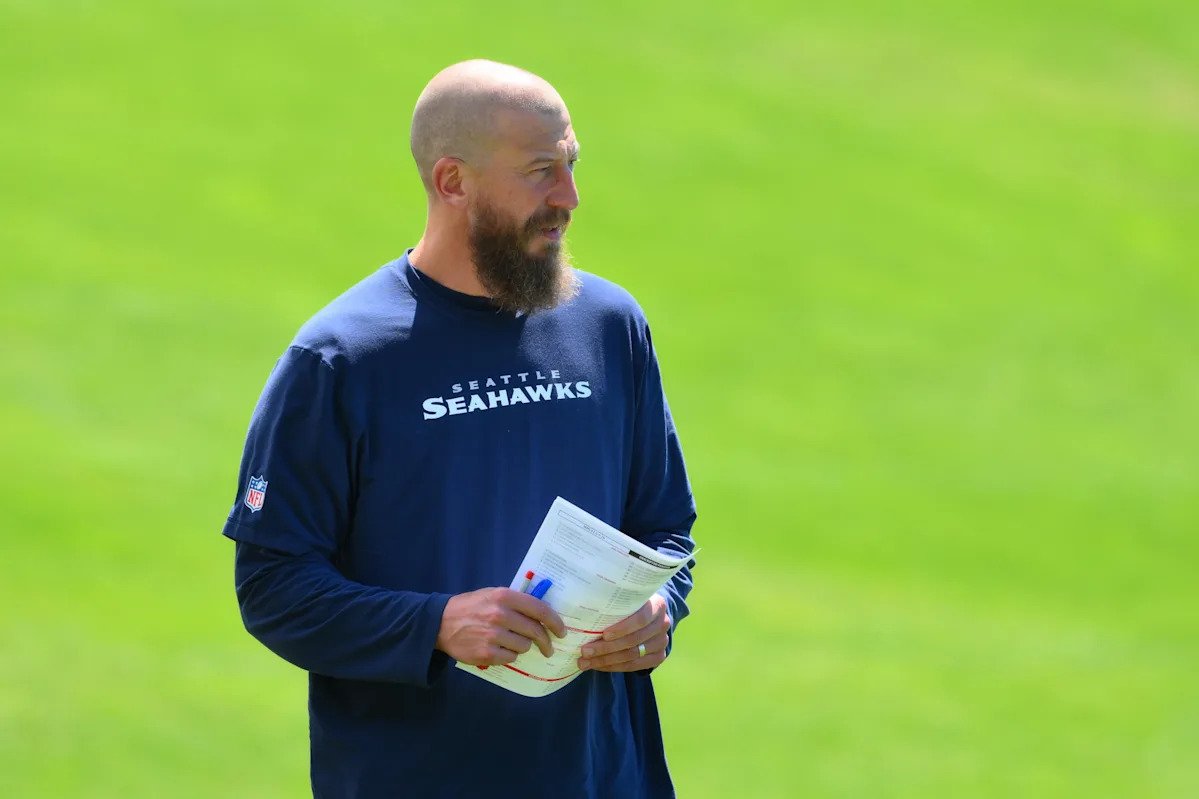
The Seattle Seahawks are entering one of the more fascinating offensive transitions in the NFL this season.
When Klint Kubiak departed after helping establish a clear offensive identity in Seattle, the obvious question became whether the Seahawks could maintain that momentum under new offensive coordinator Brian Fleury.
Advertisement
The answer isn’t simple.
Kubiak’s influence on the offense was immediate. Seattle leaned heavily into the run game, married its passing concepts to play-action, and consistently used motion and formation variation to put defenders in conflict. The result was an offense that often made life easier on the quarterback while creating favorable opportunities for its skill players.
Replacing that kind of impact is never easy.
At the same time, Fleury’s promotion doesn’t carry the same uncertainty that surrounded Ryan Grubb’s arrival a few years ago. Grubb was tasked with making a difficult jump from the college game to the NFL, and Seattle often looked like an offense trying to fit pieces into a system rather than building a system around its personnel.
Advertisement
Fleury enters under different circumstances.
While he has never served as an NFL play-caller, he has spent years working within offenses that share many of the same principles Seattle wants to preserve. His extensive background coaching tight ends and his experience in run-oriented systems provide legitimate reasons for optimism.
Of course, optimism and production aren’t the same thing.
Until the games begin, Fleury remains one of the biggest unknowns on Seattle’s coaching staff.
But every coordinator change creates opportunities, and a handful of Seahawks appear particularly well positioned to take advantage of this new chapter.
Advertisement
Elijah Arroyo could be the biggest winner
If there is one player whose skill set seems tailor-made for Fleury’s background, it’s tight end Elijah Arroyo.
Long before becoming Seattle’s offensive coordinator, Fleury built his reputation coaching tight ends. Throughout his NFL career, he worked with a wide variety of players at the position, helping maximize both traditional in-line blockers and athletic receiving threats.
Arroyo falls firmly into the latter category.
His combination of speed, burst, and movement skills gives him a profile unlike any other tight end currently on Seattle’s roster. At Miami, he was deployed in multiple alignments, operating from the slot, moving across formations before the snap, and occasionally functioning almost like a wide receiver.
Advertisement
That versatility matters.
The modern NFL increasingly values tight ends who can stress defenses horizontally and vertically, creating matchup problems against linebackers and safeties. Arroyo’s athletic profile gives Seattle exactly that type of weapon. And can help him to improve his blocking skills.
More importantly, Fleury’s coaching background suggests he understands how to create opportunities for players like him.
The second-year player may not immediately post eye-popping numbers, but it’s easy to envision a scenario where Arroyo becomes one of the most dangerous mismatch pieces in Seattle’s offense before the season is over.
Advertisement
AJ Barner may have another level to reach
AJ Barner’s breakout campaign in 2025 changed expectations.
What initially looked like a dependable complementary tight end evolved into one of the Seahawks’ most reliable offensive players. His blocking continued to improve while his development as a receiver expanded his role significantly within the offense.
Now comes the next challenge. The focus is no longer proving he belongs, it’s discovering just how much more responsibility he can handle.
Few offensive coordinators step into the role with a deeper understanding of the TE position than Fleury. Years spent coaching the position have given him firsthand experience creating advantages through formations, personnel packages, route combinations, and alignment flexibility.
Advertisement
That could unlock another layer of Barner’s game.
His value extends beyond any single responsibility. He can stay on the field in virtually every situation because he contributes as a blocker, pass protector, and receiver. Players with that level of versatility often become foundational pieces in Shanahan-inspired offenses.
Those systems frequently treat tight ends as core components rather than secondary options. They help sell the run, create hesitation from linebackers, and often emerge as some of the most efficient targets on the roster.
Barner already made a substantial leap during his first two NFL seasons.
Advertisement
Under Fleury, there is a realistic path for another one.
Jadarian Price could become the centerpiece of the running game
The Seahawks didn’t spend a first-round pick on Jadarian Price without envisioning a major role.
His physical talent jumps off the screen. The acceleration, lateral explosiveness, and ability to create chunk plays are all evident.
The question is how quickly Seattle can put him in position to succeed.
Fortunately for Price, the offensive philosophy expected under Fleury should help.
Many offenses rooted in the Shanahan coaching tree are designed to generate advantages before the running back even receives the handoff. Motion, condensed formations, misdirection, and play-action all work together to manipulate defenders and create cleaner running lanes.
Advertisement
When executed correctly, the running back is often able to make faster decisions and attack space before defenses can recover. That environment seems particularly suited to Price’s strengths. His explosiveness allows him to capitalize on even small openings, while his ability to accelerate through the second level can quickly turn routine gains into explosive plays.
Talent alone won’t guarantee success, but if Seattle maintains the structural efficiency that defined its offense in recent years, Price could quickly emerge as one of the focal points of the entire unit.
Rashid Shaheed could post the biggest statistical jump
While Arroyo may be the most intriguing schematic fit and Price could become the face of the running game, Rashid Shaheed might have the clearest path toward a major increase in production.
Advertisement
One of the most overlooked aspects of offensive development is familiarity.
Players often make their biggest leap not when they first learn a system, but when they enter their second year within it.
That’s where Shaheed finds himself.
After arriving in Seattle, he spent much of last season adjusting to new terminology, new responsibilities, and a different offensive structure. Now he enters the year with a full offseason of experience and a much stronger understanding of how the offense operates.
Even with a coordinator change, Seattle is expected to retain many of the principles established under Kubiak, including heavy play-action usage, pre-snap motion, and vertical passing concepts built off the threat of the run game.
Advertisement
That combination should benefit Shaheed tremendously.
His speed has always been his defining trait. The challenge for defenses comes when that speed is paired with an offense capable of forcing safeties to hesitate for even a fraction of a second.
In those moments, explosive plays follow.
Shaheed has repeatedly shown throughout his career that he doesn’t need high volume to make a significant impact. A deeper understanding of the system combined with another offseason of refinement could set the stage for the most productive season of his career.
Final thoughts
It’s natural to search for a single winner whenever a team changes offensive coordinators.
Advertisement
Maybe it’s the quarterback. Maybe it’s a breakout receiver. Maybe it’s a young running back poised for stardom.
Seattle’s situation feels different.
Brian Fleury isn’t being asked to tear down the offense and build something entirely new. The expectation is that he’ll preserve many of the principles that made the Seahawks successful under Klint Kubiak while adding his own influence through years of experience coaching tight ends and operating within run-first, play-action-based systems.
Because of that, the biggest beneficiary may not be one player at all.
The real challenge for Fleury will be creating an environment where Arroyo, Barner, Price, Shaheed, and the rest of the offense can grow together.
Advertisement
That’s ultimately how the league’s best offensive coordinators are judged. Not by elevating one star, but by building a system that elevates everyone.
If Fleury can accomplish that, the biggest winner of Seattle’s coordinator change won’t be a single player; it will be the entire offense.

