The Las Vegas Aces and Phoenix Mercury were five seconds from overtime in Game 3 of the 2025 WNBA Finals at Mortgage Matchup Center.
With the score tied at 88 and Las Vegas with possession, Phoenix needed to defend in regulation to avoid a 3-0 series deficit.
Advertisement
Four-time WNBA MVP A’ja Wilson had other plans.
She cut across the paint to catch an inbounds pass from Chelsea Gray. Wilson stopped at the top of the elbow where she was met by an Alyssa Thomas–DeWanna Bonner double team. Wilson sized up Bonner and dribbled towards the basket with the Mercury forward plastered to her right shoulder. Her next move was generations in the making.
Wilson stopped, pivoted and launched a fadeaway jumper over Thomas and Bonner. Her shot dramatically ping-ponged around the rim before it bounced in, quietly carrying the hopes and dreams of an entire league that had worked decades for that moment. Still, the 6-foot-4 center didn’t stop to celebrate. She jogged towards the other end with her mouth agape and tongue out.
Moments after Wilson’s shot fell, she clapped. Her clap was so loud and forceful amid a noticeably stunned Mortgage Matchup Center that it could be heard several feet above the court. Wilson was clapping for herself and her team, but also applauding for the many players who came before her and those in the future.
Advertisement
“To see that I’m now a huge print on this league, it’s just been surreal,” Wilson told USA TODAY Sports.“My thing is just like, ‘How can I be great? How can I continue to lay the path down for the next generation,’ because the path was laid down for me, no matter how easy or how hard it was?”
As the WNBA celebrates it 30th anniversary, the once-fledgling league has evolved from its 1997 launch into a global fixture in women’s sports. The WNBA is a thriving league backed by record attendance, rising salaries and unprecedented media attention. That foundation was built by trailblazers like Sheryl Swoopes, Cynthia Cooper, Rebecca Lobo and Lisa Leslie, whose elite talent and credibility legitimized the league.
The league was carried forward by other icons such as Diana Taurasi, Maya Moore, Sue Bird and Tamika Catchings, who elevated the standard of excellence. Today’s stars, like Wilson, Breanna Stewart, Caitlin Clark and Paige Bueckers, are pushing the game to new heights. Still, they stand on the shoulders of generations who fought for investment, respect and opportunity.
Advertisement
“I knew that we had to lay a solid foundation in order for the WNBA and little girls to be able to dream of playing professional basketball, and now, we’re here,” said Cooper, who helped the Houston Comets win the first four league titles. “To see the talented athletes like the A’ja Wilson’s and the Caitlin Clark’s and the Angel Reese’s, and now the new talent coming in, with (Lauren) Betts coming in and Azzi Fudd — it’s just growing and growing, and I can’t stand myself.
“I’m like, ‘Yes, I was a part of this right from the beginning,’ and to see it flourish and the new CBA agreement, I’m just over the moon. I’m super excited, not just for 30 years of (the) WNBA, but the next 30 years. The next 30 years is what I’m super excited about.”


WNBA growth reaches new heights
Growth and interest in women’s college basketball and, in turn, the WNBA can be traced to the 2024 WNBA Draft class. Clark set the all-time NCAA scoring record for men and women, hitting logo 3-pointers, and carried millions of fans to the next level. She was joined by other top names, like LSU star Angel Reese and Stanford standout Cameron Brink, in leading significant change.
Advertisement
To deal with the influx of star power and a growing need that could no longer be ignored, the WNBA announced full-time charter flights for teams. For the previous 28 seasons, players had flown commercial.
By July of the same year, the league signed an 11-year media rights package, worth $2.2 billion, with Disney, NBC and Amazon. It would later add USA Network, Paramount, Scripps and NBA TV to its growing media partners, pushing the reported value to more than $3 billion. League expansion fees, which were reportedly $50 million for a future Toronto franchise and $75 million for a Portland team, ballooned to $250 million for Cleveland, Detroit and Philadelphia, all set to debut by 2030.
“There are so many people who are getting into this world and talking about it and having platforms and places to have these conversations. It’s so different,” Bird said. “That has been the biggest difference from Year 1 to now. It’s just how many people ― even if I’m just walking down the street or I’m somewhere socially ― people are talking about the WNBA in a totally different way.
“The narratives have changed around this sport, around this league, and it’s really wonderful to see.”
Advertisement
In August 2025, the league set a single-season attendance record with 13 franchises welcoming more than 2.5 million fans over 226 games. By the end of the season, the WNBA had delivered record-breaking viewership numbers as well. It was the most-watched regular season and postseason across ESPN networks. During 25 regular-season games, matchups averaged 1.3 million viewers. Across 24 postseason games, there was an average of 1.2 million. The playoffs were the most-viewed since 1999 — the third season of the W.
The 2025 season also welcomed the Golden State Valkyries, the WNBA’s first expansion team since 2008. Golden State sold out all 22 of its home games, averaging 18,064 fans per matchup. The Valkyries also set a WNBA record for most wins by an expansion team in a debut season (23) and were the first expansion franchise to make the playoffs. Golden State has since become the W’s first franchise valued at nearly $1 billion.
“I know it’s something that I take with me for all time in just a prideful moment … I will also say, I’m more excited for us to be one of many, which I think is on the horizon,” Valkyries president Jess Smith said. “I know that this is a moment that many people have been looking for in the continued growth of women’s sports, and it’s been a long time coming.
“It’s still the beginning in so many different ways.”
Advertisement
WNBA creates groundbreaking CBA
The success of the last few seasons was all the Women’s National Basketball Players Association (WNBPA) needed as proof that they deserved more. An 18-month battle with the league to carve out a new CBA is what ensued.
In October 2024, the association opted out of the 2020 CBA, paving the way for a new agreement. The players and league, as often happens in labor negotiations, were far apart on a list of items including revenue share, salary cap and housing. Nine months into negotiations, tensions reached a boiling point when players wore “Pay Us What You Owe Us” shirts at the 2025 All-Star Game.
One of the main items on the All-Star weekend agenda was a face-to-face meeting between players and the league about the CBA. Multiple players in attendance said the meeting did not go well.
Advertisement
“We should be paid more, and hopefully that’s the case moving forward as the league continues to grow,” Clark said at the time. “I think that’s something that’s probably the most important thing that we are in the room advocating about.”
Talks continued for another nine months, leading to countless revisions to the proposed CBA by both sides. The stalemate came dangerously close to impacting the start of the 2026 season, prompting a feverish push.
On March 18, 2026, following more than eight days and 100 hours of face-to-face meetings, a landmark CBA was agreed to in principle. It was lauded as “transformational” by WNBA commissioner Cathy Engelbert and WNBPA president Nneka Ogwumike.
Advertisement
“It is, in a way, not just for today, but for tomorrow, and the years to come. It’s not just about what we see written in the agreement. It’s also about the lives that built this league, and are growing this league, that are changing,” Ogwumike said.
The new CBA, which runs through 2032, included a $7 million salary cap and a $1.4 million supermax salary — quadrupling the previous number. The cap will be adjusted annually based on league and team growth. Minimum salaries were increased from $67,000 to $300,000. Max salaries are expected to exceed $2.4 million by 2032.
“I can’t even tell you how giddy I was when the CBA was done,” WNBA Hall of Famer Swin Cash, who won three WNBA titles with the Detroit Shock and Seattle Storm, told USA TODAY. “I was just happy, waiting, like, ‘Who’s signing that first million-dollar contract?’ Like, ‘What’s up?’
“And I’m not getting a dime from it, but I can sit here and be happy for those who are.”
Advertisement
Cash got her answer quickly.
On April 9, Aces guard Jackie Young became the first WNBA player to finalize a million-dollar contract, reportedly worth $1.19 million, joining a list of 30 players making $1 million in 2026. Later in the month, Wilson would sign the largest deal in WNBA history, a three-year supermax contract worth $5 million.
Two days after Wilson’s deal, the Indiana Fever and center Aliyah Boston agreed to a four-year contract extension through the league’s new Exceptional Performance on Initial Contract (EPIC) provision. Boston’s deal was reportedly worth $6.3 million, making it the largest total salary in league history. In 2026, Boston is set to make $1 million and will earn 20% of the salary cap each season through 2029.
“You think about history books and those historical moments. This will go into a history book. It will be a historical moment for women’s sports,” said Catchings, a five-time Defensive Player of the Year. “Not just the WNBA (but) for women’s sports. We will read about this. Our kids will read about this one day. That part, to me, that gives me chills just thinking about it.”
Advertisement
Celebrating 30 years
With a new CBA ratified, the WNBA sprinted to begin the 2026 season and celebrating 30 years of women’s professional basketball in the USA.
The league was born on April 24, 1996, after the NBA Board of Governors approved the concept of the WNBA. “We Got Next,” women’s basketball said with an inaugural campaign featuring now Hall of Famers Swoopes, Leslie and Lobo.
The first game tipped off on June 21, 1997, at the Great Western Forum in Inglewood, California, between the New York Liberty and Los Angeles Sparks. Sparks guard Penny Toler scored the first points in WNBA history at the 19:01 mark of the first quarter, paving the way for hundreds of players to come. It also served as a launching pad for dynasties to come — like the Comets and Minnesota Lynx, who all have four titles apiece.
Advertisement
“My eyes just tear up, and I think the reason being is because I feel this ‘wow’ moment of, we really did that,” Swoopes told USA TODAY. “As many people who had doubts and said, ‘Yeah, here we go again,’ we kept our heads down, and we just worked.”
Before the WNBA’s launch in 1997, several leagues tried, and failed, to establish a lasting product. The Women’s Professional Basketball League (WBL) ran from 1978 to 1981 but struggled with financial instability and limited exposure. The Ladies Professional Basketball Association (LPBA) arrived in 1980 and was meant to be a rival to the WBL. However, the LPBA lasted for less than a month before it folded. Even the American Basketball League (ABL), which debuted in 1996 and boasted higher salaries, lasted less than three seasons before it declared bankruptcy.
“We did all the things, and when I say we, I’m talking about from the very beginning to where we are now. Every player that’s ever come through this league,” Swoopes added.
“It makes me a bit emotional, only because I don’t know if I even thought that we would be in the moment we’re in. The excitement. The new CBA. The money. The eyes. The brands. The sponsorships. The deals. The chatter. Everybody has finally caught on and said, ‘OK, this thing, here, called women’s basketball is pretty damn good.’”
Advertisement
On June 21, 2026, the Liberty and Sparks will meet again, on the anniversary of the league’s first game. Perhaps the result of the game will be different ― New York won 67-57 the first time ― but the ticket prices, at least for some seats, are being rolled back to $5.50 to celebrate.
The faces in the game have also changed. Instead of Toler, there’s Kelsey Plum. Leslie has been replaced by Ogwumike, another Sparks staple. Lobo, who once was a star for the Liberty, will call the game as a broadcaster. Stewart will now be on the Liberty’s side in her place.
The matchup will be held at Crypto.com Arena, with a capacity just over 19,000. What won’t have changed is the league’s level of talent, just ask one of its all-time greats.

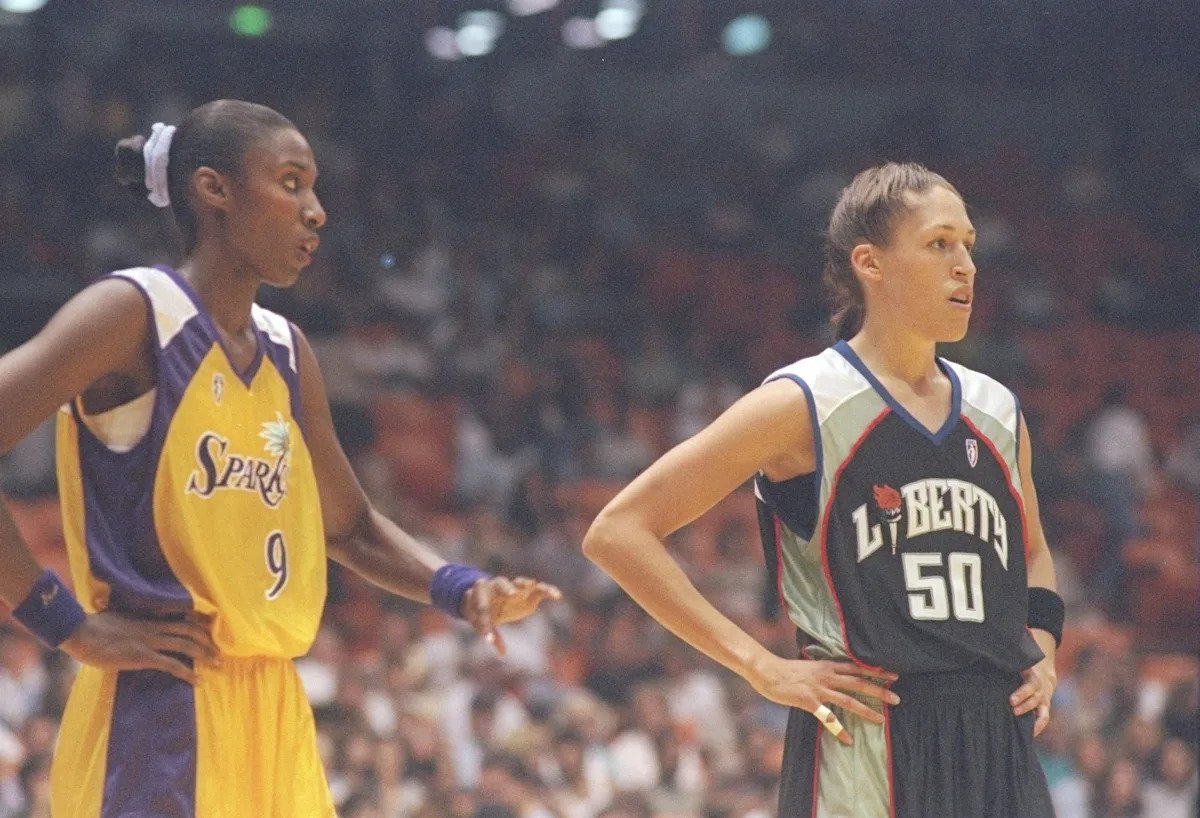
Los Angeles Sparks center Lisa Leslie and New York Liberty center Rebecca Lobo played in the first WNBA game at the Great Western Forum. The Liberty won the game 67-57.
“A point of emphasis in any sports league is 30 years. That’s how usually they judge growth, and so I thought it was unfair that they were judging the WNBA way sooner than a lot of the other five major (men’s) sports leagues,” said Candace Parker, who will be enshrined in the Hall of Fame this year.
Advertisement
“We all knew that this was possible. Anybody that laced up a shoe knew that the WNBA had a place, and as a result of the ownership taken by players, brands, NIL, social media ― has helped with where we at in the 30th season … this was possible; it was just about the investment and the visibility.”
If investment and visibility helped in the first 30 years, what do the next 30 years look like? The next generation of stars can already see what’s possible.
“Just a continued respect and growth, an abundance of national TV coverage, TV deals, advanced CBA negotiations, women making millions of dollars and salary cap increasing, revenue share increasing,” Bueckers said.
“Just everything increasing. Everything doubling. Everything tripling. Everything going up as the years go by, and then just a continued love for the game and a passion and a respect amongst all women’s sports.”
Advertisement
This article originally appeared on USA TODAY: WNBA evolution: 30 years of growth, stars and historic CBA deal

