As the New York Knicks completed the biggest comeback in NBA Finals history in Game 4, television cameras constantly panned the crowd packed with celebrities like Ben Stiller, Timothée Chalamet, Spike Lee and Larry David. But seated next to Adam Sandler was a different type of star, a kingmaker in both college and pro hoops.
John Calipari was courtside to watch three of his former players compete on basketball’s biggest stage: Knicks All-Star center Karl-Anthony Towns and San Antonio Spurs teammates De’Aaron Fox and Keldon Johnson. Calipari just completed his second season at the University of Arkansas following 15 seasons at the University of Kentucky and almost a decade at the University of Memphis. Since 2000, the Basketball Hall of Famer has coached 41 players who have gone on to be selected in the first round of the NBA Draft, including league MVPs like Shai Gilgeous-Alexander and Derrick Rose, first team All-NBA superstars like Anthony Davis and Devin Booker and four top overall picks. Those players have gone on to make more than $3.6 billion in on-court earnings through the 2025-2026 season — in all, Cal has boasted that his players have earned more than $6 billion in professional contracts — making playing for Calipari one of the safest bets for an amateur athlete if he wants to achieve long-term financial success as a professional.
Advertisement
With the 2026 NBA Draft commencing Tuesday night in Brooklyn, Calipari is set to add to that list with dynamic point guard Darius Acuff Jr., projected as the seventh overall pick by Yahoo Sports’ Kevin O’Connor, and Meleek Thomas, a sharpshooting wing, is projected to go 28th. So what makes Calipari so well equipped to not only gain and maintain the trust of so many talented players but put them in the best position to succeed, even after more than 30 years of high-level coaching?
Ever since ESPN college basketball analyst Fran Fraschilla met Calipari 47 years ago when they were 19 years old at Dean Smith’s basketball camp at the University of North Carolina, he knew that Calipari had the gift of gab. It helped the Pennsylvania native become an ace recruiter when he got his first head coaching job at the University of Massachusetts in 1988. After 10 losing seasons prior to Calipari’s arrival, the Minutemen improbably reached the 1996 Final Four led by future NBA Defensive Player of the Year Marcus Camby.
Marcus Camby was the first player John Calipari coached to be picked in the first round of the NBA Draft.
(Boston Globe via Getty Images)
Calipari was always an excellent motivator, Fraschilla said, but he had to change his coaching style over time to become better suited for the modern generation of players. Instead of being harsh and trying to wring and extract every ounce of talent out of players, he mastered the ability to be demanding and require accountability while remaining friendly with them, building lifelong bonds and relationships in the process.
Advertisement
“He’s real, he’s authentic. He cares more about your success and getting you to your ultimate goal than anything for himself,” John Wall, a Prime Video NBA analyst and former Kentucky star drafted first overall in 2010, told Yahoo Sports. “He’s invested in you as a person first. That’s why he’s still got that pull with guys and they want to play for him. They know he’s in it for them.”
Growing up in Chicago, Rose never dreamt of playing for the Memphis Tigers. But as time went on, he knew he wanted to play for John Calipari. And if not for a slew of missed free throws and a clutch three-pointer from Mario Chalmers, Memphis would’ve won the 2008 national championship. And after Rose was drafted first overall in 2008, Calipari began taking advantage of the new one-and-done culture in men’s college basketball, launching a recruitment and development powerhouse that contradicted longstanding trends in the sport.
“Anybody who’s coached in college basketball, we were always looking for continuity,” Fraschilla, a former head coach at St. John’s University and the University of New Mexico, told Yahoo Sports, “the guys that stay with us and help us win a lot of games. John was smart enough to figure out that if I lose Karl-Anthony Towns after one year, it’s okay because I’m going to get another one to replace him. It’s better to let them fly the coop to the NBA and use the previous one-and-done guys to sell the next one coming.”
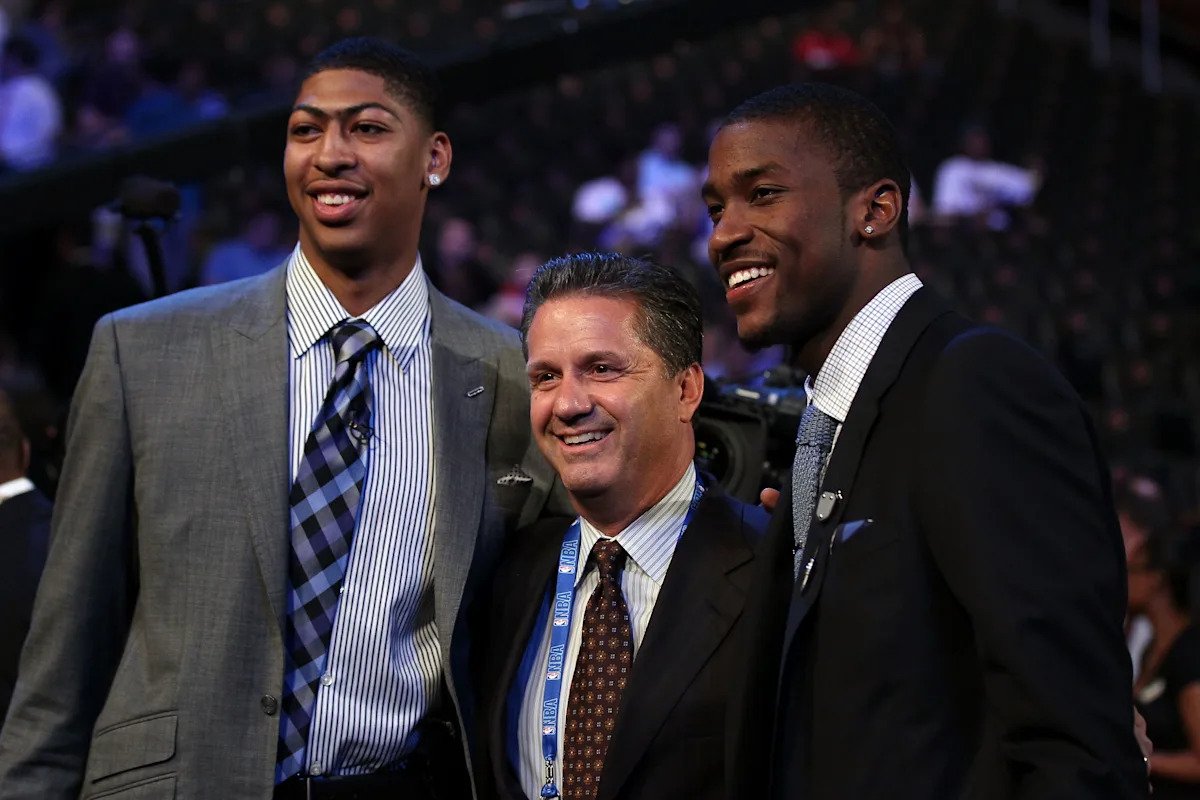
Calipari recruited Tyreke Evans to Memphis and helped him get picked fourth in 2009 before taking the job at Kentucky. In his first year leading the Wildcats, Calipari broke the all-time record by getting five players drafted in the first round, led by Wall, DeMarcus Cousins and Eric Bledsoe. After leading Kentucky to the 2012 national championship, it became the first school to produce the top two picks in the draft, Davis and Michael Kidd-Gilchrist.

(Elsa via Getty Images)
In 2015, Calipari received a lot of criticism from Big Blue Nation for a speech where he said he’d rather get eight players drafted into the league than win a national championship. But it’s this philosophy that’s helped him become a recruiting juggernaut and brand name that still develops top talent nearly 40 years into his coaching career.
Advertisement
“If he calls you up and offers you a scholarship, he’s telling you that you have a chance to play in the NBA,” Fraschilla said. “If he chooses you to be next, you know you’re likely to be next. And most of these kids, if you give them truth serum, they’d rather play in the NBA as a one-and-done than help a coach who’s making millions win a national title.”
Two decades after Rose, Cal has created an NBA pipeline that created the blueprint for developing players and getting them ready for the league in just one season. And if you’re a player who succeeds under Calipari’s tutelage, there’s a pretty decent chance of earning generational wealth as an NBA player. Of the 41 first rounders since 2000, 13 (31.7%) of them became All-Stars and 18 (43.9%) finished the 2025-2026 season with at least $75 million in career earnings, according to data from Spotrac, HoopsHype and Basketball-Reference.
Calipari then makes sure that his rapport with his players lasts well beyond draft night. And while he may do that in a more public and showy way, it’s clear that the love players like Fox and Towns have for him remains genuine. And when players like Acuff and Thomas see the strong connections players still have for Calipari along with the strong track record of producing wealthy NBA stars, it’s no wonder that he can still recruit players with the best of them. Arkansas has Rivals’ top-ranked recruiting class for next season’s incoming freshmen, including beating out Duke for shooting guard Jordan Smith Jr., the third-ranked player overall.
“John’s always been able to create a vision for the top players on what success looks like,” Fraschilla said. “He’s got a roadmap that is nearly impeccable. He’s now like Lexus or Coke as a brand.”
Advertisement
When Acuff walks to the stage Tuesday night to put on his draft cap and shake commissioner Adam Silver’s hand, he could look to the five 2026 All-Star guards who played for Calipari and plausibly envision himself in that position in the future. It’s why Calipari has stood the test of time and has cemented his legacy as an NBA kingmaker and one of the best cultivators of talent in the history of professional sports.

