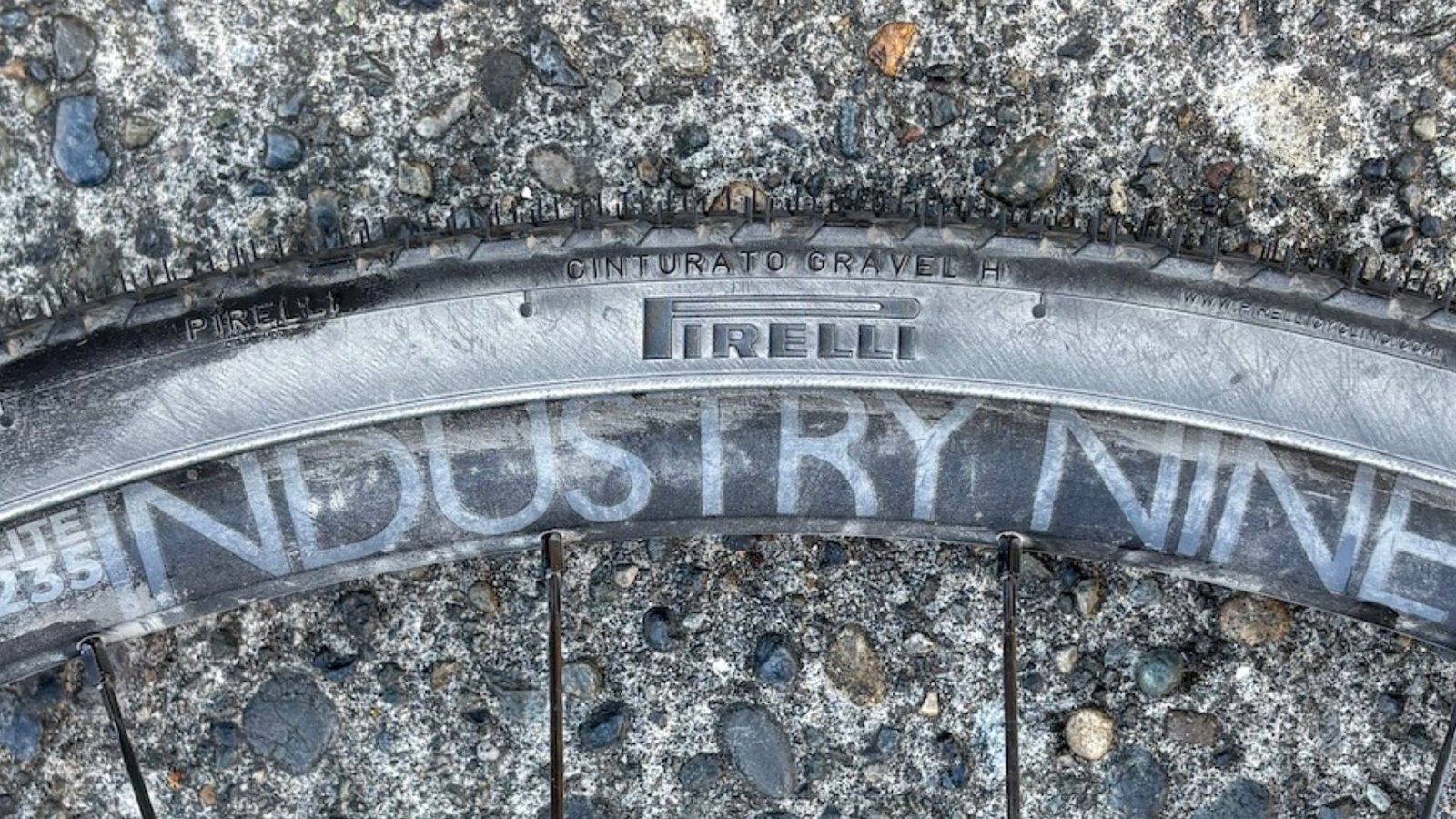
While Pirelli is perhaps best known for its involvement in motorsports, specifically as the tyre sponsor and supplier of Formula One, the company also makes a range of tyres for bicycles. The Italian multinational company offers a wide range of road, MTB, city and gravel tyres. Cars and bicycles may have very different requirements when it comes to tyres, but the two share many of the same design elements: puncture resistance, blending speed and traction, as well as resilience against degradation.
The Cinturato range of tyres comprises Pirelli’s gravel catalogue and offers a particularly wide variety of different treads and compounds available at multiple price points. The Cinturato Gravel H, as tested here, is available in both 700c and 650b diameters in several widths, tread compounds, casings and colours.
Determining the right type of tyre for you largely comes down to where you live and the specific terrain you have access to. There is no best single option across the board. Trial and error is often the best way to find what works for you and your riding, but Pirelli does have a helpful tyre configurator on its website. By inputting your monthly mileage, the type of riding you do, and whether you prefer speed or control, the tool will make suggestions as to which product within the line is best suited to your choices. There is also an interactive tyre pressure tool to assist in setup, though more refined third-party options may provide more useful guidance.

Design and construction

(Image credit: TYler Boucher)
The Cinturato Gravel H SmartEVO GR is part of Pirelli’s newly updated High Performance line, made in Italy at the company’s Milan-Bollate plant with certified FSCTM natural rubber. Other tyres Pirelli offers with this same designation have tread options ranging from a semi-slick (RH) to hardpack-specific (H), a tread designed for mixed terrain (M) and one for muddy/soft conditions (S). The High Performance line, as one would expect, is designed for racing. Pirelli also offers the same tread patterns in its Performance line, which uses a different rubber compound and costs less.
The Gravel H tyre tested here is intended for riding on hard-packed, dry surfaces.
Per the company’s internal testing, the methodology of which it has not shared, the HP “offers 20% better puncture resistance and reduces rolling resistance by 10%” over the previous iteration.
The tread design, which is directional, features low-profile knobs in a tightly spaced chevron pattern. The side knobs are slightly taller and more widely spaced. Also of note is the fact that these tyres have an unusually high number of nibs (the little vestigial hairs on a tyre leftover from manufacture, also called sprues), which gives them a furry aspect. This tread pattern is unchanged from previous iterations, but the tyres feature the new SmartEVO GR compound, 120 TPI casing and a new protective sidewall, previously used on Pirelli’s MTB tyres.
My test tyres weighed in at 579 grams per slightly more than the listed weight of 570 g.
They measured out to precisely 45 mm on 25 mm internal width rims. The Gravel H is available as a 650b tyre in 45 or 50 mm, or as a 700c tyre in 35, 40, 45 and 50 mm options.
On the road

(Image credit: TYler Boucher)
For this test, Pirelli provided me with a set of Cinturato High Performance Gravel H tyres in 45mm. Not so long ago, this would have been a common size, but in 2026, it is decidedly on the smaller side. If your gravel bike has the clearance, the current trend is to opt for 50-55 mm tyres, and sometimes more. On my own bikes, I typically go as wide as I can unless conditions are especially muddy.
I have previously spent time on Pirelli’s PZero road tyres, but this was my first time putting an extended amount of time on the company’s gravel tyres. The Cinturato Gravel H isn’t designed for technical off-road riding, and while it can be pressed into use for such terrain, it works much better for mixed terrain with generally compact surfaces.
The paved roads where I live are fairly rough (high volumes of chip seal and concrete panels), and I like to mix some mild off-road riding into most of my regular riding loops. I also have access to more remote crushed gravel pathways within a reasonable distance of home, and these spots provided an excellent place for testing these tyres.
While Pirelli classifies the Gravel H as a gravel tyre, I think they are better categorised as an all-road tyre. They performed at their best on sandy gravel roads or paths of crushed rock. In looser conditions, or where the road was bumpier, the lack of volume caused the tyres to get bogged down and jostled around more than I liked. They also lack the tread to perform well in the mud. These tyres encourage you to venture off-road, just not too far off.
For someone who lives in an area with relatively smooth gravel options, this is a tyre that will shine. For those in wetter places, or with bumpier terrain, a knobbier, higher-volume tyre would be a better choice.
I was quite impressed with how the Gravel H tyres felt on smoother pavement. They roll well and corner evenly, thanks to the uniform tread shape, which has a rounded profile. At high speeds, I found them to be quite noisy, something I chalk up to the amount of furry nibs, but they maintain speed well. I have not tried the Gravel RH model, which is Pirelli’s dedicated semi-slick tread pattern, but a combo of these two models could make for a very fast all-road setup.
This is a good tyre for a rider who rides pavement often but wants more grip than a slick tyre for when they venture off-road.
In my time testing them, I didn’t have any punctures, but then I also didn’t push it on terrain. I will say that these were fairly challenging tyres to mount and set up tubeless. I’ve had worse experiences, but these weren’t easy to get seated. Be prepared for some wrestling!
Specifications

(Image credit: TYler Boucher)
- Price: $97.90 USD
- Sizes: 45 mm as tested; available in 35-50 mm
- Weight: 579g as tested, 570g listed
Value and conclusion

(Image credit: TYler Boucher)
When choosing a tyre, I would argue that size is the most critical metric to consider, but it’s not as simple as simply choosing an option based on the stated width; it is also necessary to assess height, shape and the impact of rim width. All of these things will impact how the tyre performs, and thus your riding experience.
My usual suggestion, when asked, is to ride the widest tyres you can fit on your bike with a tread pattern you feel confident on in all conditions. We are lucky to have so many good tyre gravel options available at the moment, and finding one that works for you will make your riding all the better.
The Cinturato Gravel H SmartEVO GR is designed as a racing tyre for hardpack conditions. Other popular tyres in this category include the Specialized Pathfinder TLR, Schwalbe G-One RS PRO, Hutchinson Caracal Race, and the Vittoria Terreno T30. Of the lot, the Pirellis are the most expensive by $10-25 per tyre.
I have spent time riding all of these, save for the Hutchinsons, and have good things to say about each of them. The Gravel H stacks up favourably against all of them, but perhaps with a slightly narrower use window—it’s not the best on tarmac or rough gravel, but does well enough on both, and exceptionally well on smooth dirt and crushed stone surfaces.

