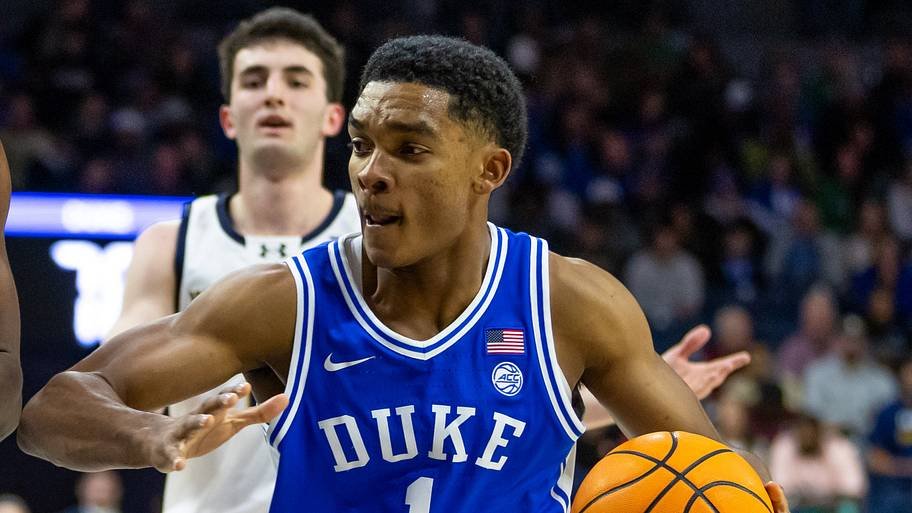
Duke and Louisville are generally viewed as the top two teams in the ACC heading into the 2026-27 college basketball season.
Head coach Jon Scheyer and his staff rebuilt a roster prepared to win in today’s era of college hoops, featuring a rotation of elite young talent, veteran leaders, and key returning pieces from a season ago.
Advertisement
There’s little debate that the Blue Devils will enter the season as the top team out of the ACC, and potentially the top team in the entire country. However, Louisville, at least on paper, doesn’t seem too far behind and could give Duke a run for the ACC crown.
Mar 26, 2026; Washington, DC, USA; Duke Blue Devils head coach Jon Scheyer stands on the court during a practice session ahead of the east regional of the men’s 2026 NCAA Tournament at Capital One Arena. Mandatory Credit: Geoff Burke-Imagn Images | IMAGN IMAGES via Reuters Connect
Duke has won the last two ACC regular-season and tournament titles, compiling a 36-2 record in league play over that span. Outside of the Cardinals, there are several clubs out of the ACC that could make a run to the top of the conference standings. Still, Louisville has the most talent of any.
Louisville is fairly unpredictable, given how Pat Kelsey built the roster. There’s a key difference between Duke and the Cardinals heading into the 2026-27 season, and it will be very interesting to watch both teams gel as the campaign rolls along.

Michigan State’s Cam Ward, left, is blocked by Duke’s Patrick Ngongba during the first half on Saturday, Dec. 6, 2025, at the Breslin Center in East Lansing. | USA TODAY Network via Reuters Connect
Duke Built Through Continuity, Louisville Built Through the Portal
Scheyer and Co. made two high-profile transfer portal signings with John Blackwell from Wisconsin and Drew Scharnowski from Belmont. The Blue Devils are also bringing in the nation’s top-ranked high school recruiting class for the third year in a row.
Advertisement
However, at its core, Duke built its rotation this offseason through its key returners. Three starters from last season’s team that went 35-3 and earned the No. 1 overall seed in the NCAA Tournament (Caleb Foster, Patrick Ngongba, and Dame Sarr) are all back. Cayden Boozer, who played about 23 minutes a night off the bench last year, and redshirt freshman Sebastian Wilkins, are also back in Durham.

Duke basketball coach Jon Scheyer subs out Duke guard/forward Dame Sarr (7) during a college basketball exhibition game against Tennessee on October 26, 2025, in Knoxville, Tenn. | USA TODAY Network via Reuters Connect
Continuity and veteran leaders have become the main priorities in roster building for many head coaches in college basketball. Over the last decade and change, Duke has revolved its rosters around elite freshmen talent. The Blue Devils are still bringing in those big-time young rookies, but the major contributors will be headlined by veterans or returners this time around.
On the other hand, Kelsey utilized the transfer portal to build his roster for the second year in a row. The Cardinals sealed the No. 1 overall transfer portal class, according to 247Sports, headlined by the portal’s top player, former Kansas big man Flory Bidunga.

Louisville men’s basketball coach Pat Kelsey answers questions from reporters during a news conference in Louisville, Ky., on June 22, 2026. | USA TODAY Network via Reuters Connect
The transfer class also features Jackson Shelstad (15.6 ppg at Oregon), Karter Knox (8.1 ppg at Arkansas), Alvaro Folgueiras (8.4 ppg at Iowa), and De’Shayne Montgomery (13.4 ppg at Dayton).
Advertisement
Louisville’s only major returner is Adrian Wooley, who averaged 8.7 points per game a year ago.

Kansas Jayhawks forward Flory Bidunga (40) shoots the ball during the first half of the exhibition game against Fort Hays State Tigers inside Allen Fieldhouse on Tuesday, October, 28, 2025. | USA TODAY Network via Reuters Connect
Continuity Matters
Scheyer built around his critical returners, whereas Kelsey bought as much talent through the portal as possible to form a team together. Likely, at least four of Louisville’s starters will be transfers, whereas three of Duke’s starters will be returners.
It’s so early in the NIL era that there’s little evidence on how consistently successful a team can be when comprised nearly entirely of transfer talent. Michigan became the first all-transfer starting lineup to win the National Championship last season. However, Kelsey has used this roster makeup before, and it didn’t pay off.

TCU Horned Frogs guard Brock Harding (2) passes near Duke Blue Devils head coach Jon Scheyer March 21, 2026 during the NCAA Men’s Basketball Tournament second round East Region game at the Bon Secours Wellness Arena in Greenville, South Carolina. | USA TODAY Network via Reuters Connect
Just last year, Louisville built one of the nation’s top transfer classes and entered the season as a legitimate Final Four contender. The campaign resulted in a 24-11 overall record and a Round of 32 exit in the NCAA Tournament.
Advertisement
Duke has the returners, Louisville has the talent. Time will tell which of the two programs was built the right way.
Today’s best reads
This article was originally published on www.si.com/college/duke as Key Difference Between Duke Basketball and Louisville Heading Into 2026.

