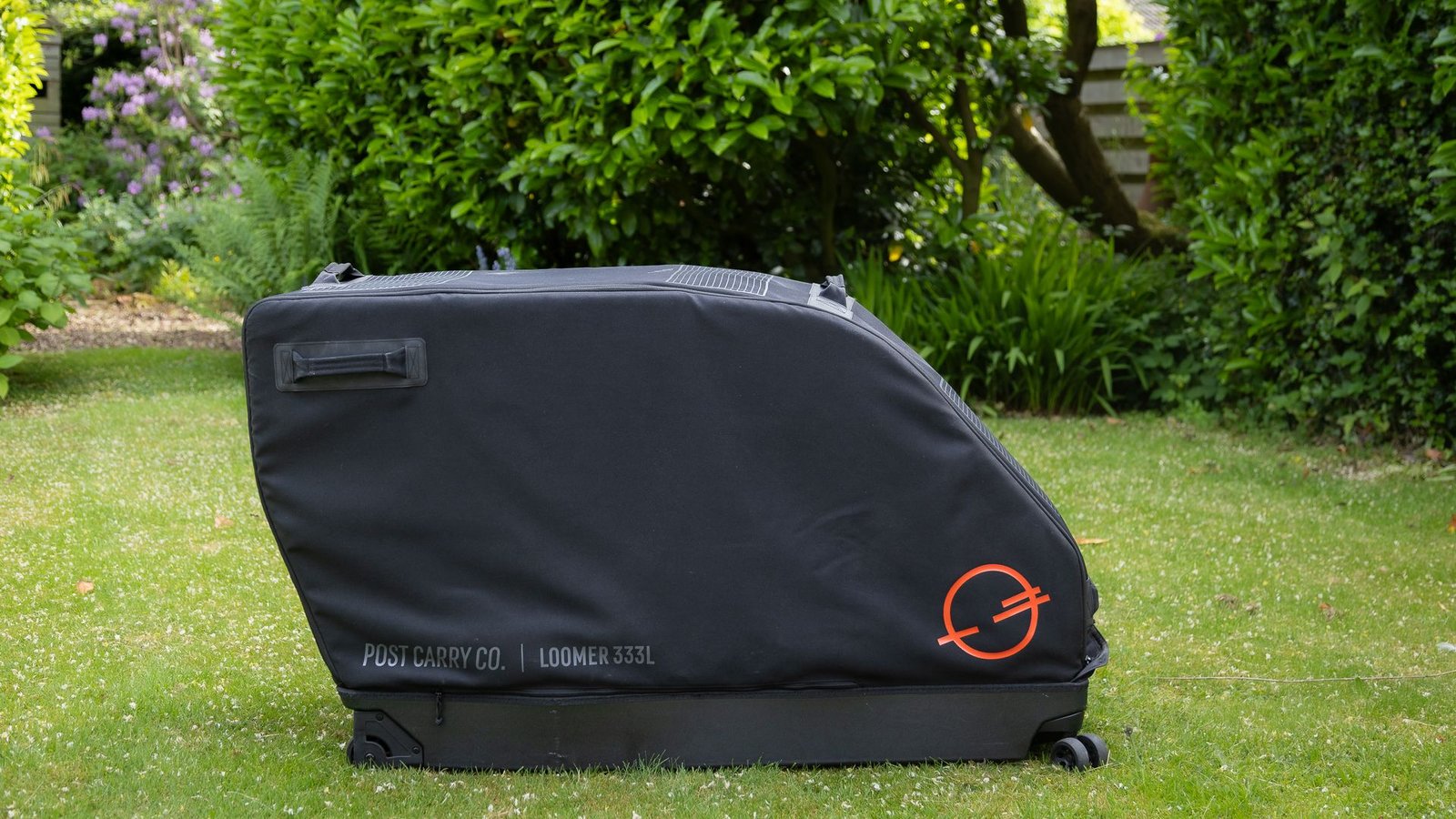
If you’re going to travel on an aeroplane with your bike, you’ll want one of the best bike boxes. The care and attention offered by baggage handlers varies, and a dedicated box will always provide more protection than a cardboard box or bubble wrap. However, for most of the year, when not in use, they are big and bulky to store.
You could hire one when required, but that brings its own issues and costs, so if you do travel with your own bike regularly and would like to buy one but are tight on storage space, then the Post Carry Loomer might be the solution.
By the way, the brand’s name comes from the fact that Marc Mendoza, its American founder, started off his sideline bag business ‘post work’, before it became full-time. ‘Loomer’ comes partly from the fact that big, exciting trips loom ahead of you and partly from the 1991 song ‘Loomer’ by My Bloody Valentine, a track about escapism. Certainly a more interesting backstory than most bike box names!

Construction
The cardboard box that the Loomer was delivered in was impressively small (for a bike box anyway). It measured just 115 x 34 x 55cm, making storage of the Loomer between trips much simpler than a full hard case. When collapsed, two sturdy straps keep it compacted, and when not in use they have their own zipped external pocket, which is a nice detail.

A lot smaller and easier to store than a hard case when packed down
(Image credit: Tim Russon)
I weighed the box at a fraction over 11kg, so similar to Evoc’s Road Bike Bag Pro and a couple of kg less than a Bike Box Alan Aero Easyfit hardshell box.
Unpacking and constructing the box for use was both quick and intuitive. The sides and top panel unfold to reveal a metal frame bolted into the bottom of the box, two padded wheel bags and four polycarbonate panels. These panels slip into zipped compartments on the inside of the sides of the box, creating rigidity and providing protection.
The material used for the outside of the box is very heavy-duty Cordura, so there should be no longevity issues there.

Polycarbonate panels waiting to be secured inside the bag
(Image credit: Tim Russon)
A large, sturdy U-shaped zip secures the top flap, also with some robust-feeling padding, and there are two sleeves for cross-bracing protection at the handlebars and the rear dropouts. Post Carry says that the bag ships with the rear brace (effectively a short section of plastic pipe) but not the longer handlebar piece; however, adding your own is quick and simple. The box is wide enough for 50cm handlebars, which is loads for a road bike, but flared gravel bars might struggle a bit.

The pipe provides extra cross-bracing and protection by the rear drop out
(Image credit: Tim Russon)
On the inside of the box, there are lots of very useful, large pockets, with two on either side, one under the down tube and one in front of the fork. All of these are bellows-style for more room rather than lying flat against the bag and are closed with a zip. There is also a poppered flap at the back which is intended to house your rear derailleur if removed.

Lots of large pockets inside the box
(Image credit: Tim Russon)
The ‘chassis’ is a hard plastic tub, into which the metal frame is bolted, with four wheels, the front two of which steer shopping trolley style.
The Loomer is available in two different sizes to minimise dead space: 333L for size 56cm frames and below, and 370L for larger bikes.

The smaller 333L size was perfect for my 56cm road bike
(Image credit: Tim Russon)
The ride
Packing the box was almost as simple as building it.
With the wheels and seatpost removed, the fork bolts to the internal frame using the thru-axle whilst the bottom bracket shell sits on top of a large, padded block and is secured using a strap. There is a short piece of material to protect the frame from the strap, but it’s not quite long enough, so I also used some foam pipe lagging too.

Forks are secured to the internal metal frame
(Image credit: Tim russon)
The rear derailleur can be removed to protect the hanger in transit and put behind the dedicated flap; I also wrapped my chainstay in some more foam pipe lagging and zip-tied my chain to it to stop it from flapping around and damaging the paintwork.
Fortuitously, I found a perfect length piece of pipe in my garage to slot into the handlebar brace sleeve.
I removed my pedals when packing the bike as they are Garmin Rally power pedals with batteries in them, but it would be possible to pack the bike with pedals in place – the padded wheel bags sit either side of the frame towards the front under the handlebars.

The wheels sit either side of the frame in padded wheel bags
(Image credit: Tim Russon)
Almost as soon as it arrived, the box was pressed into service for two back-to-back trips to Mallorca. The first was a shorter affair, and I only took hand luggage and the Loomer, so the capacious pockets were extremely useful.
As well as the saddle and seatpost, I packed two pairs of shoes, a helmet, a bag of tools, a few bottles and four sets of cycling clothes all in the bag’s pockets with plenty of space to spare. I had hold luggage for the second set of flights, so space was at less of a premium.

Plenty of room inside the bag’s pockets for a trip to Mallorca
(Image credit: Tim Russon)
However, I did learn that there is a bit of an art to packing the Loomer, as it doesn’t really like having much weight in the large pocket under the downtube that is attached to the metal frame. In Marc’s desire to reduce the Loomer’s size as much as possible, it runs with very little ground clearance, and when the central pocket is heavy, it can cause the bottom of the box to scrape annoyingly on any imperfection. Counterintuitively, it is better to put the weight in the pockets on the side of the box and leave the lowest pocket for light, bulky objects like your bike helmet.
When I mentioned this to Marc, he said that he is aware of the issue and that a solution should be added very soon.

The bag runs a little too low to the ground when laden or packed badly
(Image credit: Tim Russon)
When the bag is not scraping on the ground, the wheels run very freely and steer easily, although, much like the Evoc bag, it prefers to be pulled rather than pushed. With four widely spaced wheels, the box was super stable, and the wide, flat top was ideal for resting my hand luggage on whilst scooting through the airport.
With its short, squat dimensions, the Loomer would be a great option for someone with a smaller car, as it needs much less width than something like a Bike Box Alan. However, its width/depth meant that it wasn’t much easier to pack into my large car with a second box and hold luggage – doable but still awkward.

Much lower than a Bike Box Alan, but just as wide
(Image credit: Tim Russon)
Value and conclusion
The Loomer costs $900 or €775, with sterling pricing to be confirmed. As bike boxes go, this is about par for the course – cheaper than the Evoc, Scion or Buxumbox boxes, slightly more expensive than Bike Box Alan. It’s a chunk of cash for sure, but almost certainly a lot less money than the bike it will be protecting.
It feels well made and has been thoughtfully designed, making it very easy to pack and use without feeling like you need to be a pro mechanic. It’s nice that riders of smaller bikes don’t have to lug about the same size box as those on 62cm frames, and its compact dimensions will be appreciated whether built up or packed away.

(Image credit: Tim Russon)
I understand that Post Carry were trying to make the box as small as possible, but I think that another centimetre of ground clearance would make it much easier to pack and move around without affecting the size very much at all. However, this doesn’t stop me from recommending the Loomer to anyone travelling with their bike, regardless of whether they need its compactability or not.
It is very close to a 5-star product, but I was cursing it for dragging its underside on the ground on a long walk back to my car at Manchester airport – if/when the ground clearance is sorted, then it will warrant the maximum number of stars.

