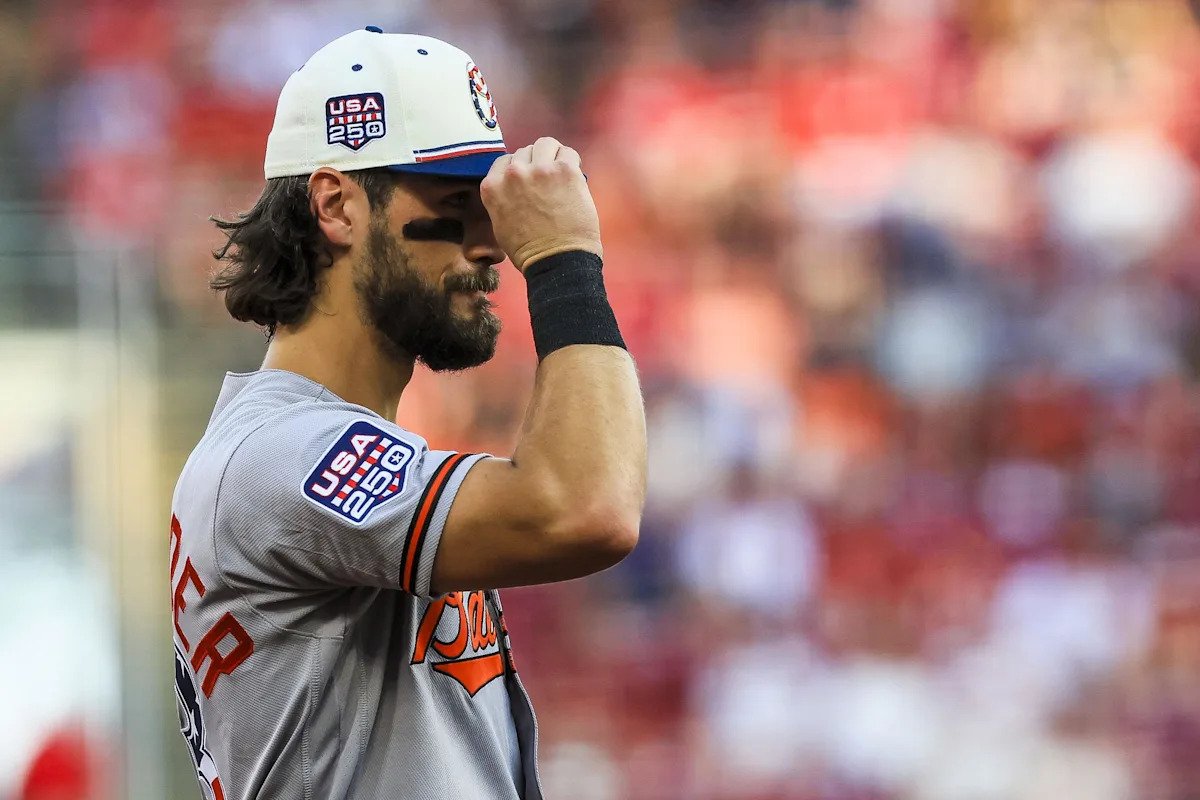
A poll of Birdland would likely show that Pete Alonso has been the Orioles’ most impactful off-season addition this year. But likely second in that survey would be bench-utility-player-turned-every-day-starter Blaze Alexander.
Quantifying just how big an impact Alexander has had on the 2026 Orioles is hard to do, given the unexpected nature of his rise and the player he’s replacing. When Mike Elias acquired the 27-year-old infielder from the Diamondbacks, he was seen as 2026’s Jorge Mateo. The expectation was he’d provide useful depth at 3/4 of the infield spots while being able to play CF as well. Any offensive upside would be a bonus.
Advertisement
However, spring training injuries to Jordan Westburg and Jackson Holliday cast Alexander into the role of near-everyday starter. After a rough first 70 ABs with O’s, Alexander has turned into an on-base machine who exists somewhere on the spectrum between peak Luis Arraez and 2024 Bobby Witt Jr. Since May 3rd, Alexander’s .381 average is best in the majors among players with at least 100 PAs. His closest competition—Miami’s Otto Lopez—has an average 3o points lower.
Alexander also leads all of baseball in on-base percentage during that time period, with his .429 OBP just beating out MLB WAR leader Pete Crow-Armstrong (.425). And while Blaze is not seen as a power hitter, his .552 slugging percentage during his hot streak is good enough for 20th in the majors—ahead of All-Star sluggers like Bryce Harper and James Wood.
Perhaps all of this shouldn’t be as big a surprise as it still seems. Alexander was always a plus athlete. His arm strength and sprint speed have consistently ranked in the 80th percentile or higher throughout his MLB career. As a prospect in the Diamondbacks’ system, every tool (other than his hit tool) was rated as above average or better.
We’ve seen it before with players who start out as more athletes than baseball players; sometimes those guys need patience and a concrete opportunity to actually show their quality in the major leagues. The same was true of Mateo when he arrived in Baltimore at the same age that Alexander is now. If Blaze can maintain anywhere close to his current level of play, the O’s will have added an above-average starter for the cost of a fringe major-league reliever and two minor-league pitchers.
Advertisement
Alexander’s two most standout traits this season are a direct reflection of that athleticism translating into on-field production. The Orioles’ infielder ranks in the 88th percentile in average exit velocity, putting him just ahead of former All-Stars Corbin Carroll, Fernando Tatis Jr. and Ketel Marte. That’s led to a 47.1% hard-hit rate (80th percentile). That top-tier exit velocity—as well as consistently elite launch angles—has allowed Alexander to produce at a high level despite a less-than-ideal amount of swing-and-miss in his game.
The success the front office found with Alexander should inform the way the Orioles approach this upcoming trade season. Elias has expressed his desire to be amongst the buyers this month. With the O’s currently 3.5 games out of a Wild Card spot, the ninth-longest tenured GM in baseball may just get his wish.
Armed with the knowledge of how good a Blaze Alexander-type can turn out, the front office can go into this trade deadline looking to add players who can make a difference now and past this season. The beauty of the Alexander deal is not just that the Orioles paid a negligible price for an above-average starter. The true beauty lies in the fact that he can be an above-average starter in Baltimore through the 2030 season.
If/when the Orioles add to the offense this month, it should be players who show the same analytical upside as Alexander while offering a similar level of team control. Could the floundering Giants be convinced to part with outfielder Heliot Ramos, the 26-year-old with 30-homer upside and three additional years of team control? Would the perennially last-place Rockies be willing to part with All-Star Hunter Goodman? The versatile catcher with outfield experience (who plays better outside of Coors) would give the O’s another right-handed power bat under control through 2030.
Advertisement
What we can’t see happen again is a repeat of the 2024 trade deadline when it comes to supplementing the lineup. Two years ago, with the O’s sitting atop the AL East, Elias chose not to meaningfully add to the lineup. Instead, he made small moves for the likes of Eloy Jiménez, Austin Slater and Cristian Pache—with only Slater playing well enough to ultimately make the playoff roster.
When the current front office was put in place, they brought the promise of an analytics-led revolution in Baltimore. To date, that revolution has fallen flat more often than it’s proven to be successful. However, Blaze Alexander is proof of the good the Elias scouting approach can produce. If Elias & Co. can produce a few more Blaze Alexander’s at this year’s trade deadline, the playoff dreams may actually be alive.

