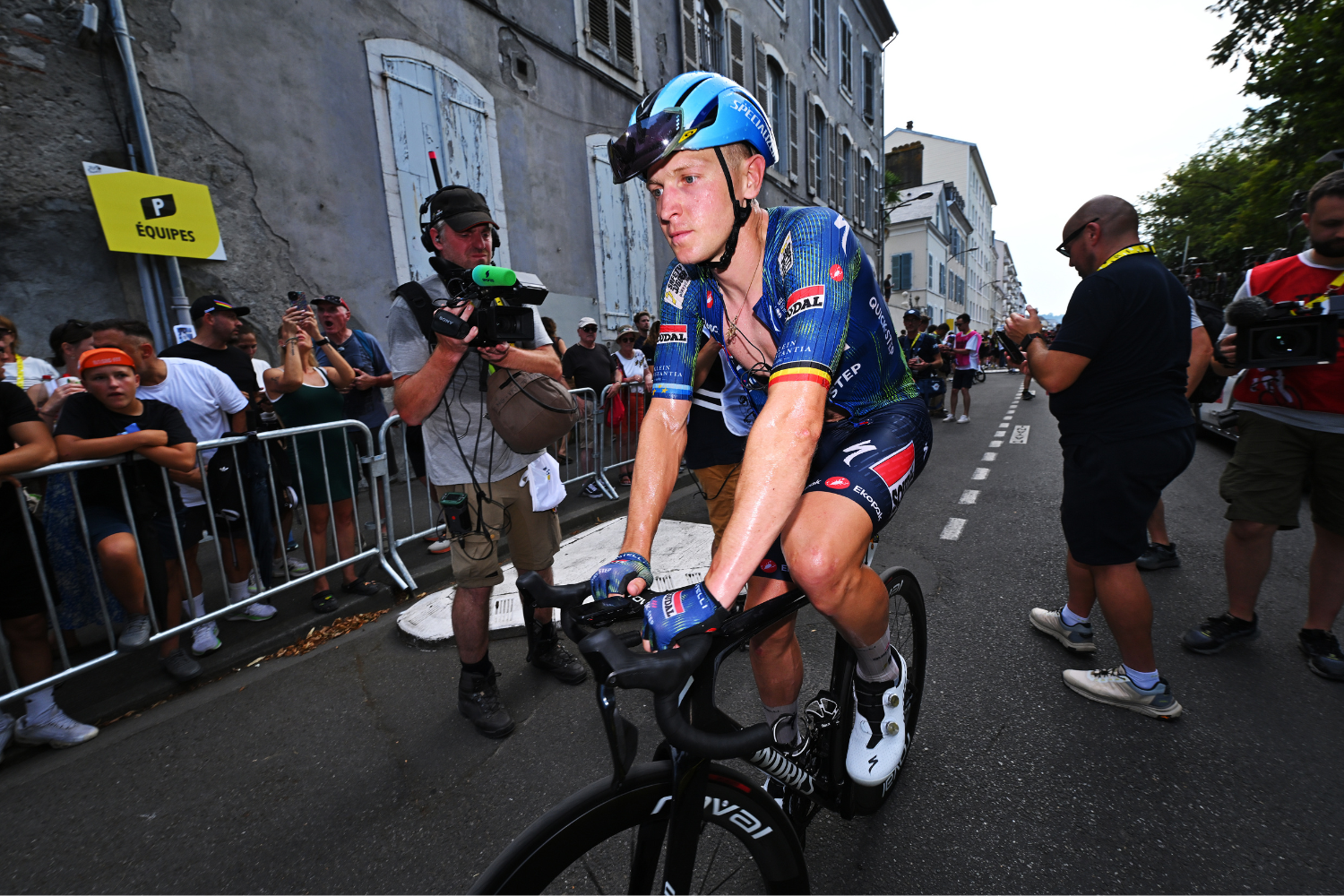
Stage five of the Tour de France was primed for Tim Merlier and Soudal Quick-Step. Long, straight roads with few roundabouts and sharp bends lent itself perfectly to the Belgian team’s leadout train.
But then with 5.6km to go on the 2026 edition’s first sprint stage in Pau, the peloton split in two. A crash in the middle of the bunch brought down multiple riders, including half of Merlier’s eight-man team. The two principal actors in his sprint train – Jasper Stuyven and Bert van Lerberghe – were among those affected. Stuyven tore half of his skinsuit, and grazed most of his left leg and elbow.
Tom Steels, Soudal Quick-Step’s lead sports director at the race, knew immediately it would have negative consequences for Merlier’s chances. “That last corner to the right was a bit of a disaster,” Steels sighed. “The team were together, they crashed, and we lost most of the team.”

It meant Merlier had to go it alone. He produced a valiant effort, riding to third behind stage winner Olav Kooij of Decathlon CMA CGM, but Merlier didn’t see the positives.
“I don’t like to be third – I want to win. And even more in the Tour,” the 33-year-old told Cycling Weekly after the stage. “I’m looking forward to the next opportunities but every chance that is gone, is gone. I’m disappointed.”
Merlier, to many people the best sprinter in the game right now, was honest that the absence of Stuyven and Van Lerberghe in the finale hindered him. “It was a big shame that I missed these two strong guys to bring me into a good position towards the 5km point,” he said.
“I tried to gamble a little bit but in the Tour you can’t gamble – you need to get into position. I gave it a try, tried to hang onto some other lead-out trains, but I don’t like that. I prefer to do my own thing [with my team-mates].”
Under the flamme rouge, Merlier was quite far back in what was a vastly-reduced lead group, before finding a gap on the left of the road to power through to third. Kooij finished comfortably ahead of him, though. There wasn’t really a contest.
“There were three or four mistakes too many from myself and that’s definitely why I lost too much speed,” Merlier critiqued himself. “Why I didn’t win the stage is because I lost too much energy trying to get myself back into a good position.”
Steels shared Merlier’s frustration, believing that with a leadout train he would have been victorious. “For sure, I have no doubt about it,” Steels said. “He had to do that last part all alone. The way he did it was perfect but he just lost a little bit of momentum in the last 300m.
“If you have two guys in front of you, you don’t have to think – you just have to follow. He jumped from wheel to wheel which takes a lot of power away. If he goes directly to the left he probably gets more speed but that’s a split second decision he had to make.”
Nonetheless, Quick-Step can take heart from Merlier’s performance. A knee injury hampered his spring campaign, but he has shown signs of the form he had last year when he won 16 races. A stage win at the Tour of Belgium, and three at the Tour of Hungary, indicated that he will be a contender on the Tour’s sprint days. Friday in Bordeaux is his next chance.
“This was exceptional circumstances,” Steels said. “If you lose your whole team that’s in front of you and you have to do the last 5km alone surfing when you’re not a windsurfer, [it’s difficult]. But he looked for solutions and he did an excellent sprint that only a few sprinters in the world can do.
“It’s a pity because he had the legs, but onto the next one. He doesn’t have to doubt his condition or speed, that’s for sure.”
Merlier was reminded that in the pre-race press conference in Barcelona last week he struck a cautious note, refusing to big up his own chances. It’s clear from stage five, however, that if Merlier can count on his teammates he will be in contention plenty more times.
“I prefer to not look so confident but then do it with my legs rather than my words,” he said. “That’s the way I like it. That’s Tim Merlier.”

