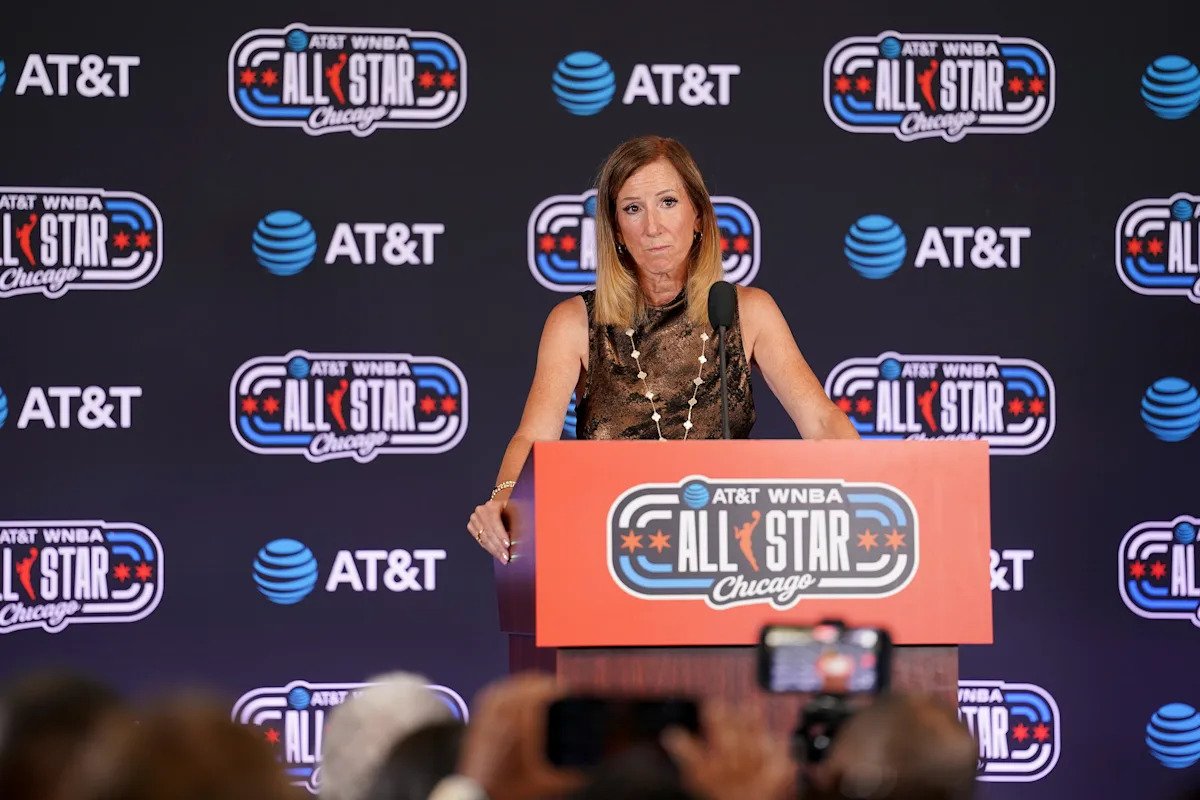
CHICAGO — The league’s elite players want personalized check-ins beyond congratulations on their accomplishments. They open their phones to check texts and scroll social media.
WNBA Commissioner Cathy Engelbert figured they wouldn’t want to hear from her and the league all the time. She sits at a computer and sends emails to relay major information.
Advertisement
You see the problem.
There is a clear disconnect between Engelbert and players, despite an overall thawing of tensions four months after signing a collective bargaining agreement. It plays out in headlines, Instagram stories and social media posts because this is a professional sports league, and conflict creates noise.
In the WNBA players’ case, noise results in change. The tweaks here are minor, considering the sides that were once on the brink of a work stoppage appear to be on better terms.
(Geoff Stellfox via Getty Images)
There were no bold claims about poor leadership, nor accusations of bad-faith acts during Friday’s player media portion of All-Star weekend. No feelings were harmed in the unzippering of warm-ups in the vein of last year’s “Pay Us What You Owe Us” T-shirts. It is far from a consensus affirmation of the job Engelbert has done, and she herself remained noncommittal on her 2027 job status when asked directly for a third time in as many state-of-the-league addresses.
Advertisement
But it was a refreshingly calmer tone.
“Cathy has done a lot to really get us to this point,” Stewart said this weekend. “Obviously, she was across the table during those CBA negotiations and eventually we got to a historic deal, and I think there’s flowers that need to be given all around in order for this deal to really happen.”
The movement on this particular issue need not be as transformational as the CBA that paid out each All-Star $15,000 for participating. As with all of their paychecks in this new era of labor peace, it’s significantly larger than in years past. Individual winners over the weekend made bank.
Money does solve some problems. It can only do so much about bettering communication in the ways those involved want to receive it. And times are far different from the days of the legends who helped jump-start the 30-year-old league.
Advertisement
“It’s friendly when you see each other, but it’s not like I was calling [former WNBA president] Val Ackerman [or] [former president] Donna Orender, no,” Aces head coach and former New York Liberty star Becky Hammon said. “I don’t know what the temperature is like now, but you have to understand too, [we were] just getting phones. I was still carrying out CD packets with movies in it. It was just a completely different world.”
Listen closely to any of Engelbert’s press conferences, including her state of the league address on Saturday night, and the differentiating words are clear.
“The internet is a very complicated place,” Engelbert said on while answering a question on individual security practices and player safety. “Someone gave me this term: keyboard warriors.”
For all the olds know, that phrase was so last year. It’s definitely not new, and that Engelbert had someone share it with her is telling.
Advertisement
Engelbert, 61, spent the entirety of the WNBA’s existence at Deloitte, where she rose into the role of CEO. Her corporate speak still pokes out all these years later, though Stewart gave her credit for adjusting on the fly and within that role.
“From when she started to now, I think she’s more open and more personable and maybe that just comes with the comfort of your surroundings and your work environment and things like that,” Stewart said. “I think that’s something that she can always improve on.”
Engelbert’s adult life spanned from rotary phones to dial-up internet to having the entire world in one’s pocket. The league’s first commissioner, after decades of leaders with the “president” title, is more comfortable at the dais, while occasionally awkward within the role.
These are entities operating on different foundational levels. The oldest players in the league, born in 1987, made it through high school without smartphones, but the young stars of the W certainly didn’t. Paige Bueckers, born in 2001, is a self-proclaimed and overly proud “iPad kid.” (That’s a person glued to their device. She touches grass … with the screen.)

(Sage Zipeto via Getty Images)
A majority of them live their lives online. They communicate constantly, commenting on photos of food rather than merely major life accomplishments.
Advertisement
Take this into consideration: what other league features a 72-hour live stream over its All-Star weekend that leads to viral clips of the most mundane of conversations and activities? A clip of the “Studbudz,” Courtney Williams and Natisha Hiedeman, showing “good” or “bad” waffle fries to their camera, made the rounds.
In a life lived on a phone, their leader can feel nonexistent. It’s another instance of everyone wanting the same thing (more communication) but not knowing how to meet in the middle.
“Relationships are really important to me,” Caitlin Clark said. “And I think we can always improve in that area. I think that can improve a lot of things. … Communication and relationships solve a lot of issues and a lot of problems.”
Clark name-dropped Adam Silver, the NBA Commissioner who oversees the WNBA and has developed strong relationships with certain star players. Sabrina Ionescu has also mentioned him in remarks about Engelbert and communication. Engelbert, whether purposeful or not, referenced the NBA as “our big brothers” during her announcement of the league’s new replay center.
Advertisement
She is in a difficult middle-management position in that way. But Silver doesn’t give out the awards, hold the press conferences or lead the league. A’ja Wilson said again this weekend that she only hears from Engelbert when she wins an MVP.
“I love to see her in that light, but when I think it comes to leadership, I’m always big on bonds, I’m always big on connection on a different level,” Wilson said. “I think that’s what we all try to look for when it comes to a leader. When we’re on our teams, when we’re coming to the business table. It’s a partnership and it should go hand in hand.”
Again on Saturday, Engelbert acknowledged room to improve while avoiding a question about whether that level of touching base should be within her job purview as a major sports league commissioner.
“We need to be better,” Engelbert said. “There’s no doubt. I need to be better. Everybody needs to be better at communication. I think all the time. So we’ll continue to work on that and communicate.
Advertisement
“We’ll get [information] to them in a format and platform that makes sense to them.”
The conversation around Engelbert’s job status continues to fester and will swirl for as long as she is in the role. The boos at these events are a monsoon now, though it is a storm that all major commissioners weather.
In the meantime, she is the league’s leader amid a moment of great transformation and challenges. Some players, including Stewart, said this week it’s not up to them to say if Engelbert should keep her job. It is up to them to communicate and build a league with whoever holds the title, particularly now that the sides agreed to revenue-sharing.
Advertisement
“Throughout this new CBA it’s just really important for everybody to realize, we’re literally now all in it together because as the league grows, then we grow, and vice versa,” Stewart said.
In as corporate a move as they come, Engelbert and the players communicated about better communication earlier this week on a video call. The players will be checking their messages for action.

