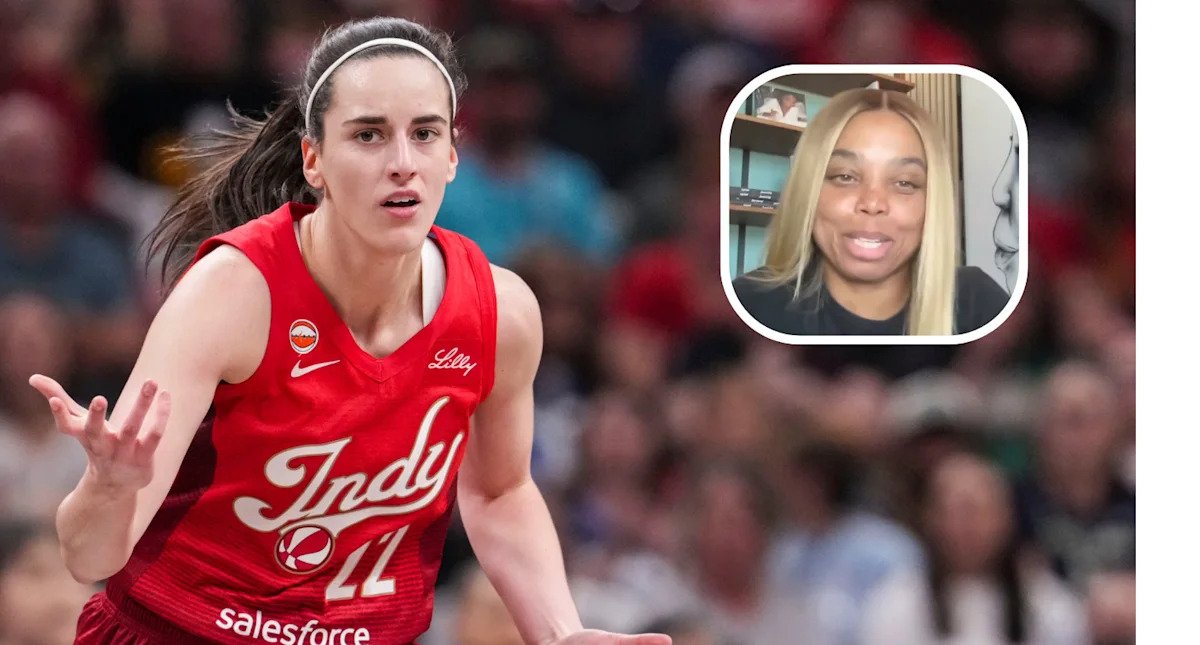
The WNBA appears to be at an inflection point that will decide whether it can successfully navigate the inordinate attention around Indiana star Caitlin Clark, or if it will be captured by uninformed media perspectives and false narratives.
Clark is a full-fledged icon in America’s culture wars, a straight white point guard in a largely Black and LGBTQ league. And she is also a money-maker like the WNBA has never seen. She also is a 24-year-old who can’t seem to ever satisfy critics.
Advertisement
In an appearance on The Awful Announcing Podcast this week, sports commentator Jemele Hill shared her thoughts, after covering WNBA All-Star weekend, on the vast divide between media perspectives on television and across the internet and how the people close to Clark feel about her.
“I feel a lot of empathy for her, just because there’s so much of this she did not ask for,” Hill said. “She didn’t ask to be some kind of bat signal for a culture war. She certainly didn’t ask for the group of fans — which I believe are not the majority — the group of fans that have decided that she’s going to be their vessel to get off as much racism as they possibly can.”
Hill likened the intense scrutiny toward Clark to another sports story, transgender athlete laws, that has been co-opted by conservative media as well.
“Anything that happens with Caitlin Clark, it gives Fox (News) programming for six hours,” she said.
Advertisement
Yet, Hill added, she believes there is a “real relationship” between Clark and a veteran teammate like Kelsey Mitchell, a fellow All-Star.
Even among less politicized media, Hill believes history will not look kindly on those who jumped to conclusions that other players in the league “don’t like” Clark or “want to hurt her.”
“This narrative that the media keeps drilling that the players don’t like her, that they’re jealous of her, that they want to hurt her,” Hill said, “that is not the dominant perspective or feeling in the league. They’re just competing, and the fact that you’re villainizing people for just competing with her, it is something that will prove to be historically embarrassing by the way it has been discussed.”
Advertisement
During her rookie season, a hit to Clark’s face by Connecticut defender DiJonai Carrington became a national news cycle, the beginning of the idea that other players were out to get Clark. More recently, Clark was struck in the head by Phoenix’s Alyssa Thomas and later suspended. Many commentators homed in on these moments to argue that players around the league were retaliating against Clark for the fame and attention she received.
Still, others have made a more simple argument that the league has actually overcorrected with Clark, to the point that she is officiated more lightly than other players (even if the free-throw statistics don’t really bear that out). And of course, there have been instances in which current and former WNBA players have been directly critical of Clark’s personality, on and off the court.
All athletes are subject to big, strong opinions. Where Hill believes the conversation has gone haywire around Clark is that nobody is calling balls and strikes, which allows unfounded theories to solidify.
“It took Cathy Engelbert too long to get in front of a microphone,” she said. “It didn’t even have to be The Dan Patrick Show. She should have been doing some type of media after the Alyssa Thomas incident happened. She needs to be out front more. Because that’s the way you help to control the narrative. At this point, it might be too late. But it would be really helpful if the commissioner didn’t disappear at the most critical moments. You should be able to get her on the phone and her help to shift and change the narrative.”
The post Jemele Hill: Narrative that WNBA players ‘want to hurt’ Caitlin Clark ‘will prove to be historically embarrassing’ appeared first on Awful Announcing.

