Swimming’s Most Unique Stroke? The Reasoning Behind Top Breaststrokers’ Similarities, Differences
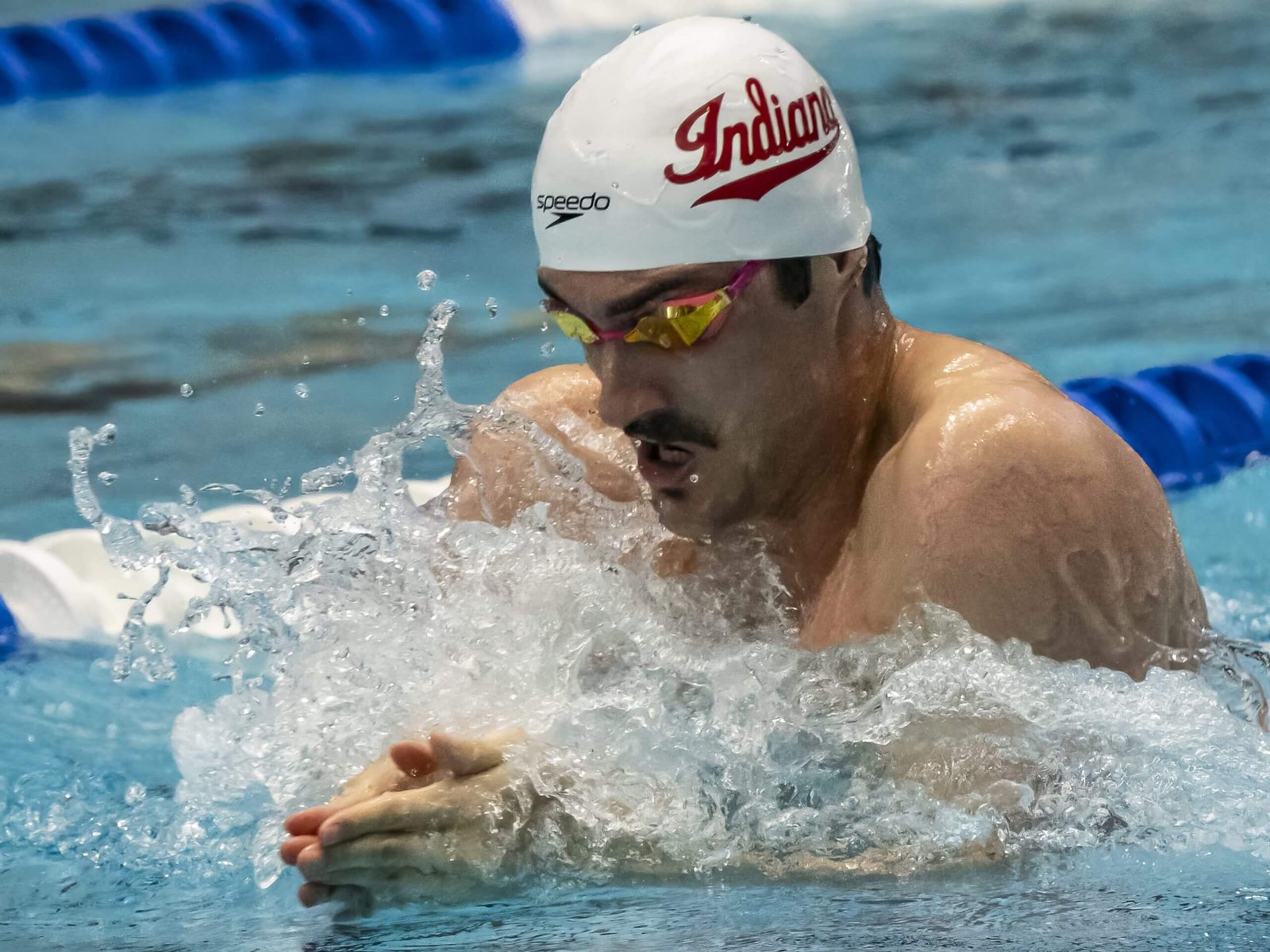
When Van Mathias swims breaststroke, the pool is silent. The 25-year-old, who has broken American records in the 50 breaststroke and 100 breaststroke this year, glides through the water with ease, no motion wasted, lifting his head no more than an inch above the water. It looks like he’s barely trying, yet he’s moving faster than almost anyone in the world.
“There’s such a fine line between power and drag,” Mathias said. “I just try to stay on top of the water, and keep my hips high.”
Meanwhile, watching Rūta Meilutytė swim breaststroke, a “swishing” noise rattles through the arena. The Lithuanian Olympic gold medalist powers forward over the water, her upper body leading the way.
“My breaststroke is really about strength and efficiency,” she said. “I’m not particularly mobile, nor do I have a specific strength, but I have a great full-body strength and explosiveness, which I’ve worked on a lot.”
Both strategies are effective ways to swim the stroke. Both swimmers are incredibly successful at implementing them. And yet, they vary greatly. Dave Salo, the former USC, Arizona State and U.S Olympic coach, believes the discrepancy stems from physiological differences between swimmers, more than any other stroke.
“Breaststrokers are very unique, as you usually identify them early on in their career,” he said. “So much of it is about things like hip flexibility, ankle flexibility, and shoulder flexibility.”
The specific mobility and strength requirements of breaststroke make it unique, according to Salo, who coached Olympic-gold-medal-winning breaststrokers Rebecca Soni and Amanda Beard. However, he also pointed to different swimmers swimming “different methods” of the stroke. “Swimmers who swim different spans of events, might change how they swim,” he said.
With so many variations, what specifically fuels the sport’s best to swim their style of breaststroke? And what similarities do their strokes share, allowing them to generate speed? We talked to some of the nation’s best breaststrokers to uncover the truth behind the mystery.
How Do Physical Traits Create Breaststroke Form?
When Matvei Namakanov, an A-finalist at NCAA Championships for the University of Delaware, was growing up, he was captivated by Adam Peaty. He would watch the world-record-holder soar over the water, his quick kick snapping forcefully, looking to replicate his success.
“He was so powerful, and shot right out of the water so quickly,” he said. For Namakanov, though, attempting Peaty’s style of swimming is nearly impossible.
“I would die after 60 yards if I did his stroke rate,” he said. “I choose to compromise and prioritize other things.”
Such “compromise” is what happens with many of the top swimmers. Salo explained that even at the highest level, many of his top swimmers have physical limits, influencing how their stroke is structured. He used coaching Staciana Stitts, an Olympic champion in 2000 in the 400 medley relay, as an example.
“She was very rigid, without much hip flexibility,” he said. “So we figured out that we were going to have a very narrow kick, and ended up having great success.”
Sometimes, those strengths can even be adapted. Mathias referenced his increased strength after taking a break from swimming and lifting weights as a reason for his style of swimming.
“I was doing a bunch of bench press work, so my pull became stronger,” he said. “I felt less connected, since I had taken a break from the pool, but I was stronger and really able to reach over the water.”
Salo expressed a belief that there was no “right way to swim breaststroke,” due to these differing styles. He maintained, though, that three key principles must remain in every breaststroker, to be efficient. Those include:
- Extending your arms forward with your elbows out during your recovery, with your palms facing downward.
- A flat lower back “so water doesn’t congregate and create drag.”
- The very specific timing of the kick, in which the “elbows are kicked through the hands.”
Without these elements, the coach believes it’s impossible to have an effective breaststroke.
“They’re non-negotiable,” he said. “You need to be able to get into a body line that moves smoothly through the water, and that’s how.”
Namanakov emphasized the same, believing that no matter the minor distinctions, certain traits must remain.
“I’ve learned over the years, everything in breaststroke is about being tight and efficient,” Namanakov said. “Whether you’re Peaty, or someone with a very low stroke like (Olympic gold medalist) Lydia Jacoby, you must apply those principles.”
Personal Preference Shifts Stroke
How a swimmer competes isn’t just dependent on their physical toolbox; it’s also dependent on the race that they’re competing in. A 50-yard breaststroke often looks far different from a 100, and a 100 looks foreign in comparison to a 200.
Salo pointed to many of his athletes being able to apply multiple different styles of breaststroke, depending on the race distance. He used Russian Olympic medalist and world champion Yuliya Efimova as an example, an athlete he claims had three different styles of breaststroke.
“She would start her 200 with a long, hip-driven stroke, then speed things up in the middle, and then transition to a full sprint style stroke at the end,” he said. “We ended up trying to get it down to just two methods, but it was very unique.”
The idea of swimming multiple styles of breaststroke is something swimmers indicate has become more prevalent in the wake of the 50 breaststroke’s introduction to the Olympic schedule. They emphasized that the 50 was very different from the 100 and the 200, therefore requiring its own form.
“If you’re looking at the best sprint breaststrokers, none of them have a super wide kick,” Mathias said. “It seems to be the most effective way of keeping and maintaining speed.”
Salo also admitted he had tested a new style of the stroke with his sprint breaststrokers at Arizona State, in the midst of the introduction of the 50 as an Olympic discipline.
“I was having swimmers compete with ‘alligator eyes,’ with their heads slightly elevated so they can keep up with the high tempo of the race,” he said. “It ended up being rather advantageous.”
The adaptations truly depend on the swimmer, their race strategy, and their preferences.
“You really just find what works for you,” Towson graduate Brian Benzing said. “It’s mostly super minute and small details, but it makes a difference.”
Can Swimmers Change/Adapt Their Style?
The minute details of breaststrokers’ strokes, whether physiologically-based or rooted in personal preference, are critical to how they swim. Especially when successful, the top athletes emphasized that they rarely make major technical tweaks to their strokes, instead relying on the style they’ve developed.
“My actual stroke hasn’t really changed in years; what’s changed is my wisdom,” Meilutyte said. “Unlike when I was younger, I look to maintain that stroke throughout the entire race, instead of getting caught up in the moment.”
Mathias even admitted that he rarely swims breaststroke when practicing, trusting in the form that has led him to this point.
“I don’t do tons of repetitions of the stroke; it’s mostly just about defining speed and changing race details,” he said. “You change some really small details, but I’ve been swimming for so long, my stroke has kind of become what it is now.”
Salo believes maintaining such consistency with breaststroke can be important. It’s a stroke, he explained, that can shift by the day, because of its unique timing.
“Because of the timing aspect, one day you can be feeling off, and the next day feeling great,” he said. “It’s on us as coaches and swimmers to make sure we’re still practicing the little details correctly.”
It’s a mental battle, one Meilyute has learned to handle.
“Every single detail of my stroke has gone wrong at some point, in the midst of my 20-year career,” she said. “You learn to just maintain your focus and deal with adversity how it comes.”

