Mankind’s gravitational pull towards mountain ranges – for recreation, at least – is a relatively recent phenomenon. Before Horace-Bénédict de Saussure’s expedition to Mont Blanc in 1786, mountains were largely regarded as places of danger. People ventured onto them only when necessity demanded it: to hunt, wage war or keep watch over the land.
Nowadays, we positively throw ourselves at them. Every year, hikers, runners, skiers, rock climbers and, of course, cyclists are drawn to the mountains in their thousands. We cyclists, in particular, love nothing more than squaring up to a sky-bound ribbon of tarmac and letting rip.
Why? I believe the answer is twofold. Firstly, riding up a mountain pass is arguably the most satisfying experience it’s possible to have on two wheels. Climbing a mountain is pain and pleasure in equal measure; purgatory and heaven rolled into one.
Latest Videos FromCycling Weekly
Secondly – and I think this is where the real attraction lies – mountains are places of unparalleled beauty. More than that, they have an uncanny ability to remind us where we fit in the grand scheme of things. Stand in the foothills of a great mountain range, watching the Earth’s crust buckle into towering peaks, and it doesn’t take long to think, “Oh yeah… I’m actually not that important after all.” It’s good to be humbled. It tends to make you less of an idiot.
Which is why Dan Baines, my colleague at Cycling Weekly, and I headed for Corsica – the most mountainous island in the Mediterranean – in the hope of becoming less idiotic.
Summit searching
(Image credit: Stephen Shrubsall)
It wasn’t until we’d landed in Corsica and driven across the island to our accommodation that we realised just how mountainous it really was. This little French island is the very definition of dramatic, so much so I was left lost for words. I turned to Dan and simply offered him a selection of expletives; he concurred.
Yes, the landscape in Corsica is otherworldly and the climbs, well, they just didn’t know when to stop. Between us we’ve ridden most of the great passes of the Alps and the Pyrenees, yet there was something different about the roads here.
More by luck than design, we discovered the following morning that our accommodation sat at the foot of what Strava‘s heatmap suggested was one of the island’s most popular climbs: the Col de la Vergio. At 32.9 kilometres long, the climb accumulates 1,496 metres of vertical ascent, averaging 4.4%.
Naturally, we decided to ride up it, at speed. A two-up time trial was in order.
We were very much ‘all the gear’; I was rocking a Team UAE issue Colnago V5RS with all the bells, whistles and weight-saving measures that make absolutely no difference to a chap who is partial to a pint and pork pie. Dan was astride an aero Factor Monza, specced for pure speed. I hoped my lightweight climbing machine would close the gap between our power-to-weight ratios; Dan’s Functional Threshold Power (FTP) was around 4.2 w/kg at the time, whilst mine was 3.9. However, I could hold 350 watts for an hour, to his 320. Regardless of who was stronger or more built to climb, I knew this was going to hurt.
The road that just kept going up

(Image credit: Stephen Shrubsall)
We set off on shallow slopes, with my fresh legs setting a 300-watt pace out of the small town of Porto.
“Did you see that?” Dan asked, looking a little concerned.
“No, I was too busy looking at my power meter,” I unashamedly replied.
“It said we have 33 kilometres to the summit.”
You guessed it, we hadn’t researched the stats before we set off – perhaps our goal of reduced idiocy required more work than the climb could offer. Yet, before I’d had the time to compute just how decimated our quads would be at the top, Dan rode through for a turn, maintaining that same high-tempo effort. Death or glory. The race to the top of the Col de la Vergio was on.
“Perhaps our goal of reduced idiocy required more work than the climb could offer”
The early kilometres of the mountain aren’t without their charm. After 5km you’re high enough that Porto is a sea-bordered speck enveloped by skyscraping granite crags. But the real beauty of this climb reveals itself after around 10 kilometres.
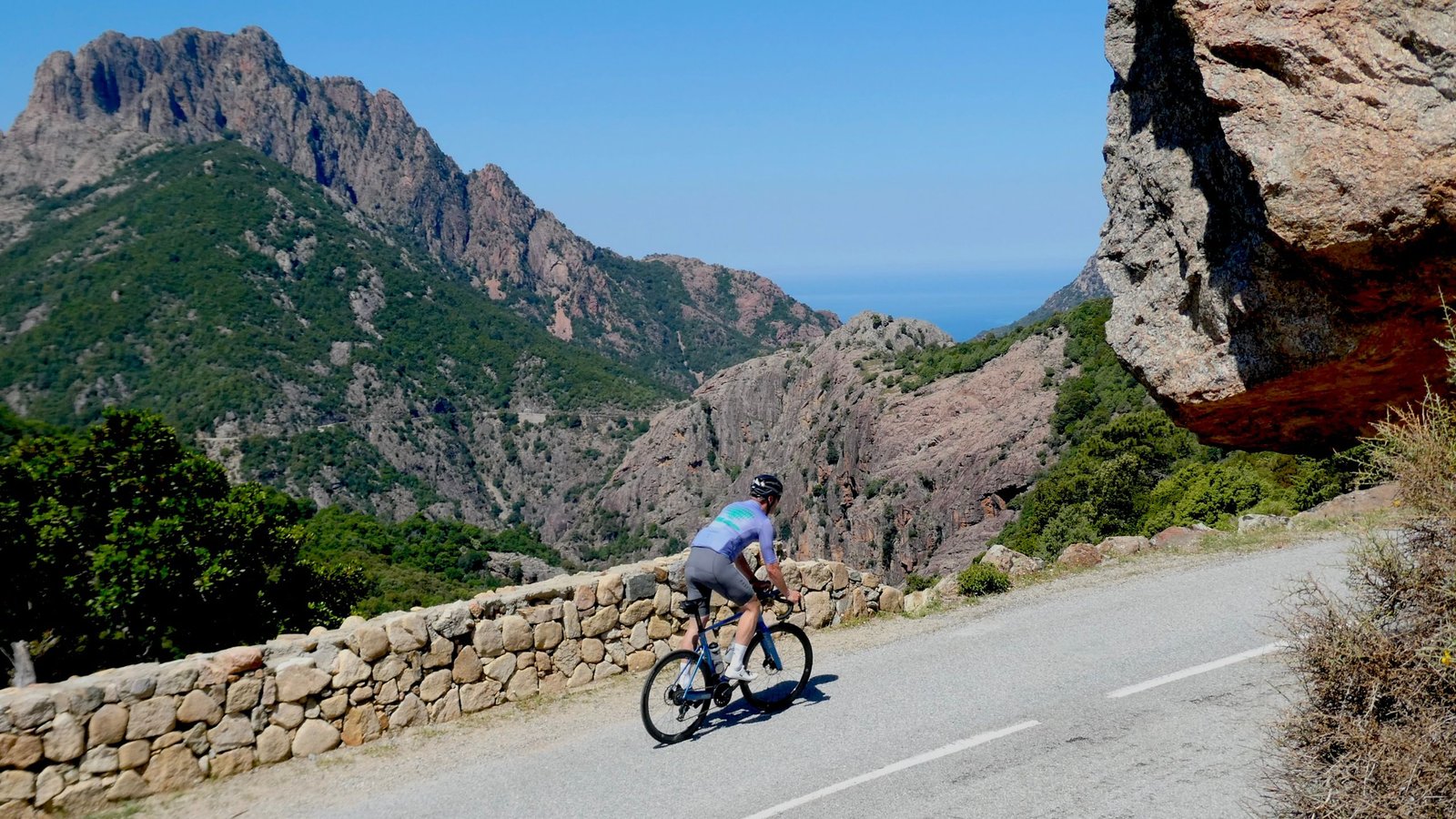
We’d been riding through-and-off for around 40 minutes, keeping the chain tight and the concentration levels high. But rounding a tight corner through a corridor of red granite walls, we seemingly rode through a portal and onto another planet. A naturally formed colosseum of a biblical scale presented itself: the road – which was now a kind of mantel piece, built into the side of the sheer granite mountain face – provided a sweeping arc, and looking across its unending forested expanse made me feel, well… irrelevant.
Who cares about time trialling to the top? Who cares about 300 pathetic watts? Evidently we did.
A glance back from Dan confirmed that he’d acknowledged what we were riding through. I replied with a fresh selection of rasped expletives. The race to the top continued.
Cyclists often talk about purgatorial ascents – the ones on which you seem to live an entire lifetime. Just when you think you’re about to crest the summit, bam, the road kicks up again and you’re back at the coal face, asking your legs to deliver more than could ever be reasonably expected of a pair of limbs. The Col de Vergio is one of those climbs.
The road surface smoothed out as we approached the small village of Evisa. Glass-like tarmac means speed and we sliced through the little settlement replete with quaint cafes spilling out onto the pavements. I was pacing us – a rare turn on the front – and I looked back at Dan as we rode studiously past a glacerie. The temperature was still in the mid-20s despite the fact we’d reached and breached 1,200 metres – an ice cream would’ve hit the spot.

(Image credit: Stephen Shrubsall)
But no, we’d come this far at pace, to stop now would be a brazen act of surrender. Pralines and pistachio would have to wait.
Leaving Eviso, the road – which up to now had been open and exposed – disappeared under dense canopy cover. We rode through pine and fir: families of wildboar snurgled, rock lizards sprinted along drainage gulleys, a whip snake skimmed across the tarmac, cow bells rung deep within the wood. We barely looked up for our work.
It had been an hour and 45 minutes since we left Porto and the big push to the summit was on. Sensing the end was in sight, Dan added a few watts. I clung to his back wheel like a limpet, determined that we’d reach the top in unison, determined to share the glory of dispatching this mammoth ascent.
Three hundred watts; three-twenty; three-thirty; must hold on. And then, there it was: the summit of the Col de Vergio. We rolled over the crest and brought our bikes to a standstill.
“That was a bit long, wasn’t it?,” I said
“I think it’s the longest climb I’ve ever ridden,” he replied.
As it turned out, what we’d ridden was the longest continuous climb in France, if you discount the 36.3km Val Thorens, which cheats with a descent between kilometres 11 and 14.

(Image credit: Stephen Shrubsall)
What was left was the rather splendid task of riding back down.
The outing amounted to little more than 45 miles, yet it was a very strong contender for the finest day’s riding I’ve ever experienced. The Col de Vergio isn’t the steepest climb, and it’s certainly not the highest. But its unrelenting nature and ethereal scenery provided a unique kind of dreamy discomfort.
Corsica had been sitting patiently in the Mediterranean waiting for our wheels. And now it’s been discovered I’m going to struggle to see a cycling destination beyond it. I’m not sure it’s made me any less of an idiot but it reminded me exactly why I ride bicycles.

