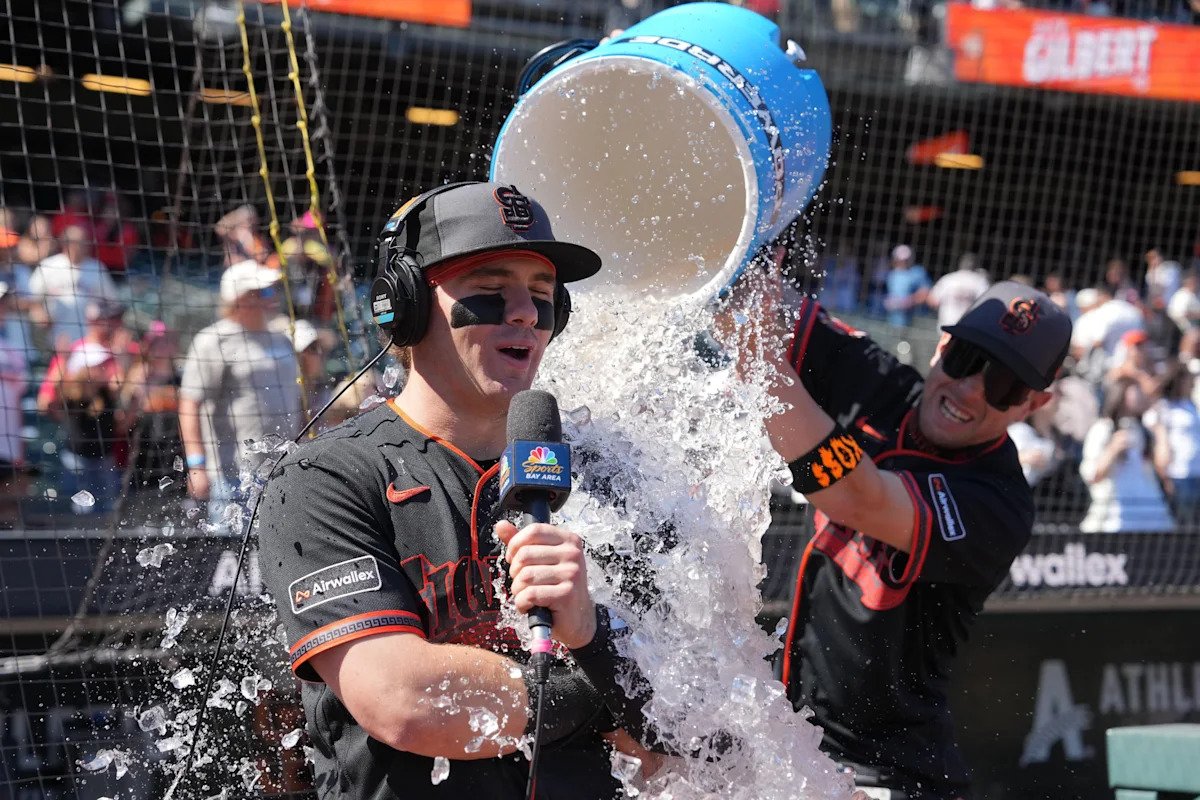
Drew Gilbert had never hit lead-off before. The vast majority of his plate appearances this season have come out of the 8th and 9th spots in the batting order. There’s plenty of reasons why Gilbert wouldn’t be seriously considered to bat first when constructing a Major League line-up. Mainly, he doesn’t hit for average, he doesn’t hit for power, nor does he inflate his on-base percentage with walks. Gilbert’s barely the same species as a Kyle Schwarber or Shohei Ohtani, the 21st century take on the top spot. Considering he’s swiped only 2 bases in 137 Major League games, Gilbert is pretty far from Vince Coleman and the more old-school, light-and-fast model too, aimed at wrecking havoc on the bases after beating out an infield single.
The lead-off man has been a revolving door for the Giants all season. It’s been dependent on the opposing starter’s arm, who’s healthy, or the hot hand. No one has been particularly good at it. San Francisco’s lead-off men have posted a .279 OBP — by far the lowest in the Majors. Their overall production, with a 89 wRC+, is well below league average.
Advertisement
The point of the offensive spear being not that pointy could explain some of the team’s frustrating inconsistencies and overall struggles.
Game 123 of this doomed season, Tony Vitello is throwing spaghetti against the wall and seeing what sticks. Dating back to July 30th, in which the Giants have gone 4-10 while dropping four straight series, seven different players have hit lead-off. Pencilling Gilbert’s name into the top spot — because why not? — made him the 13th player to serve in the role this year, which is the most in any Giants season since 1901.
13 might be a lucky number because Gilbert transformed himself to fit into the role. The middle schooler hyped-up on Mountain Dew Baja Blast energy he typically emanates at the plate was completely gone. In its place, a stoic figure, a discerning eye. The new number-1 went 3-for-4, with a walk, 3 runs batted in, and 2 runs scored. He worked a lead-off walk, taking six straight pitches, and didn’t lift his bat off his shoulder. The Number- 9 hitter Gilbert probably would’ve swung a dozen times. But that Gilbert is dead now; or at least, repressed, stuffed in the locker of his subconsciousness (for the day at least), because when he came up again in the 3rd, nothing had changed. Gilbert was just as calm and disciplined. He took a first pitch fastball in the dirt for ball one, and an elevated curveball at the letters for ball two. Being ahead in the count matters, and Gilbert specifically needs that breathing room. He’s hitting .300 with a 1.014 OPS (70 AB) when he’s swinging with count leverage. When he’s backed into a corner: .224 with a .585 OPS (85 AB).
Up 2-0, Gilbert was cool and collected. He could sit on a specific pitch in a specific location. Starter Michael Lorenzen‘s best bet of getting in the zone was with his fastball, he put it on the inside corner and Gilbert beat him to the spot, lining it onto the arcade for a game-tying solo shot.
Turning an 0-2 count into a base-on-balls was good, the solo homer was obviously better, but Gilbert out-did himself as the lead-off man his third time up. With the bases loaded and two out in a tight 2-1 game, Gilbert didn’t let the situation rush his approach. The prospect of knocking in runs didn’t cause him to devolve back into his previous hacker state in which he was liable to take a cut at any moving object within feasible reach of his bat. He maintained control and put himself in a good count by taking two fastballs off the plate. He fouled off a cutter, only his second swing of the day, but didn’t succumb to swing-mode when Lorenzen dotted another just above the letters. With the count back in his favor, he got his fastball — this time a sinker decently located low-and-away — and the ball found a hole.
Advertisement
This is how the number 1 hitter has to operate, especially in the middle of a game. When the line-up flips back over to the top, that shift should be felt by the opposing arm. The pitcher should be thinking Again? Didn’t I just pitch to this guy? They need to be a nuisance. They need to extend and prolong and act as a gateway to the heart of the order. Gilbert did exactly that — he picked up number-9 man Christian Koss after he rolled an ineffectual comebacker for the second out of the inning. Even with the bases loaded, Lorenzen approached him with care. He made his pitches and Gilbert still got the best of him. His single was the Giants’ first hit with a runner in scoring position, and it led to two more in quick succession from Devers and Eldridge.
It was opposite day for the Giants in many ways. Gilbert set the tone in this bizarro world with his disciplined approach. 5 of San Francisco’s 6 runs in the 4th came with two outs. They worked three walks while the pitchers Logan Webb, Carson Seymour, and Dylan Smith gave out none. The offense went 3-for-6 with runners in scoring position, a situation that had been their collective bugaboo of late. Two of those clutch hits from Devers and Eldridge came in a disadvantaged split against lefty reliever Parker Mushinski.
I’d be remiss if I didn’t mention Turner Hill, who made his Major League debut in left field today. While it may not be as noteworthy as Joshua Baez’s three homer debut (a first in baseball history), Hill gave the Giants the lead with a bases-loaded sac fly, a key situational at-bat that kicked off their back-breaking rally. Overall, Hill went 0-for-3 with a couple of routine put-outs recorded in the field.
Advertisement
Logan Webb turned in another excellent outing albeit an abbreviated one. After six complete, with a 7-1 lead and Webb dealing with the inevitable aches that a 100+ MPH line-drive off the shoulder would cause, Vitello decided to pull him out of an abundance of caution. Webb had more in the tank. He had only thrown 80 pitches while striking out 7 (his season high is 8).
The four-seam, not typically called on to bear a heavy load, served as the workhorse in this one. Webb used it 30% of the time, a season high — a necessary adaptation to face the seven lefties in the Colorado line-up. It worked well. The Rockies appeared caught off guard by Webb’s willingness to push the straight fastball up in the zone. The pitch punctuated four of his strikeouts and generated a 50% whiff-rate (8 of 16) along with 9 called strikes. Not bad for an offering that typically scoots in around 92 MPH.
Advertisement
When contact happened, it was quick and pretty weak. Webb held Rockies hitters to four singles, unfortunately three of them came on three consecutive pitches in the 3rd. Three doinky donks which gave Colorado the early lead. Both Ezequiel Tovar and Jake McCarthy found grass with 60 MPH bloops, and Cole Carigg’s grass cutter, which looked like a tailor made double play ball off the bat, proved to be an RBI single thanks to the defensive alignment of the shortstop. A meek rally made up of the kind of contact that keeps Webb up at night, and ironically, it’s the kind of contact he’s built a career on. This is the bargain Webb has made: the doinks giveth, and they taketh away.
Thanks to Gilbert, Webb didn’t have to sweat the run for long. He’d take the mound in the 4th with the game tied and again in the 5th with a comfortable lead. Though the liner off the bat of Brett Sullivan probably didn’t feel too good, it didn’t take the veteran out of his rhythm. Koss would handle the deflection easily, just one of the 11 Webb would record in order to end his afternoon.

