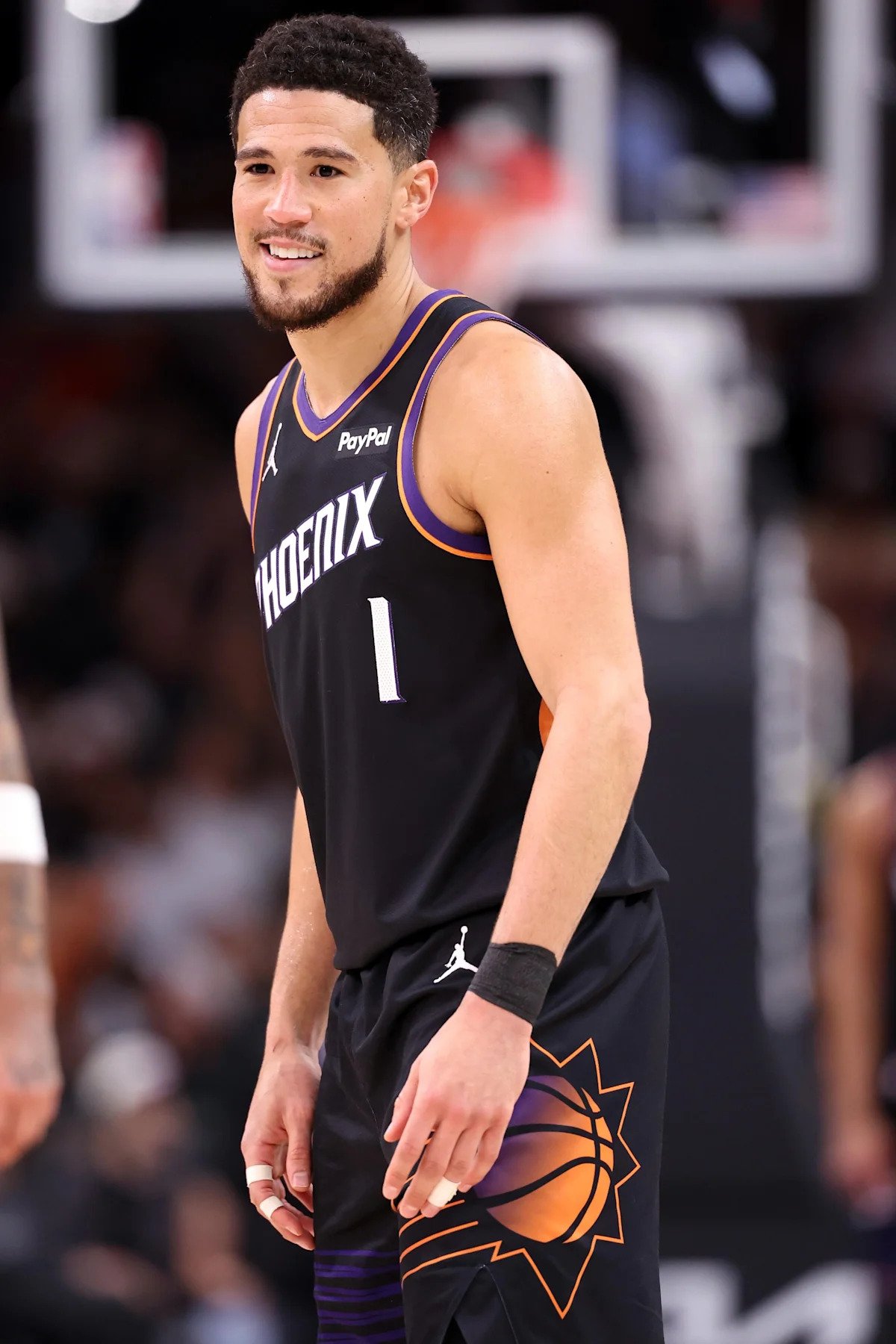
As we find ourselves buried in the unrelenting sands of the desert known as the NBA offseason, we can’t help ourselves. We begin projecting forward, wondering what could happen with the Phoenix Suns during the 2026–27 season. It’s only natural to dive into the statistics we already have and attempt to project what they might mean moving forward. Such is the cycle of sports.
We’ve already looked at five reasons why the Suns could fall short next season, so now it’s time to explore the other side of the equation. Why might they exceed expectations?
Advertisement
And what exactly are those expectations? We can all set our own. Maybe it’s securing a playoff spot and a top-six seed. Maybe it’s making a run to the Western Conference Finals. Maybe it’s winning a championship. All are viable expectations depending on how optimistic you want to be. For this exercise, though, I’m going to use the baseline provided by the oddsmakers in Las Vegas, where the Suns’ win total sits around 38.5.
So let’s talk about the five biggest reasons why Phoenix could exceed that number.
The Suns don’t need traditional positions
Yes, I understand the argument that the Suns don’t have a true point guard or a true power forward if you’re looking at the traditional expectations, archetypes, and historical significance of those positions. But this is where I remind everyone that simply because we don’t view this roster as having a traditional point guard or power forward doesn’t mean those roles don’t exist within the confines of the modern NBA.
Advertisement
Look at the two teams that played in the NBA Finals last season. Would you define Jalen Brunson as a traditional point guard? Maybe in terms of size, sure, but that’s about it. He ranked 16th in the NBA in assists last season at 6.8 per game. Since becoming a primary starter in 2021, his final season in Dallas, he has averaged 6.3 assists per game, which ranks 21st over that span.
He was also 14th in the NBA in scoring last season at 26.0 points per game. Brunson is a score-first point guard who possesses the ability to create for others, but distribution isn’t his primary role. That sounds very similar to what Devin Booker has been asked to do in the past, what he’ll be asked to do again this season, and something he has done successfully. Booker averaged 26.1 points last season, which ranked 13th, along with 6.0 assists, which ranked 29th. What separates Brunson from Booker is his ability to operate effectively in the clutch, but from an overall archetype standpoint, they aren’t all that different.
Then look at the power forwards who started in the NBA Finals last season. Were they big, bruising, 6’10” traditional power forwards? No. They were 6’7″ OG Anunoby and 6’7″ Julian Champagnie. So the idea that the power forward position has to be filled by some massive bruiser is rooted more in how we historically think about the position than how it functions in the modern NBA, where the ability to spread the floor is at a premium.
And yes, I understand that spreading the floor and consistently shooting the three point ball at a high percentage could be a weakness for this team. Of that there is no doubt. But that’s exactly why I think No. 2 on this list is so important.
Advertisement
The Suns’ depth gives them a margin for error
The Phoenix Suns are deep. In my opinion, it’s unbelievably impressive how they’ve navigated the cap sheet while still maintaining that level of depth. I guess that’s what happens when Kevin Durant and Bradley Beal are no longer on the roster. Sure, you’re still paying Bradley Beal $19.4 million not to play for the team, but you’re no longer paying him roughly $30 million more than that. That creates a significant amount of money to work with, and over the past two seasons, the Suns have done a stellar job of filling out the roster with both veterans and young prospects.
That depth is going to matter. From a three-point shooting perspective, Phoenix has options. Luke Kennard, Collin Gillespie, Jordan Goodwin, and the potential of what Rasheer Fleming can become all give the Suns shooting that can come off the bench and contribute.
They’re deep at the five. They have multiple wings that can come in and confidently contribute. The guard room has options as well, and all of that exists while the team also has two-way players capable of filling similar roles.
Advertisement
That depth also matters because every team eventually faces adversity. We can sit here all summer and project what this team is going to be, but you never truly know until you get punched in the mouth. You have to adjust to what the season gives you, and one thing the season will undoubtedly provide is injuries. That’s unavoidable. The fact that Phoenix has depth across multiple positions is something to appreciate because it gives them the ability to absorb injuries, provide rest when needed, and still remain competitive on a nightly basis.
And that’s especially important because of the new anti-tank rules. Which brings me to point No. 3.
The Western Conference has opened the door for Phoenix
You can already see it in the preseason projected over/unders across the league. The new anti-tanking rules, which will ultimately incentivize winning rather than losing, are going to have a profound effect on how teams operate. If you finish with one of the three worst records in the league, you no longer get more lottery balls. You get fewer.
Advertisement
What that means is a struggling team in March is no longer going to sit all of its starters in an effort to improve its lottery odds. Those teams are going to compete because they’ll want to avoid falling into that relegation zone. Which means there are no nights off.
For a team like the Suns, which did a good job beating up on bad teams last season, that creates some concern. But when you look at the entire landscape of the Western Conference, not only the teams projected to live near the bottom, I think the conference is weaker than it was a season ago.
Oklahoma City is now flirting with the second apron and has to move off key pieces in an effort to become more fiscally responsible. Lu Dort is now with Atlanta, as is Aaron Wiggins. Isaiah Joe was sent to Detroit. Yes, Oklahoma City has players waiting in the wings to replace them, but I don’t think this is the same plug-and-play Thunder team we saw a season ago.
Advertisement
The Denver Nuggets also appear to have taken a step backward. They traded Peyton Watson because they couldn’t afford to keep him after making a poor financial decision to re-sign Christian Braun. Minnesota completely pivoted as well. LaMelo Ball, who has never won a playoff game, is now running point for a team that once possessed tremendous size and depth but no longer has Julius Randle or Naz Reid.
Who knows what the Lakers are going to be? Having Luka Doncic on your team feels like it guarantees you 50 wins, but Luka and Austin Reaves as a defensive backcourt isn’t something I’m particularly afraid of. Houston is relying on a healthy Fred VanVleet to improve its chances next season, and there’s something about having Kevin Durant on your team that reminds us success is never guaranteed.
The Western Conference is weaker. Players like LeBron James, Kawhi Leonard, several Thunder players, and Julius Randle have gone East. That creates an opportunity for Phoenix. And part of that opportunity leads me to reason No. 4.
Continuity could be the Suns’ biggest advantage
This is one of the biggest reasons I believe the Phoenix Suns are going to be better than they were last season, and why I’m happily taking the over on 38.5 wins.
Advertisement
Yes, there were periods of instability last year, and much of that was driven by injuries. You can show me all of the statistics from the back end of the season and try to point the finger at Jalen Green as the primary reason things didn’t work. I don’t buy that.
Green played a grand total of 32 games, but only 27 of them came with Devin Booker, 12 with Dillon Brooks, and 16 with Mark Williams. You can look at last season and pull whatever conclusions you want from that sample size, but my response is that there simply wasn’t enough time to fully understand what this team was or allow them to showcase what they could become while learning from the mistakes they made along the way.
Now you’re bringing back four of the five starters from last season, and that matters. There is familiarity. There is an understanding of spacing. There is camaraderie that you can’t quantify on any website. Basketball Reference isn’t going to show you a chemistry metric, and that is where opportunity exists for Phoenix. So many teams across the NBA will spend the first couple of months figuring out the basics of chemistry. The Suns already possess a good portion of that, and I think that advantage will manifest itself throughout the season.
The other side of the conversation is that Phoenix is still relying on progress to improve. Several players had career years, and now you’re asking them to improve again. You’re asking the youth to showcase development and continue fanning the flames of one of the pillars this organization is trying to build around.
Advertisement
Easier said than done? Absolutely. But continuity makes that progression easier to obtain. Roles are more established. Expectations are clearer. There is less instability. And for the first time since Monty Williams, the Suns are bringing back the same head coach for a second season. That matters too.
Although there is one guy who wasn’t on the team last season…
Miles Bridges changes what the Suns can do
I honestly believe this one. I understand who and what Royce O’Neale and Grayson Allen were, but in my opinion, Royce O’Neale plus Grayson Allen does not equal Miles Bridges plus Luke Kennard. That is an upgrade for this team. You now have more offensive options, players who can do more than stand in the corner and wait for a three.
Advertisement
Miles Bridges possesses a gravity that is going to affect everyone around him, and players like Devin Booker and Jalen Green should benefit from it. If Bridges has the ball, whoever is defending Booker has to be cognizant of what is happening. Miles isn’t going to stand behind the arc like Royce O’Neale and wait to fire away. He can put pressure on the rim, and when he does, defenses will naturally collapse. When defenses collapse, they’re doing it off of other players on the floor. Booker, Green, Brooks, and Williams can all benefit from that. Bridges can be a willing passer, and I expect him to be one within this offense.
Bridges is also a reclamation project, someone looking to resurrect his career, and I believe Phoenix is the right place for him. This is an organization that will do everything it can to put him in a position to succeed. Ultimately, it comes down to him executing both on and off the court, and that could be a defining factor for the Suns as a whole next season. Bridges has shown throughout his career in Charlotte that he can play in a multitude of different ways. That Swiss Army knife ability may need to shift from night to night depending on the opponent, and, given his experience, I believe he can adapt.
I’m looking forward to seeing what he looks like within the confines of this offense, these schemes, and this roster.
Yes, it’s all speculation at this point. We won’t truly know what this team is until they tip off on October 21 in Portland. But I do believe there is reason for optimism.
Advertisement
I can also recognize the arguments for why this team could falter. My challenge with many of those arguments comes from something I’ve learned over multiple years of doing this. We tend to look at previous statistical results and use them to project forward. And that makes sense. You identify trends and assume those trends will continue in the same direction. The problem is that I did the same thing last offseason, and I was wrong. I did it the two offseasons before that as well.
The lesson I’ve learned is that you can’t rely solely on previous statistical results to dictate what will happen next in the NBA. Continuity and chemistry don’t have clean metrics attached to them, yet both play vital roles in the success or failure of a team. Last year’s Suns had an abundance of chemistry. The team before that was almost completely devoid of it.
So while statistics should always be part of the conversation when trying to understand what a player or team could become, they can’t be the end-all, be-all of the argument. These points of view are much more nuanced than that. They depend heavily on the ecosystem a player is operating within, not simply what he did last season in Charlotte.
And that’s ultimately why I’m willing to take the over on 38.5 and believe they will be better than last season’s 45-37 record. It isn’t because the Suns suddenly solved every problem, or because the numbers guarantee some dramatic turnaround. It’s because the context around those numbers has changed. Phoenix has more depth, more continuity, more versatility and, in Miles Bridges, another player capable of changing how defenses have to operate. Sometimes the best projection isn’t based on what happened last season, but on what has changed since.

