I met up with an old friend recently. We used to race together as students and have kept in touch, but I hadn’t seen him for a long, long time. Since we raced together I’ve gone on to do more bike racing, and he went on to start a business that made him irritatingly rich. (Irritating to me. He seems OK with it.)
“I’m not sure I’d have made the company work without bike racing – you learn so much that’s so useful. I’m sure you’ve lots of transferable skills if you ever decided to grow up and get a real job,” he said casually.
My first thought was to tell him that the main thing I’ve learned from cycling is how to sack off to go for a ride. I can be endlessly creative in my justifications for this. My essential go-to is always the promise that I’ll return energised and ready to do useful work, but I’ve also come up with “thinking time”, “meditation” and “something to do with blood sugar levels that makes my brain work better – I can’t quite explain it but if my theory is right, I’ll be able to express it more clearly when I get back.”

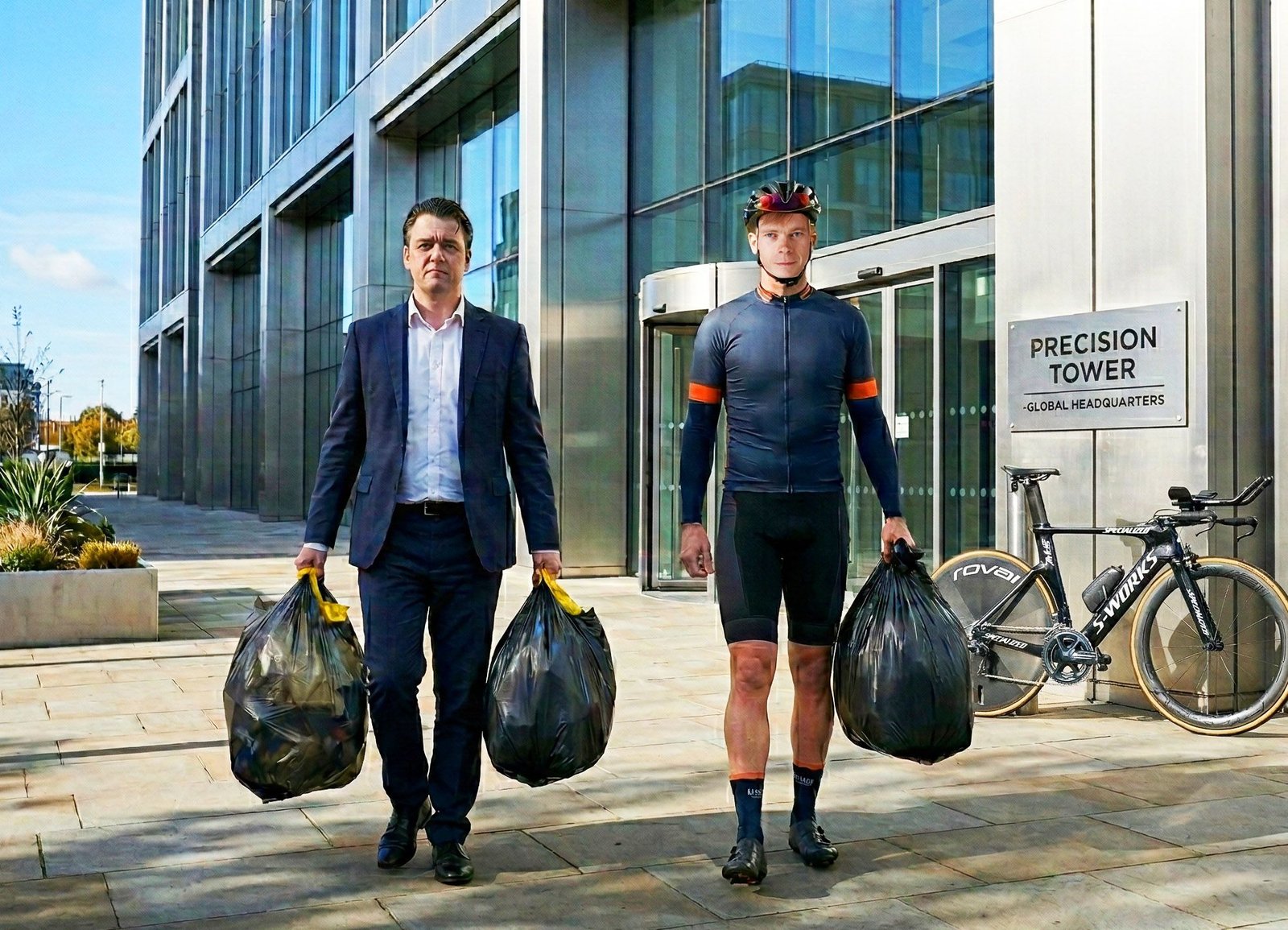
There are other things I’ve learned that might possibly be more use in a business environment. I can cope with disappointment, for example. It would almost be worth applying for a real job so that when the interviewer asks me what talents I have, I can tell them that, first and foremost, when it all turns to crap and we’re standing outside the building with all our possessions in bin-liners, it won’t cause me too much personal distress.

Michael Hutchinson is a writer, journalist and former professional cyclist. As a rider he won multiple national titles in both Britain and Ireland and competed at the World Championships and the Commonwealth Games. He was a three-time Brompton folding-bike World Champion, and once hit 73 mph riding down a hill in Wales. His Dr Hutch columns appears in every issue of Cycling Weekly magazine.
I’ll be able to add that a mastery of excuses long honed round the result board of a time trial means that not only will I be relaxed in the face of disaster, but that someone above me will take the blame.
Years of tinkering with bikes has given me a can-do approach. Almost always if you take something apart carefully it’s possible to put it back together again. Sometimes in this process you manage to fix a problem, either knowingly or unknowingly. Usually you learn something interesting along the way. But the key is not to be put off by apparent complexity. Get some tools and get cracking.
This means that in an actual job environment I would be fearless in the face of the complicated. I would be totally up for dismantling an entire IT system, for example. I wouldn’t be the sort of person who sat wringing their hands and waiting for support, I’d get right into it. Either I’d fix it, or I’d break it properly – and so often in life it’s easier to fix the totally broken than the slightly broken. It’s like giving the bike shop a clean slate to work with.
Another business thing I really do understand is marketing. I’ve learned a great deal from being its victim – I’ve discovered that I’m almost infinitely suggestable, and that I’m totally convinced that the more expensive something is the better it must be.
I am far from unique in this. In cycling the best way to increase the demand for something is to put the price up. I’m not sure that all the other industries have caught up with this yet. If you make it expensive and tell people it’s made of a new improved version of whatever material the thing is normally made from, to which you must give a proprietary name that can’t be cross-referenced to any known universal standard, you can sell anything.
I’d say you couldn’t put a price on knowledge like that, except that you can. I know because I’ve paid it. Over and over again.
I explained all this to my friend. He didn’t offer me a job.
How to….. be annoying
There are occasions when you want to be friendly and cooperative in your dealings with other riders. And there are times when you do not. Most often it’s in either a race scenario where your agenda does not match the riders around you, or on the sort of group ride that, for whatever reason, needs to be made less fun and you feel that you’re the little git who can make that happen.
You can just sit on the back – but that’s only a little annoying, and only in a smallish group. If you want to try it, you can spice it up by beginning to go through before you “change your mind”, so the rider who’s just done a turn has to sprint to get back in.
You can be much more annoying at the front of the group. Don’t go through – just slow down and make someone come around you. Or go through, then slow down. Or go through and swerve from one side of the road to the other while making incomprehensible gesticulations.
There are more subtle ways too. You can ride at a decent pace, but do it in (ideally) a downwind gutter. Swerve around drain covers and potholes without warning. Not annoying enough? Get out of the saddle every so often and make sure to kick the bike backwards a little when you do, to give the rider behind you a little fright. It’s especially effective combined with a drain cover.
But don’t brake-check people. There’s being annoying, and there’s that.
Dear Doc
last weekend on the club ride, one of our number broke their chain. We didn’t have a chain-tool or a quick-link between us, so in the end we decided that pushing Jon home was the only option.
This went all right, there were a few of us to share the pushing. Until we got to a junction a few miles from home.
“Left!” shouted the ride leader.
“Why?” said Jon. “The GPS says go right. It’s supposed to be a 100km ride – it’s only about 90 if we go straight back. I want to get my weekly miles in.”
We turned left.

