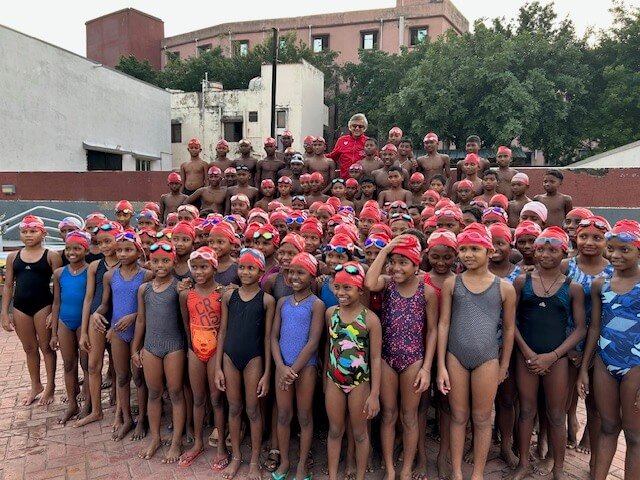
A Unique Swimming Program: The Glenmark Aquatic Foundation – Mission and Inspiration
By Don Heidary – The World Swimming Coaches Association & Orinda Aquatics
I was asked to come to India to evaluate the Glenmark Aquatic Foundation program and offer any insights on development, with specific regard to the age-group program. Having spent the past forty-five years (yes forty-five) pursuing elevated performance and culture at the age-group level, and working in the highly competitive world of USA Swimming, I felt that I could help in some way. Twenty-four days and eleven flights later, I am dissecting a story that is extraordinarily powerful and unique to the sport in so many ways.
The trip offered another example of the diversity and inspiration in the world. I have always viewed sports as the youth neutralizer. Aside from occasional advantages, the bulk of development comes from available water, athletes willing to commit to a program, and passionate coaches that offer structure and a pathway to development. This they have, and so much more.
I believe this may very well be the most inspirational (and greatest) story in the swimming world today.
Let me begin with the Glenmark organization. The foundation is a subsidiary of Glenmark Pharmaceuticals of India, and its outreach (CSR – Corporate Social Responsibility) vehicle, which supports and subsidizes the sport of swimming throughout India. As the corporate founder was a pioneer in medicine, GAF is a pioneer in swimming. I hope you’re sitting down for this. Kids pay nothing. Everything is paid for by the foundation – swimmers’ fees, learn-to-swim lessons, pools fees, staff salaries, travel, equipment, and on and on. In a world of corporate condemnation or profit mongering, you need not look here. This is the model that should exist everywhere; corporations embedded in the communities, lifting children up, and creating limitless opportunities where they are rarely found.
The program was spearheaded by Neha Saldanha. Swimming is in her family (daughter swam for Johns Hopkins), and in her blood. She is not only passionate, altruistic, but driven to produce the top swimmers in India and the broader region, and to change the status quo. This is a sea change in swimming in India and Neha, and her leadership team, are driven to succeed.
The program is run by COO Vijay Bharadwaj, a former IT and sports marketing executive. Although not a swimmer, he lives and breathes the sport and this program. He is an infinitely wise and insightful “get-it-done” individual and he is on this 24/7, working the phones, the room, the politics, the facilities, travel, and everything that touches the GAF.
Ian Els oversees the age-group program. He is a veteran coach from South Africa, and is a measured and thoughtful man, unduly dedicated to young athlete development. He is as caring as he is wise and has a depth of sincerity that is rare at the age-group level, or anywhere. He oversees the entire development program, beginning with learn-to-swim. Under his purview are some 1,000 swimmers that operate in a stunningly organized and highly efficient manner.
Courtesy: Don Heidary
Partha Majumder runs the national development program. He came highly recommended as one of the highest-level coaches in India. He was so much more. He is charismatic, firm, humorous, obsessed with the sport, data, and physiological applications, and the James Earl Jones voice only adds to his presence. He strikes an incredible balance of firm and nurturing, and the athletes respond.
Although I went to support Glenmark, I found myself in meetings with senior officials from The Sports Authority of India (SAI), aka, the government sports arm. They too are highly motivated to develop swimming in India and are looking at Glenmark to take the lead.
While I visited five sites, I will touch on three that offered profound inspiration, hope, and potential fulfillment of the Glenmark mission. And the inspiration that I mention, is not only inspiration to Glenmark or India, but for youth sports in entirety.
Delhi/Bangalore
The Bangalore site, Partha’s, was home to a group of 25(ish) athletes ranging from 15 to 24 years of age. They have reached a level of achievement that allows them to join an elite group of athletes in a camp setting where their main focus is training. They live on an SAI (Sports Authority of India) site, something akin to the USOPC in Colorado Springs. Swimming (and school) is their life, and their teammates are their family. I gave a few talks to his group and mostly watched the flow of Partha’s incredibly well-constructed training sessions that blended energy systems (heart rates), feel and movement, creative drills, and main sets that were as strategic as they were challenging. And as well-thought and well-prepared as his sessions were, they were executed even better. I could not tell whether or not the swimmers were driven more for their training performance, or for the coach’s approval. This coach and this group offer incredible hope as the pinnacle of the Glenmark program, and a pathway to international success.
Trivandrum
Courtesy: Don Heidary
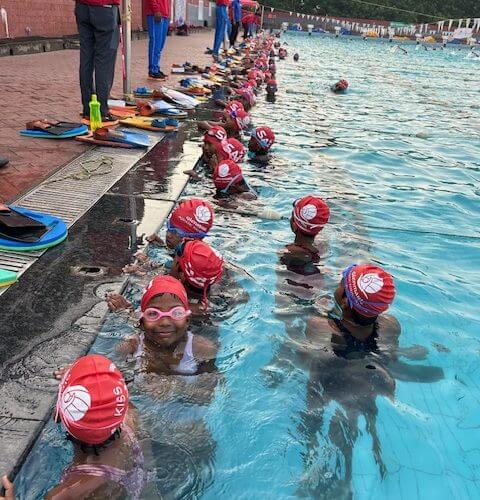
This site, in the south of India, also resides on an SAI site. The facility is older and shows its wear, with cement and tiled blocks, flags with no flags, actual ropes for short course training (and with no flags in that direction – and no one minds). While the coaches are still younger and developing, they operate at high levels of professionalism; prompt, polite, eager to help, eager (almost begging) to learn, and hurrying to fill any need.
And then there were the kids. The worst thing they did in my two days/four sessions was forget to say, “good morning Sir”, and “thank you Sir”. They were on time, including every AM (five senior and three age-group – note, that’s 11-14). I never saw a hint of demonstrable fatigue, apathy, negativity, and the concept of anything resembling disrespect was not in anyone’s DNA. They were, however, very quiet, reserved, if not guarded. As far as training, it was machine-like, for everyone at every age and ability. In my four sessions, not one swimmer stopped, rested, or had an issue of any kind. It was almost like the concept of not leaving on a send-off was completely foreign or illogical, therefore it was never even contemplated.
My first workout was a morning session. We arrived in the dark and I watched kids walk onto the deck at 5:00AM. What I assumed would be the senior group was in actuality every group – the senior group, three junior (age-group developmental) groups, and, wait for it, the learn-to-swim program. Yes, LTS at 5:30. That was a first for me. Each group ran a self-led pre-workout dryland activation, impeccably executed, in unison, no talking or socializing, and highly focused.
The entire 50-meter pool was occupied with groups running the 25-meter width, from LTS in the shallow end to senior in the deep end. They swim quite a bit (in our terms) with regard to volume, with workouts up to 6,000 meters at eight to nine sessions a week, for age-group swimmers.
This site could grow and be an anchor site to the Glenmark system.
Bhubaneswar
I next flew to Bhubaneswar, in the east. There I met the co-head coaches of the program, Hussain and Afra. They drove to the hotel to give me an overview of the program the evening before the first session. They are a young couple, former national level swimmers for India, and now in charge of some 700 children. All I knew was that it was a large site – 500ish competitive swimmers and 200+ learn-to-swim members.
Courtesy: Don Heidary
As they described their program, I couldn’t help but think a documentary film should be made. I had never heard the word “tribal” to describe a swim team roster, but it was the very core of theirs. If you were sitting down for the “Glenmark covers all expenses”, you may want to lay down for this. This program is housed at the Kalinga Institute for Social Sciences (KISS – look it up), a truly massive entity that boasts a Medical School and several colleges under their prestigious University umbrella. It also provides schooling from kindergarten through high school, and college, for indigenous or tribal children, who come from families that cannot properly care for them. I asked how many. “Thirty thousand”. I now understood how this program was so large.
I can only understate this campus. Think Cal times five, with every athletic facility/stadium imaginable, and state-of-the-art, including the aquatic facility used for training, and some fifteen other pools throughout the campus. When I asked where the founder, Dr. Achyuta Samanta “got his billions of dollars from” (I assumed a tech startup or something), I was told that he himself grew up as a tribal child, in poverty. He went on to earn a Ph.D. and worked in the Indian Parliament. To “give back”, he started a single group home, which has since grown in the behemoth that is KISS and KIIT (the Kalinga Institute of Industrial Technology). Also look for the book, The Art of Giving, A Away of Life, by Dr. Samanta himself.
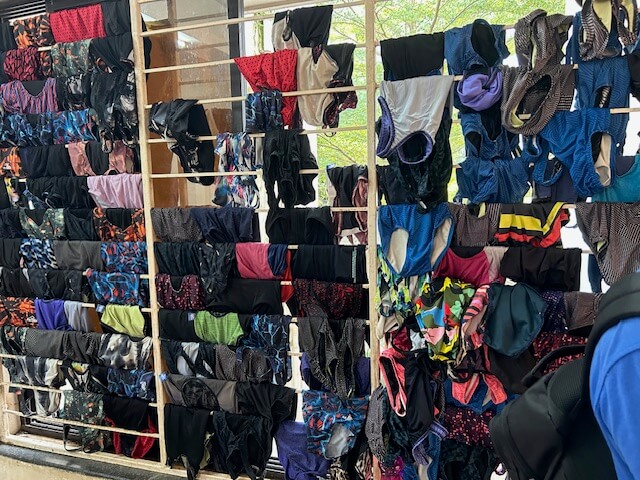
The children live in hostels, get three meals a day, full schooling, and have the opportunity to participate and compete in a vast array of sports. Enter Glenmark and its staff, some twenty coaches, that are all on the deck at 5:00AM and ready to fill any need for these kids, including providing supplementary nutrition after every workout (for two to three hundred kids). They not only teach swimming skills but life skills as well. They go to the hostile and walk the endless line of young athletes to the pool, help them locate their goggles, caps, and suits (all held at the facility), and get them organized for the workout, feed them after, pack up the goggles, cap, and suit, and walk them back, one to two times each day. Personal note – these kids are absolutely precious, all seven hundred of them!
And while a program (shockingly) in its infancy, it is well organized and staffed, and poised to become the engine of swimming in India.
Let me close by saying that one of the primary take-aways for me was that the “character first” concept of athlete and youth culture, that we work daily to procure, is NA in this program, i.e., not applicable. The kids are off-the-chart respectful, humble, helpful, grateful, and resilient, every one. If anything, they can teach the lessons of character and values to anyone who wants to see a real world demonstration. It was truly an honor to witness the Glenmark mission. I will be honored to assist in any way I can, and I will incorporate lessons that I learned into our program, and into my own life.

