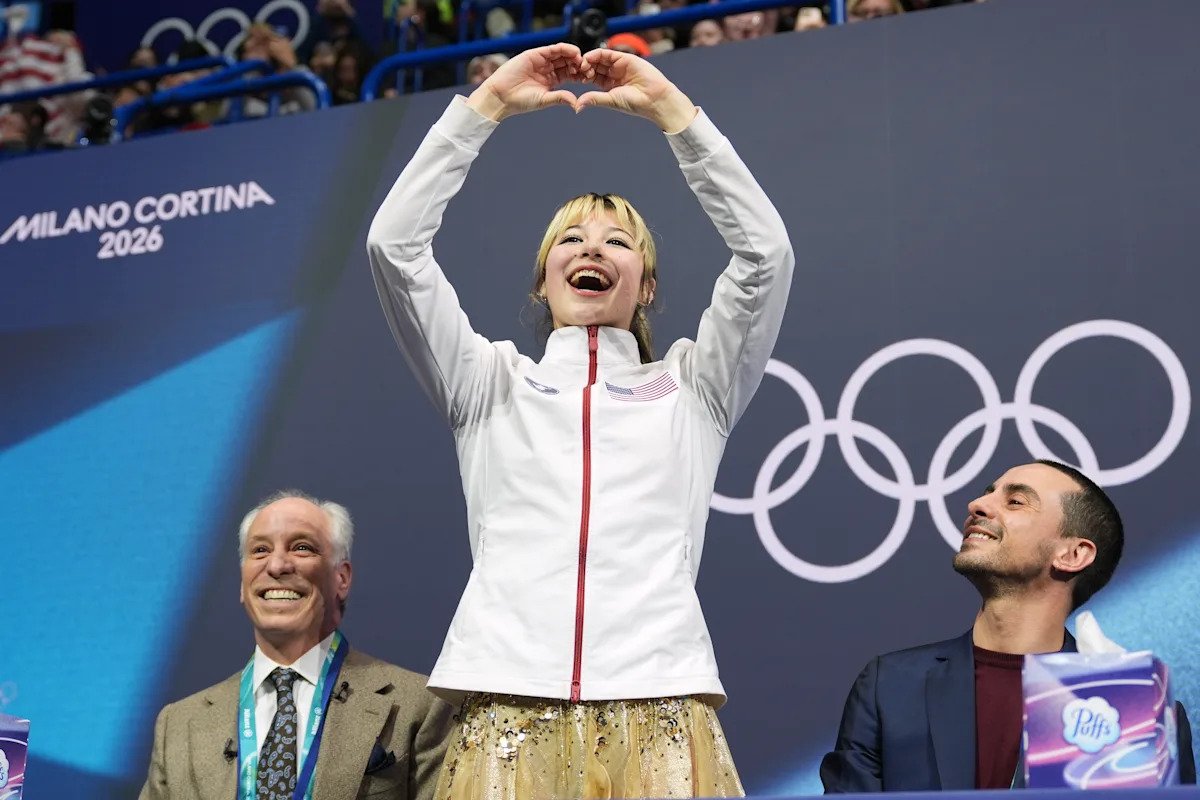
MILAN (AP) — Alysa Liu probably cared the least of all the women in figure skating at the Milan Cortina Olympics about winning the gold medal.
Maybe that is why she won it.
The 20-year-old with the striped hair, prominent frenulum piercing and carefree attitude never showed any worry or strain when she took the ice for her free skate on Thursday night. Instead, Liu waved up at her friends and family in the stands, grinned throughout her program, and acted as if she was going through just another training session at the Oakland Ice Center back in California.
Advertisement
“My family is out there. My friends are out there. I had to put on a show for them,” Liu said afterward. “When I see other people out there smiling, because I see them in the audience, then I have to smile, too. I have no poker face.”
It was all smiles for her crew after Donna Summer’s version of “MacArthur Park” came to a conclusion. Liu earned a score of 226.79 points, sending her surging past silver medalist Kaori Sakamoto and Japanese teammate Ami Nakai, who took bronze.
Liu’s coaches, Phillip DiGuglielmo and Massimo Scali, embraced in a hug, content in knowing that a comeback two years in the making had achieved something incredible: The first women’s figure skating gold medal for the U.S. since Sarah Hughes in 2002.
Liu’s family members stood and cheered, as did the rest of the crowd inside the Milano Ice Skating Arena.
Advertisement
No doubt every official at U.S. Figure Skating, and every member of its Olympic team, also felt a surge of joy. Or relief. It had been a frustrating Winter Games on a number of levels, beginning with some controversial ice dance scoring that denied Madison Chock and Evan Bates the gold medal, and continuing right through Ilia Malinin’s struggles in his free skate earlier in the week.
The only golden moment until Thursday night had been the team event, when Liu helped the U.S. defend its Olympic title.
“If I had a nickel for every gold medal I have here,” Liu joked, “I would have two!”
That’s the kind of “dad joke” only Liu would crack after triumphing on figure skating’s grandest stage.
Advertisement
Four years ago, the daughter of a Chinese immigrant was in a much different mental state. Liu had just finished sixth at the Beijing Games as a 16-year-old prodigy, but she might as well have finished last. She was so burned out by figure skating that her prevailing thought after that Olympic free skate was relief that it was over, rather than pride in what she had accomplished.
She was the kid who’d get dropped off at the rink in the morning and picked up at night. Her childhood revolved around practice, and not of her own choosing. When she became the youngest U.S. champion at 13, and defended her title the following year, it only upped the ante among those who saw her following in the footsteps of Kristi Yamaguchi, Michelle Kwan and Tara Lipinski.
Liu was trying to fit the mold that everyone wanted for her.
So, she quit. Walked away. Abruptly decided to retire after the Beijing Games, leaving all of that mental strain behind her.
Advertisement
For two years, Liu did what she wanted, which had little to do with skating. She went on backpacking trips with friends and began studying psychology at UCLA. She got the frenulum piercing that shows across her front teeth when she smiles. In short, she became her own person, one whose individualism has made her a hero to the alt, emo and punk crowd.
She broke just about every mold for a figure skater.
“I love that Alysa is showing the entire world, and especially our skating world, that there is more than one way to win,” said Johnny Weir, the two-time Olympian, who along with Lipinski called her free skate for NBC on Thursday night.
Indeed, when Liu launched a comeback two years ago, she did it her way. She would only spend as much time at the practice rink as she wanted. She would be involved in every decision when it came to designing her programs. She even had a say in her dresses, with her favorite being the glittering gold ensemble that fit the moment so perfectly Thursday night.
Advertisement
“Honestly, it was more than just work, it was experience,” Liu said. “The last time I was skating, it was so rough. I genuinely can’t begin to start on it. It took a lot to get to this point, and studying psychology has really helped. I love psychology.
“All I want in my life is human connection and, damn, now I am connected with a hell of a ton of people.”
That includes women like Tenley Albright, who won Olympic gold at the 1956 Cortina d’Ampezzo Games, and was watching from the crowd on Thursday night. And other U.S. champions, such as Carol Heiss, Peggy Fleming and Dorothy Hamill.
But it’s more than that.
Advertisement
It’s a connection to everyone who has walked away from something and found their way back. Who cut ties with something they once loved so that they could learn to love it again. And who had to go searching far and wide to discover who they really are.
“I have no idea how I am going to deal with it. I’ll probably wear some wigs when I go outside,” Liu said, when asked how she plans to handle her sudden fame. “I hope with all this attention I can raise awareness about mental health in sports, and mental health more generally. I think my story is very cool. Hopefully, I can inspire some people.”
___
AP Winter Olympics: https://apnews.com/hub/milan-cortina-2026-winter-olympics

