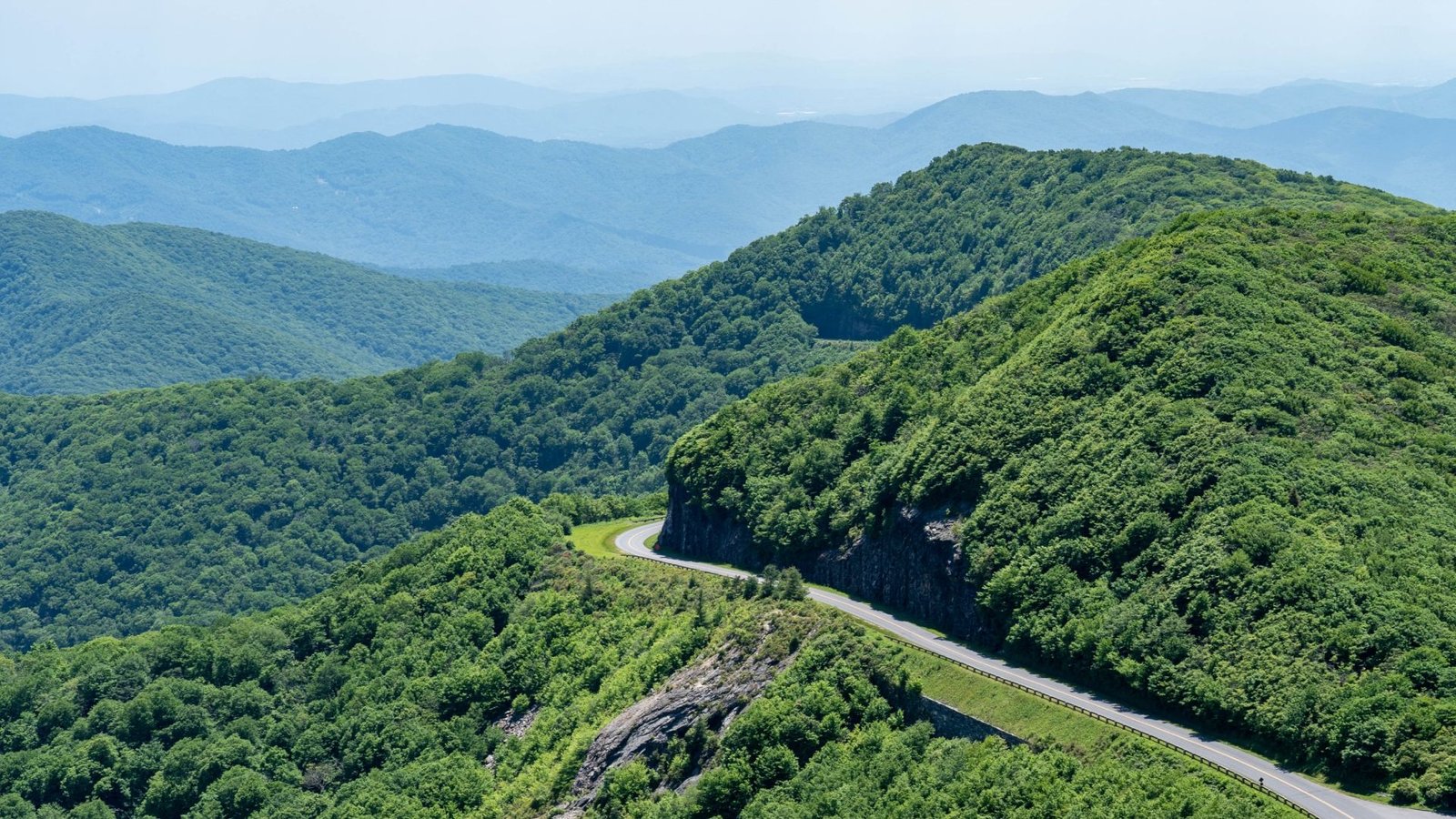
Think of America’s hallowed cycling grounds, and you probably conjure images of Colorado, California, Hawaii, Arizona, and Utah. But on the East Coast, snaking through a mountain range that is older than the rings of Saturn, are some of the best cycling routes, some of the toughest and most rewarding climbs and their thrilling descents, all tucked into the Blue Ridge Mountains of Western North and South Carolina.
I recently had the opportunity to ride 270 miles through Appalachia as a guest of the Arthritis Foundation’s Carolina Hills Classic, and experienced it all: the undulating, never-ending rollers, the fearsome grades, and the hush-quiet farm roads that seem to stretch endlessly in the valleys between the mountains.
If you’ve ever ridden there, you already know Appalachia offers some of the most leg-crushing climbs in the United States. But with seemingly endless roads, most of which are very lightly trafficked, picture-perfect mountaintop views, the kinds of long, sustained climbs that you might find in the Alps or the Dolomites, and plenty of Southern Hospitality along the way, the Blue Ridge Mountains of Western North and South Carolina should be considered amongst our country’s cycling meccas.


(Image credit: Arthritis Foundation)
“Wait,” you might be thinking. “Did this guy really just compare the Carolinas to the Alps?”
I did. Of course, you don’t have to believe me. But maybe you’ll believe legendary American racers like Christian Vande Velde, Bobby Julich, and George Hincapie, who have long called the area home, drawn to it for precisely those reasons I just listed. With 37 Tours de France raced between them, they might know a thing or two about Alpine climbs.
Matthew Busche is another former pro who relocated to the area more than a decade ago, decamping from New Mexico to the Blue Ridge Mountains while he was still racing for Team RadioShack. Like me, he was a guest of the Carolina Hills Classic. Unlike me, he can maintain a conversation while climbing an 11% grade.
“The climbs are long here, some are steeper, some are more gradual,” said Busche, a two-time National Road Race Champion who’s raced the Tour de France, Critérium du Dauphiné, Vuelta a España, Liège-Bastogne-Liège, Amstel Gold Race, Strade Bianche, and the Tour of California, amongst dozens of others of pro cycling’s biggest and most prestigious races.
“And there’s such a good variety of terrain here, the roads are quiet, and it’s just beautiful. But the cycling culture is so deep here that, any time you show up to a local race, someone from this area is potentially going to win.”

(Image credit: Arthritis Foundation)
Our route was a four-day, 270-mile endeavour that took our group of 44 riders from Asheville, North Carolina, through the charming little mountain village of Brevard, and finally to the bustling mini-metropolis of Greenville, South Carolina. It was conceived by Chris Reed of bike-race production company Medalist Sports, who worked with local cyclists and guides to stitch together four days of riding through the Blue Ridge Mountains. And while the route was eminently achievable for riders of all abilities, I was a bit shocked at just how brutal some of the days were.
“These particular riders, despite their age and their ability, are grinders,” Reed, who has planned the Foundation’s other big events in the past, said. “They’re just like, ‘Throw something at us, we’ll get it done.’ They’re open to hard routes, and the Carolina Hills Classic, with all of the vertical, is a hard event.”
Reed’s route featured two 70ish-mile loops bookending two point-to-point days. We spent our first and last days looping 70 miles around Asheville and 50 miles around Greenville, South Carolina, respectively. Day two, we travelled from Asheville to Brevard, a charming little mountain town a few dozen miles down the road as the crow flies (though the bike route would be a bit more circuitous). And early on day three, we shoved off from Brevard and headed south toward Greenville, tackling 70 more miles as we wound up and sped down the mountains and foothills that span the North and South Carolina borders.
The second day of the ride was an easy highlight, as we enjoyed most of the day on what is widely considered amongst the most scenic routes on Earth: the famous Blue Ridge Parkway.

(Image credit: Getty Images)
There, we tapped away at a marathon-like 14-mile climb. And while it only averages a moderate 3-4% grade, the climb took us nearly 4,000 feet into the clouds, to the top of Mount Pisgah, where absolutely jaw-dropping views of the Blue Ridge range stretched out beneath us. After a tiny respite, maybe three miles of gentle rollers, another five-mile climb proved the weekend’s biggest gut punch, where the scenery fell away, the walls of my tunnel vision caved in, and all I could see was the short bit of road, five or ten feet in front of my wheel.
However, what goes up must come down, and what followed that climb was perhaps the greatest descent I’ve ever ridden: 16 miles of wide, sweeping turns, a negative grade that was steep enough to blow my hair back but gentle enough to allow me to really enjoy the ride.
After about 45 minutes, I reached the bottom of the mountain, the valley floor, and rode another 20 miles over beautifully undulating two-lane farm roads, eventually pulling up to our hotel in downtown Brevard. The day’s final tally: 85 miles. 8,000 feet.
For our second point-to-point, a 70-mile ride from Brevard, North Carolina, to downtown Greenville, South Carolina, we traded the long mountain climbs for the gentler rollers of the Appalachian foothills. “Gentler” is, of course, a relative term, as the route still packed in 3,500 feet of climbing. The highlight was a 15-mile descent out of the mountains on Old Highway 25 with a brief stop at Hotel Domestique, the cycling-focused inn owned by George and Rich Hincapie, before tackling our final stretch into Greenville’s famous Swamp Rabbit Trail greenway.

(Image credit: Arthritis Foundation)
My favourite surprise came on the final day. Away from the long climbs that define the Blue Ridge, the route ducked onto narrow farm roads connecting towns like Tigerville and Travelers Rest and Mountain View. As the day had us taking quick rights and lefts, roaring up short, punchy climbs and over less-than-ideal tarmac, I felt like I was racing my own little Spring Classic (albeit, much, much slower). And though I kept telling myself that I wanted to spend the day riding with relative ease, I couldn’t help but hammer up the area’s bergs. It was a route that was simply too much damned fun.
By the time we rolled into downtown Greenville on day four, our legs had logged more than 270 miles of road and climbed over 20,000 feet. But, more impactfully, the 44 riders who undertook the Carolina Hills Classic raised nearly a quarter-million dollars for the Arthritis Foundation.
But beyond the miles ridden, the friendships made and fostered, the elevation gained, and even the fundraising impact, the impression that will stick with me, and the one I will evangelise to anyone who’ll listen, is how rich and compelling a place the Blue Ridge Mountains are to ride a bicycle. These mountains, these roads, these climbs and their descents deserve equal billing with the likes of Colorado, California, Hawaii and Utah. This place is one of our country’s true hallowed cycling grounds.

