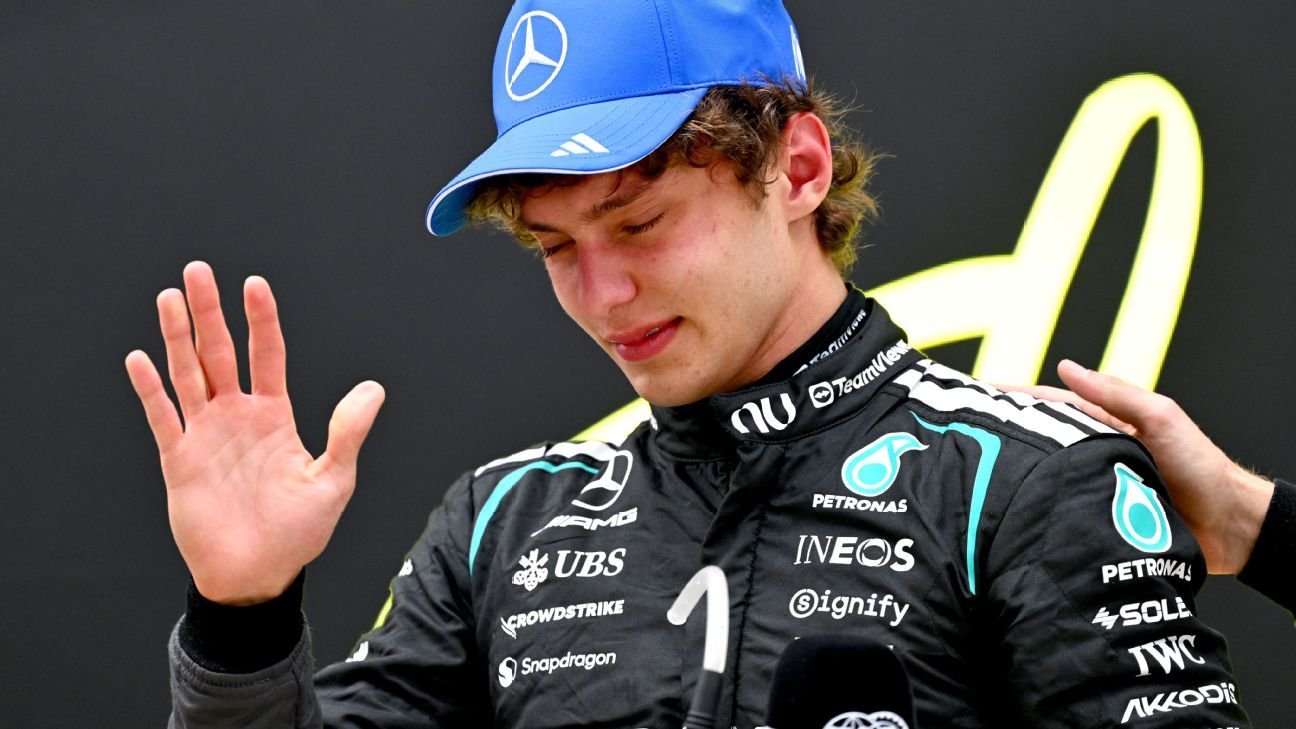
SHANGHAI – – Kimi Antonelli could not keep his emotions contained as he processed becoming Formula 1‘s second-youngest winner of all time.
“I’m speechless,” said a tearful Antonelli, 19, as soon as a microphone was thrust into his hand on Sunday. “I’m about to cry, to be honest.”
The tears did indeed flow, and Antonelli’s win will be a popular one difficult to replicate any time soon.
Depending on your view of it, Antonelli’s win, and the fact he was flanked by the man he replaced at Mercedes, Ferrari’s Lewis Hamilton, on the podium, was the culmination of a much-needed shot in the arm. On paper, the second race of F1’s new era — featuring cars whose power units have a controversial, much-debated 50/50 split between combustion power and electrification, including a big shift toward energy harvesting and battery boosts — had everything you could want from a grand prix.
Multiple lead changes? Check.
Cars able to follow each other closely, much closer than we’ve seen through recent rule changes? Check.
A popular new race winner, a fresh faced superstar seemingly on a rocket ship to superstardom? Check.
A title battle suddenly not as predictable as it might have seemed seven days ago? Check.
Ferrari in the mix? Check.
A long and entertaining duel between Ferrari’s drivers, Hamilton and Charles Leclerc, who regularly went wheel to wheel without coming to blows? Check.
As if to top it all off, F1 was treated to a feel-good post-race podium ceremony. The race result culminated in Mercedes’ past, present and future sharing a podium together with the popular Peter Bonnington, who was engineer for Hamilton until the seven-time world champion left for Ferrari, the move that prompted Mercedes boss Toto Wolff to make the risky move to replace the man who is statistically the greatest of all time with a teenager.
Given the driver Antonelli is turning into, that looks like an absolute masterstroke now.
But as the celebrations on the podium unfolded, the day’s other headline was already being crafted a little further down the Shanghai pit lane. Ironically, it came from the the man who’s name is the only one standing above Antonelli’s on the list of F1’s youngest race winners: Max Verstappen.
“It’s still terrible,” said the Dutchman, who has despised these new cars since his first lap in them. “I don’t know, if someone likes this, then you really don’t know what racing is about. It’s not fun at all. It’s playing Mario Kart. This is not racing.”
Verstappen went from TV camera to TV camera repeating a similar line, his most succinct and cutting evisceration of the new rules so far. Amid all the good vibes from the race at the front, it was also difficult to ignore what Verstappen said, and even more difficult to ignore how many people seemed to agree with his sentiments as soon as he said them, even if Sunday’s race had all the ingredients of a classic.
It’s still hard to know exactly what to make of Formula 1’s regulations, but Sunday’s Chinese Grand Prix gave a curious and contrasting tale of two sides, and just how far apart those two extremes are.
The yo-yo effect
While Sunday’s race saw the top four finish in the order they started the race, that did a disservice to how the contest played out. As was the case at Melbourne’s opener and again during Saturday’s sprint in Shanghai, the fast-starting Ferrari’s made life very difficult for Mercedes out in front. Hamilton led into Turn 1, to huge roars of approval from a Chinese crowd that seemed as passionately behind the seven-time world champion as you might find at Silverstone later this year.
After some early fun, Mercedes quickly got itself back into a comfortable one-two, only for fate to intervene in the form of Lance Stroll‘s stopped Aston Martin. An early Virtual Safety Car at a similar point of the race had nullified the wheel-to-wheel fighting in Melbourne seven days ago, but the Safety Car this time around reignited the contest. Antonelli was able to scamper clear into the distance for his first win, but George Russell‘s long battle to get past the Ferraris, and their own battle that followed, would become the story of the race.
F1’s new cars have given the sport something of an existential crisis since their first public outing in February. F1 has always had things that needed managing — notably, in recent years, Pirelli’s unpopular tires — but nothing to such extremes as required by these new hybrid engines. Cars now harvest energy into their batteries through the braking phase of a lap, which has reduced qualifying into a lifeless, horrible spectacle in which drivers often coast through some of the calendar’s most fearsome corners. The spectacle has at least, outwardly, been more spectacular during races themselves.
After Melbourne, Leclerc coined a phrase that will likely stick to these cars for as long as they exist: “yo-yo racing.” The back-and-forth nature of passing has already become a hallmark of this generation. With a battery pack on each car, drivers have now been given the choice of when they use the boost and when they don’t around a lap. Earlier in the week, Verstappen likened this to Mario Kart, joking that he had taken to the popular video game as part of his practice for the race. After their battle for the win in Melbourne, both Russell and Leclerc had said the newest element of the cars had created a racing style that has traded bravery for strategy.
Mercedes was on a different planet on Sunday, and when it mattered, made light work of the Ferrari pair. But Hamilton and Leclerc’s fight went on and on, with the Italian team not stepping in at any point to intervene or freeze the positions for fear of a collision.
“Huge respect for both of them,” Ferrari boss Fred Vasseur said after the event. “It made sense in this situation to let them race. I know perfectly well we can also look very stupid half an hour later, but at the end of the day, it’s also the best way to build up a team.”
0:46
Hamilton & Leclerc admit they had ‘great fun’ during Chinese GP battles
Ferrari’s Lewis Hamilton and Charles leclerc speak after the Chinese Grand Prix.
Leclerc and Hamilton had nearly come to blows during a wheel-to-wheel fight during the sprint, but their fight on Sunday was firm and fair. “This is actually quite a fun battle,” Leclerc told his team at one point.
The fun he referred to will be up for debate for a long time. You do not have to scroll through social media for long to find fans arguing very loudly that two drivers using a power boost to pass each other back and forth is not really the kind of racing Ayrton Senna talked about when he uttered his iconic quote, “If you no longer go for a gap that exists, you are no longer a racing driver.” Gaps with F1’s new cars seem irrelevant now — all that matters is whether one car has more boost than the other at the next approaching corner.
What is not up for debate is one thing the new formula appears to have done. F1 has had several iterations of regulations in the past that have produced the same old problem: cars that cannot follow each other closely. A car that cannot get close enough to follow can also not get close enough to attempt an overtake. Drivers that attempted to would chew through their tires, their brakes, or both. It was why the Drag Reduction System (DRS) aid was required in the first place in 2011, after Fernando Alonso spent the entire 2010 Abu Dhabi Grand Prix stuck behind Renault’s Vitaly Petrov, costing him that year’s title.
While a common criticism of the new regulations has been that they have created “artificial” racing, it’s worth remembering the DRS contraption was the sport’s first artificial aid to produce more passes during race weekends. It was often called a band-aid and was far from perfect, but it would be wrong to suggest artificial racing has just appeared from nowhere this year.
While much of the focus on the new generation has been what’s underneath the engine covers, the aerodynamics were a big part of the change, too. This seems to have a superb impact in changing the racing. More simplified aero was implemented to lessen the impact of “dirty air,” the turbulent wake generated behind cars that made following each other so difficult. That problem, at least according to Hamilton, has been consigned to the past with these new cars.
“The cars are easier to follow, much better than past years,” he said on Sunday evening. “You can get very close. There’s not a bad wake where you’re losing too much downforce. I think it’s the best racing that I’ve ever experienced in Formula 1.”
It’s often said in Formula 1 that a competitive driver is a happy driver. Hamilton, especially, sums this up better than anyone at the moment.
The seven-time world champion loathed the so-called ground effect cars of 2022-2025, a period that saw him claim just two race victories. His complaints about them were numerous; he was one of the most vocal about the bouncing quirk the cars produced, an effect known as porpoising. It could not have helped seeing Red Bull and Verstappen cleaning up the championships in the first years of that set of regulations.
Things have flipped 180 now.
While Hamilton and Ferrari appear to be in a good place, Verstappen and Red Bull are in a horrible place. Nowhere near as competitive as Mercedes suggested it would be in preseason testing, Red Bull has had a brutal start to the new year. Verstappen retired the car midway through the contest. Every journalist waiting for him in the media pen knew he was going to double down on his criticisms.
Asked if the rules can be saved by making small tweaks within the regulations, Verstappen said, “You can help it a little bit, but it’s fundamentally flawed.”
When it was put to Verstappen by ESPN on Sunday evening that the sport had so far featured three races of back-and-forth action, he shrugged.
“It’s just Kimi or George that is winning, right? It’s not really back and forth,” he replied. “They’re miles ahead of the field. It’s just that Ferrari sometimes has these good starts that they push themselves in front, and then it takes a few laps to sort it all out. Like I said, this has nothing to do with racing.”
On whether F1 was now pushing overtakes above anything else, regardless of how they materialized, he said, “I hope they don’t think like that, because it will eventually ruin the sport. It will come and bite them back in the ass.”
Here you have to say, Verstappen has a point. All three of the races we’ve seen — two full-length races and Saturday’s sprint in Shanghai — have seen Ferrari’s lightning fast starts vault the red cars into contention. Mercedes was still 15 seconds clear of the quickest Ferrari after Melbourne’s 58-lap contest, and 25 seconds clear after Sunday’s 56 laps in Shanghai, and that was with a Safety Car that bunched the field back together after 11 laps of those laps. Mercedes is well ahead, and it’s fair to wonder what a race will look like once the lead cars are able to nullify Ferrari’s threat from the launch.
The fact Verstappen was in neither fight — and the fact it seems like a long time until Red Bull will be anywhere close to it — might well be a mitigating factor in the broadside he leveled at the sport Sunday night, but he insisted current competitiveness was irrelevant.
This is not an opinion Verstappen has suddenly gleaned in the past days, weeks or even months. You can go back to 2023 and 2024 to hear him saying exactly the same, when the regulations were merely written down on paper. He and Red Bull predicted “Frankenstein cars” where the driver had little to no real input in real racing.
“I would say the same if I would be winning races, because I care about the racing product,” Verstappen added. “It’s not about being upset of where I am, because I’m actually fighting even more now, of course. So you get to understand what you have to do and what it is about even more. For me, it’s really a joke.”
Whether Verstappen would have been saying the same if he had the 2026 Mercedes at his disposal is up for debate, but his criticisms have to be taken seriously. Wolff certainly suggested the Dutchman’s situation at Red Bull might be coloring his opinion on all things Formula 1 at the moment.
“I mean, Max is really in a horror show,” Wolff said on Sunday evening when asked about Verstappen’s quotes.
The Class of ’26
The final word should go to F1’s newest race winner. Antonelli’s victory will surely be the first of many in a career that promises to be captivating. The Italian driver’s F1 journey so far has been a rollercoaster, and we saw a hint at why three laps from the end.
The 19-year-old, who has rarely raced at anything other than the limit, locked up at the penultimate corner, briefly running wide and losing a tiny chunk of his healthy lead. It was a heart-stopping moment that ultimately had no bearing on the outcome, but perfectly encapsulated the boyish enthusiasm Antonelli has always raced with.
“Let’s just get this thing home,” came the message from an understandably nervous Bonnington on the pit wall. Bonnington oversaw all 84 of Hamilton’s victories with Mercedes as race engineer, coining the famous, “OK Lewis, it’s hammer time” phrase for when it was time for the seven-time world champion to push his tires to the limit.
The winning manufacturer sends up someone to collect the team trophy with the top three drivers and there was only one man, other than Wolff, who should have been up there. Bonnington, better known as “Bono,” went up there. It was a remnant of the Mercedes title-winning juggernaut of 2014-2021, and hope for those in the team that it can rekindle the glory days.
As a singular moment, it was a little too much for Wolff.
“It’s been a while since I’ve been in Formula 1, but that podium now was probably one of the best moments I’ve ever had in Formula 1,” he told Sky Sports F1. “The three of them, with Bono right in the middle … rarely that I’m overwhelmed, but that is such a moment.”
As for Antonelli, he seemed overwhelmed by the whole thing.
Asked how special it was to share it with the key Mercedes figures of his career, with Hamilton by his side and his father in attendance, he replied, “It’s been great to have also my dad here, to share this moment with him because he’s been part of this whole journey since karting. Also, with Bono and Toto — Toto took me in the team in 2018 and brought me all the way to Formula 1. He gave me the opportunity last year to put me in the car, and then again this year. So definitely it’s been a great journey so far. But of course, there’s still a long way [to gp], but we’re on a good path and I’ve been enjoying a lot the time with Mercedes, with the whole team. Just looking forward to the future.”
The noise after Antonelli’s win might well center on Verstappen’s comments and the ongoing debate around F1’s confusing new cars, but make no mistake about it, a star was born on Sunday in Shanghai.

