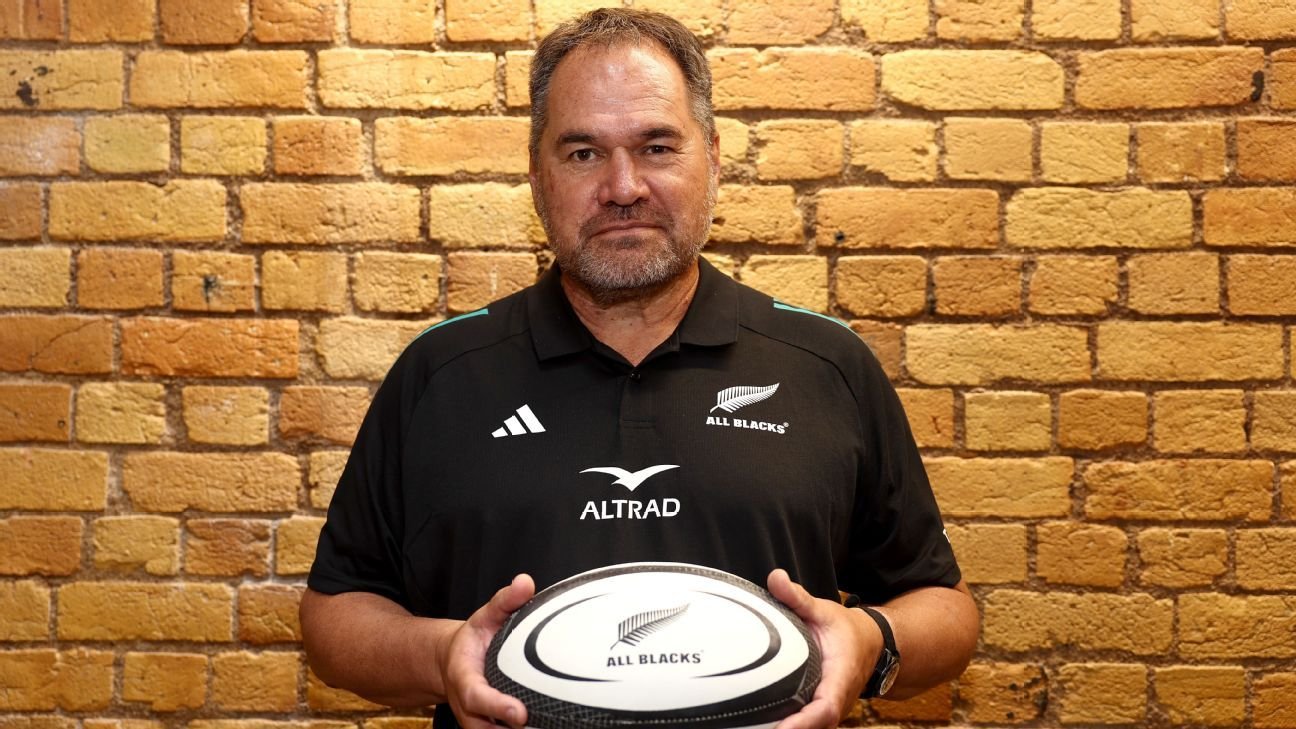
Dave Rennie is returning to Test rugby.
Three-and-a-half years on from his axing as Wallabies coach, Rennie will take charge of the All Blacks after he was on Wednesday confirmed as Scott Robertson’s replacement.
Rennie has been preferred ahead of Highlanders coach Jamie Joseph, who has now twice missed out on what is the most high-profile job in world rugby.
The 62-year-old Rennie will also be the owner of a unique piece of rugby history in becoming the first man to coach both the All Blacks and Wallabies.
Read on as we answer some of the key questions of Rennie’s appointment, after the Kiwi fronted the media alongside New Zealand Rugby [NZR] chairman David Kirk in Auckland on Wednesday afternoon.
WHEN WILL DAVE RENNIE BEGIN HIS ALL BLACKS TENURE?
Rennie is halfway through the Japanese League One season with Kobe, who currently sit behind Kubota with nine wins from 11 games. The League One regular season runs through to the weekend of May 9-10, before a three-week finals series.
If Rennie’s Kobe go all the way to the final, Rennie’s last game in charge will be on the weekend of June 6-7, which coincides with the quarterfinals of Super Rugby Pacific. That means Rennie could foreseeably return home to New Zealand to watch the country’s semifinalists, however many there are, in action, and the Super Rugby decider a week later.
New Zealand Rugby typically unveils its squad for the mid-year Tests in the days following the Super Rugby decider, which this year falls on June 20, with a camp following that announcement.
That will leave Rennie with two weeks to prepare his squad for their opening Nations Championship match against France, with Tests against Italy and Ireland following that. Once the Nations Championship is halted, the All Blacks face the Springboks in four Tests as part of the “Rugby’s Greatest Rivalry” series.
HOW MUCH SHOULD WE READ INTO RENNIE’S FAILED WALLABIES STINT?
Rennie coached the Wallabies between 2020 and 2023, beginning his tenure amid the mire of the COVID-19 pandemic, when forced isolation and training bubbles were a near-constant bedfellow.
Facing the All Blacks in four Tests straight up was always going to be a tough challenge, but Rennie’s Wallabies very nearly won at their first attempt, with only a coat of Dulux denying Reece Hodge’s match-winning penalty, before a thrilling Wellington Bledisloe finished 16-all after six-and-a-half minutes of injury time.
Rennie’s Wallabies were handsomely beaten in the second and third Tests, but they did snap a 10-Test drought against the All Blacks in the fourth game in Brisbane. Two years later in Melbourne, the Wallabies were denied another win over New Zealand when French referee Mathieu Raynal made his infamous “we play” call and pinged Bernard Foley for time-wasting. Ultimately, Rennie finished with a 1-7-1 record against New Zealand as Wallabies coach.
That stat will matter little to All Blacks fans, but they might be excited by Rennie’s 3-1 record over Rassie Erasmus’ Springboks, albeit there is the caveat that all four of those Tests were played on Australian soil.
In the end, Rennie finished with a 38% winning record, the lowest of any Wallabies boss to have coached 30 Tests or more.
“I’ve got no regrets. I’ve got a lot of strong relationships there, I learnt a lot from coaching at that level,” Rennie said of his time with the Walabies. “It wasn’t an ideal end, obviously I didn’t get the chance to go to a World Cup, but I felt more for probably about 13 or 14 players who would have gone to a World Cup with me who didn’t get to go either.
“So I am looking forward to the opportunity to go to one next year.”
WHAT ABOUT RENNIE’S ASSISTANTS, WHO MIGHT THEY BE?
As it stands, Robertson’s All Blacks assistants are still employed by New Zealand Rugby. But a change of head coach usually means a change of assistants, at least to some degree, so it’s likely that one or more of Scott Hansen, Bryn Evans, Jason Ryan and Tamaiti Ellison could be out of a job. Ryan is highly regarded and would ensure some stability for the All Blacks if he is retained, after stints under both Robertson and previously Ian Foster.
But Rennie will want to put his own “quality people” around him, and he isn’t short of options having coached in Scotland, Australia and Japan after first forging his career in New Zealand.
“We’ll work through that, but I’ve got a strength of surrounding myself with quality people, so I’m keen to bring some people in,” Rennie said. “But when a head coach leaves it affects a lot of people, so what I want to do is be able to sit down and talk to some of the affected people and then make some decisions over the next week or two.”
There have already been reports that Kobe assistant and former Scotland scrum-half Mike Blair is likely to join Rennie at the All Blacks, though another of his Kobe backroom staff, Wayne Smith, was announced to have departed New Zealand Rugby earlier in the year.
One man who won’t be joining Rennie’s coaching cohort is Stephen Larkham. The Wallabies great had been linked with a shock move across the Tasman following the Brumbies’ sensational win over the Crusaders 10 days ago, but the World Cup-winning playmaker re-signed with the ACT, and by extension Rugby Australia, earlier on Wednesday.
WHAT ABOUT THE PLAYERS, WHO IS THIS GOING TO AFFECT?
There is no doubt that one of Rennie’s first jobs will be to oversee a cultural shift within the All Blacks, after it was one of the key drivers behind Robertson’s sacking earlier in the year.
According to multiple media reports, All Blacks players did not get the feedback from Robertson they craved, and did not endorse a setup that saw assistant Scott Hansen oversee much of the day-to-day training.
Multiple Wallabies coached by Rennie have told ESPN that communication is one of Rennie’s great strengths, that he is effusive in praise when it is deserved, but also knows how to deliver the tough messaging when required, too.
Ultimately, just like his assistants, Rennie will choose the players he believes will not only fit his playing style, but also have an impact on a positive culture.
It will be a clean slate, too.
“Whether I was coming back for this role or not, I’d watch a lot of Super Rugby, I watch a lot of stuff happening up in the U.K., obviously we’ve got a competition that we play in [League One], so I watch a fair bit of footy,” Rennie said.
“So I’m not concerned about having an understanding of where players are at. But I’ll watch it closely and we’ll use a little bit of analysis as well, and I’ll spend a little bit of time down here in bye weeks. We’ll get support staff made up so we can get a bit of planning around our game model and then get a handful of things in place, so players by the time they come will be ready to go.
“But I guess one advantage is, players are going to earn the right to wear the jersey. I’ve got no loyalties, I don’t come from a team where I’ve had a lot of guys previously, so I think that’s really exciting. We’ll select based on form.”
COULD THERE BE A CHANGE OF ALL BLACKS CAPTAIN?
That is not beyond the realms of possibility, but Rennie indicated a decision on the All Blacks captaincy would not be among his first priorities.
Given the environment overseen by Robertson and the negative feedback the players delivered to NZR, it might be that Rennie opts to clean house there, too, which would see the end of Scott Barrett’s tenure.
“I think you’ve got to work through those things and I’m keen to have a chat to players,” Rennie said. “I know Scott Barrett, fantastic player and current captain, and so I’ll be keen to have a chat to him about [the situation] going forward.”
If Rennie deems a change in direction is needed, then it may well be Ardie Savea who takes over the All Blacks captaincy. Savea is reported to have been one of the biggest critiques of Robertson’s tenure, which NZR chairman David Kirk denies, but there is no doubt the star flanker will be pleased with Rennie’s appointment.
Savea has previously deputized as All Blacks captain when first Sam Cane and then Barrett were injured, and is already working alongside Rennie in Japan.
“I’m not going to divulge what conversation we’ve had, but he’s a proud All Black,” Rennie said of Savea. “He’s over in Kobe at the moment, he’s getting his body right, and he’s playing good footy for us. I know he’s really excited about the future, our job is to make sure he returns mentally refreshed but also in better condition than he arrived.”
COULD ANY ALL BLACKS RETURN FROM OVERSEAS WITH THE CHANGE OF COACH?
New Zealand’s policy remains that only players contracted to New Zealand Rugby are eligible for Test selection, with Richie Mo’unga already poised to return from Japan later this year. Whether Rennie is able to convince NZR that Mo’unga should be available to face the Springboks remains to be seen, but at this stage the No. 10’s first opportunity will come against the Wallabies in October.
And then there is Brodie Retallick, another of Rennie’s Kobe cohort, who recently said he wasn’t sure his 34-year-old body could again handle the rigours of Test rugby.
“I’ll comment on Brodie Retallick, I get to see him train and play every week,’ Rennie said when asked about New Zealanders playing overseas. “He’s strong than he’s ever been, he’s fitter than he’s ever been; he’s top try-scorer in Japan at the moment with 11.”
Asked whether he could lure him back, Rennie added: “I’m not sure if I’m allowed to yet, but there’s no doubt that if you want to win a World Cup ideally you’ve got your best players available. And obviously Richie’s coming back, which will be good, he’s been in great form in Japan.
“Certainly if you have someone like a Brodie Retallick coming into the environment, I reckon it will really grow the whole group. He’s done a phenomenal job around leadership at Kobe.”

