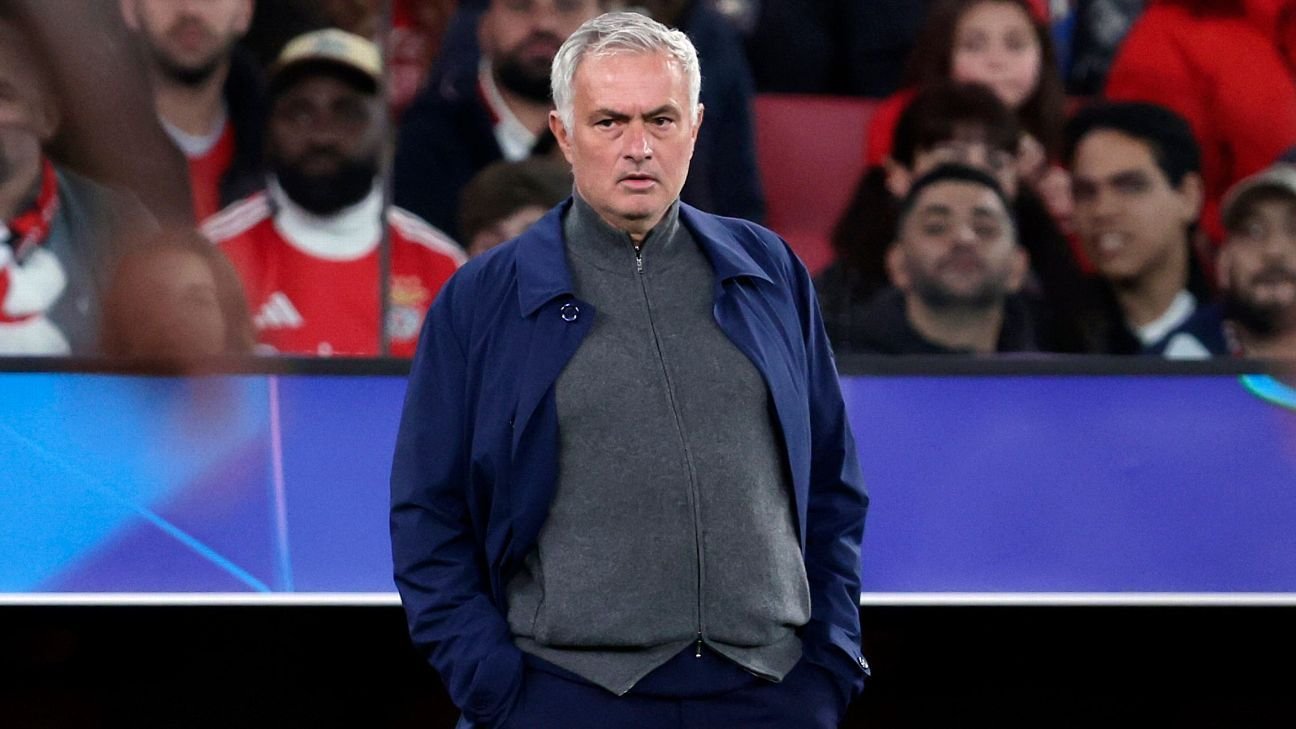
Perhaps I’m in the minority, but I still believe that Real Madrid president Florentino Pérez hasn’t discarded the concept of José Mourinho managing the LaLiga giants next season. It’s a proposition that would grow in strength if Mourinho’s Benfica overturn their 1-0 first-leg deficit at the Santiago Bernabéu on Wednesday and eliminate Álvaro Arbeloa’s unpredictable team from the UEFA Champions League.
Although Mourinho is banned from coaching Benfica from the touchline when he returns to the stadium where he coached for three seasons, this is the first opportunity for the “Special One” to prepare for an important, competitive match at the Bernabéu since he lost the Copa del Rey final to Atlético Madrid there as Los Blancos coach in May 2013.
Before thinking about how Benfica can counter their dismal away form in the Champions League this season (played four, won one, lost three, -4 goal difference) and how they’ll have to do without Gianluca Prestianni — provisionally suspended by UEFA following allegations that he used racist language directed at Vinícius Júnior in last week’s first leg — it’s important to calibrate how Madrid’s president and his one-time golden boy feel about one another.
– Marcotti’s Musings: Real Madrid are off the rails (again)
– UCL talking points: Can Arbeloa lead Madrid to UCL glory?
– Madrid keeper Courtois buys stake in ‘French Wrexham’
First, let’s start with the 78-year-old billionaire Pérez as there are arguable similarities between the moment he recruited Mourinho from Inter Milan in 2010 and now.
Pérez most certainly loves seeing his club win trophies, and he has never lost his knack for building a commercial fortune. But the other side of the coin is that he, naturally, gets upset when the world is having what he considers a “love-in” with Barcelona.
He shares this sentiment with Sir Alex Ferguson. When the Scot joined Manchester United from Aberdeen in the 1980s, he described his mission not in terms of trying to build an Old Trafford empire, but one of “knocking Liverpool off their f—ing perch.”
Pérez has always been shrewd enough to know, in purely actuarial terms, that if he can somehow distract and dilute Barcelona, the path to winning LaLiga becomes exponentially easier. Atleti are intermittent title winners, and no one else outside the hegemony of Madrid and Barça — since Valencia 21 years ago — is really in contention.
Sometimes, the first step to victory isn’t improving your performance, but damaging that of your main rival. Mourinho was Pérez’s “scorched earth” manager last time around when it came to that anti-Barcelona mission, and he could fit that bill again now.
The Portuguese was a man-o-war whose arrival didn’t spark a flurry of trophies (though he lifted the Copa del Rey, LaLiga and Spanish Supercopa across three seasons), but it absolutely burned out Pep Guardiola, forced most of the Spanish sports media to choose sides, gave Madrid a more combative edge, and at least set the table for the flood of European trophies that followed over the next few years under the more talented, less abrasive Carlo Ancelotti and Zinedine Zidane.
The first witness in my case is Aitor Karanka, a Champions League-winning centre-half with Madrid in 2000 and 2002. These days, he serves as the Spanish FA’s director of football, but he was Mourinho’s assistant at Madrid all those years ago. It has been only a month since he was on the Spanish football podcast “Cafelito“, where he was asked whether Mourinho aspired to take over at Real Madrid again.
Karanka tried to keep a straight face, but broke into surprised laughter before replying: “What do you want me to say?” Then he continued, unprompted: “I think he’s already had a chance or two to return to Madrid, but as happens in football, things didn’t quite work out at those times. Right now, Madrid have a good young Spanish coach whom we [the Spanish FA] hope lasts a long time in the position.”
Immediately, when asked the follow-up question: “Madrid and Mourinho were close to something?” Karanka answered: “From what I understand, yes … but I can’t recall precisely when.”
The final question on the subject was: “Why didn’t it work out?”, to which Mourinho’s friend and former assistant replied: “Football has moments like that … maybe it was midseason, maybe José was deep in another project … but nobody should be surprised by the relationship between José and the president…”
Now to Mourinho. I’d not be surprised if NASA astronauts, during their training, were advised that among the objects that you can see from space, such as the Great Barrier Reef, the Grand Canyon and the Great Wall of China, Mourinho’s ego was also mentioned.
That shouldn’t feel automatically pejorative: The 63-year-old transmits self-assurance, swagger, braggadocio and a “follow me” manner that has sometimes played well with talented, coachable footballers, undiscriminating fans and the voracious global media. Every leading sportsman and woman needs a very healthy ego.
I’ll bet every last dime that I own that he can hear “opportunity” screaming at him from the Santiago Bernabéu. Not just this week, but with regard to usurping Arbeloa.
Yes, Benfica is a brand name in European football. Yes, there’s a chance that the Portugal international job might fall into his lap after the World Cup. That’s all well and good. But he left Madrid unfulfilled: only two major trophies, no Champions League crown, drained from the psychological battle he had deliberately triggered with Guardiola (among others) and ultimately forced to watch, with his nose pressed against the window, as Ancelotti and Zidane led largely the same squad to four Champions League trophies in the following five years.
Which competitive, aggressive, compulsive and fame-hungry man-about-town wouldn’t want another shot at putting that right?
1:37
Kompany slams Mourinho for ‘huge mistake’ with Vinícius Jr. comments
Vincent Kompany speaks about Jose Mourinho’s comments about Vinícius Júnior suffering alleged racist abuse vs. Benfica.
Now, is there a question about Mourinho’s actions during the previous two Benfica-Madrid ties this year having a negative impact on his glow in the eyes of president Pérez? I think not.
In January’s 4-2 win in the league phase that snuck Benfica into the playoffs, Mourinho significantly outcoached his apprentice and acolyte Arbeloa. Score one for José. However, his remarks in the wake of Vinícius Júnior reporting to the referee that he had been racially abused during the first leg of this playoff to reach the round of 16 served only to fuel the fires around that incident, even though he tried to backtrack.
My bet is that Pérez, deep down, will have recognized the same combative spirit that attracted him to Mourinho the first time. There’s a downside to that trait — he’s suspended for this week’s rematch for, by Mourinho’s admission, directly accusing the first-leg referee, François Letexier, of avoiding booking Madrid players who were one yellow card from a suspension for the second leg. Just as he was suspended for his behavior during the Champions League semifinal first-leg home defeat to Barcelona in 2011, and just as he was sent off during his final important Madrid match — that 2-1 Bernabéu defeat to Diego Simeone’s Atlético in the Copa del Rey final.
Characteristically, Mourinho refused to attend his final few news conferences in the days leading up to his Madrid departure in 2013. What it meant back then was that Arbeloa, in the media mixed zone, was left not only to stand up for his outgoing boss, but also to attempt a goodbye eulogy.
“Mourinho has always put Real Madrid above everything else; he’s thought of Real Madrid before himself, and many times, that’s damaged his image,” Arbeloa said at the time. “I don’t know if anyone at this club, including the players, can say the same.
“What I’m saying starts with me. I look out for myself first. I want things to go well for me, and then for the club. I think there are many people like that. Many of us are perhaps worried about getting bad media coverage, about maintaining a good image, about always speaking in our own best interest. Because this club is very complicated, especially when things aren’t going well, things get very tough here.
“It has been a turbulent season, especially towards the end, and there are people who haven’t agreed with some of the manager’s decisions.”
Ironically, nearly 14 years later, most of those words apply to the current situation. Arbeloa’s impact has been mostly positive, sometimes with crystal clarity — including the standout excellence of the general performance in Lisbon. But Madrid remain vulnerable, hampered by key absences and unsure whether Kylian Mbappé can shrug off his knee pain, and a recent dip in form, to usher them through to the round of 16.
A 2-1 defeat at Osasuna at the weekend will have prolonged the nagging voices in Pérez’s head about whether Arbeloa is ready to be sole leader. A defeat to Benfica would not only raise that volume, but it would reassert Mourinho as a candidate.
This week, banned and without Prestianni, Mourinho starts as a slight underdog. How will the Santiago Bernabéu treat him in his absence? Longing applause and name-chanting? Haughty, “never-going-back” noses in the air and silent treatment?
So, he might be an underdog in playing terms this week, but that doesn’t mean that, by the summer, Mourinho can’t once again become the leading man at the world’s most successful, most high-profile club. This match isn’t just a rite of passage into the Champions League lknockout phase proper; it’s a referendum for how Madridistas consider their onetime hero and a test of fire for the hot-seat incumbent, Arbeloa.

