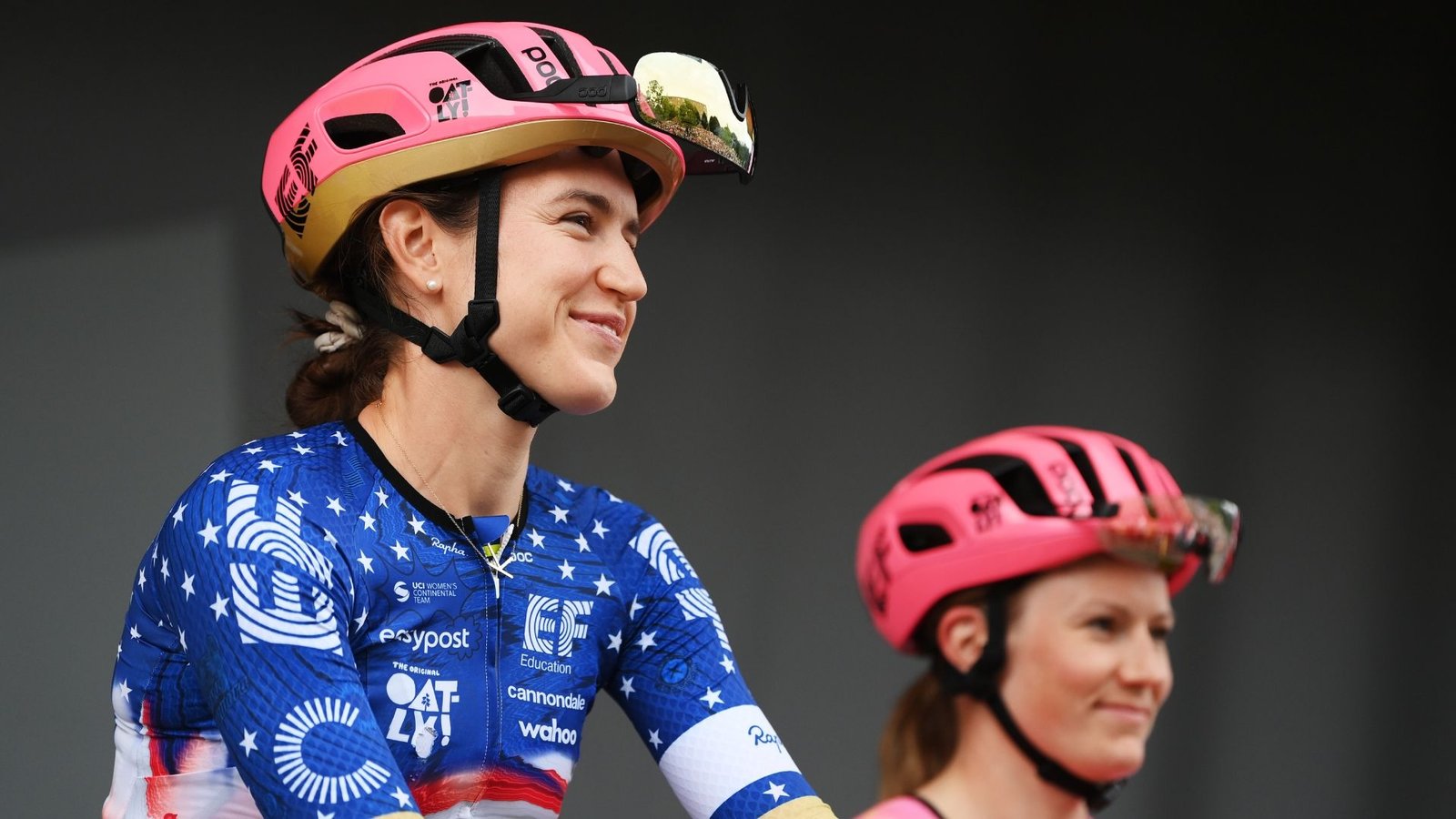
With an eye on LA2028, reigning Olympic champion Kristen Faulkner isn’t just training hard; she’s building her own AI model to analyse nine years of performance data and uncover what’s been missing from women’s sports science.
Last week, Faulkner revealed she had returned to coding to build an AI-driven system around her training. And we were keen to learn more. Speaking to Cycling Weekly, Faulkner explains how she’s turning nearly a decade of data into a personalised model, and what it could mean for the wider sport.
Article continues below
A lot of questions to answer, a lot of data to synthesise
(Image credit: Getty Images)
Faulkner shares that she spent her off-season in tech-haven San Francisco, where she “saw the pace of change in AI up close.”
“It became clear that technology had reached an inflexion point… [AI] can now help answer questions that used to be too messy or too time-intensive to model well. That made this the right moment [for me] to start building.”
Faulkner isn’t your typical professional cyclist. She clipped into cycling pedals for the first time at 24 and earned her first Olympic medals at 31.
Faulkner holds a degree in computer science from Harvard and has been vocal about using her experience as a venture capitalist to empower women in sport.
Now, Faulkner is drawing on her background in computer science and business to make sense of nearly a decade of biometric data, seeking clearer answers about how performance and recovery intersect.
“I’m especially interested in how sleep, hormonal rhythms, heat and training load interact with performance and recovery,” Faulkner says. “A lot of those signals are usually looked at in isolation, but in practice, they overlap. What matters most to me is data that helps explain not just what happened, but why.”
Sometimes spending upwards of 10 hours a day coding —and often doing so while still in kit from the day’s training session— Faulkner is pulling her own data like heart rate, HRV, sleep, weight, cycling power, menstrual cycle phases, DEXA scans and more from a variety of repositories to analyse through a mix of hand-written code and large language models like ChatGPT and Claude.
“I’m being selective about [the data] sources because the goal isn’t to collect everything possible, it’s to bring together the signals that are actually useful,” Faulkner says. “I write the architecture, define the logic, and review the implementation myself, while using AI tools to accelerate iteration and debugging.”
Faulkner notes that while AI is powerful, it still requires the technical judgement of someone who understands what should be built, what is correct, and how the ecosystem of data fits together.
“You can’t just hand the LLMs raw data and expect rigorous insight,” Faulkner explains. “The quality of the output depends on how well the data is organised, what assumptions are built into the system, and how carefully the analysis is framed.”
Turning data into a personalised model

(Image credit: Getty Images)
Faulkner is careful to differentiate between a data dashboard and what she is building, which is patently not a data dashboard.
“A dashboard tells you what happened, and it usually only shows one or two variables,” Faulkner says. “What I’m trying to build goes a step further by looking at how different variables may be influencing performance and recovery over time.”
Faulkner shares that her goal is to disentangle the disparate performance variables and build a clearer picture of how each variable contributes to overall performance and recovery.
Further, Faulkner wants to use the causation and correlation information from these variables to understand what to do when one of the variables, such as temperature, menstrual cycle, or sleep, changes.
So far, the Harvard alumna’s project seems to be producing strong results.
Faulkner used her research to help her prepare for the Pan Am Championships this year, where she won three gold medals. She also shares that she produced her best-ever 20-minute power thanks to her research’s insights.
Personal performance aside, a bigger motivator behind this project is the lack of women-specific sports performance research, especially at the elite level.
“Women athletes have often had to work with tools and frameworks that were built around men’s physiology,” Faulkner says. “I think there’s a real opportunity to build more individualised, evidence-driven systems, and I’d love to see more of that in endurance sports.”
Faulkner isn’t the first person in the endurance sports space to use AI for performance gains.
Tour de France winner Sir Bradley Wiggins launched his own AI coaching app, The Coachsters, this year, and it is entirely AI-based with no human interaction.
FasCat Coaching is an AI-based coaching platform created by Frank Overton. It takes a more collaborative approach to AI by combining AI training insights with the emotional connection of a real human coach.
Even bike fits are now incorporating AI. AiRO, for example, is a new AI-powered aerodynamic analysis app that lets bike fitters optimise any cyclist’s position with a handful of measurements, a turbo, and a few photos of the rider.
Sharing her research, thoughtfully

(Image credit: Getty Images)
Faulkner, who recently announced her partnership with AI-focused content management system Sanity, says that what she’s created with her research is a web app that is also mobile-friendly.
The branding and product details are being kept under wraps for now while the Olympian refines and tests her research and its presentation format.
Faulkner’s ultimate goal is to make her research useful for other athletes, noting that she wants to do that “thoughtfully.”
“Right now, the priority is building something rigorous, useful, and well-tested before opening it up more publicly,” Faulkner says. “The responsible approach, in my view, is to start with a small beta group [of product testers], gather feedback, and continue refining the product before any broader release. There are a lot of considerations that come with putting something like this into other people’s hands, and I want to do that well.”
The two-time gold medalist is actively looking to connect with “people working at the intersection of AI, performance, and women’s health,” and encourages those interested in her AI work to follow her on LinkedIn and Instagram.

