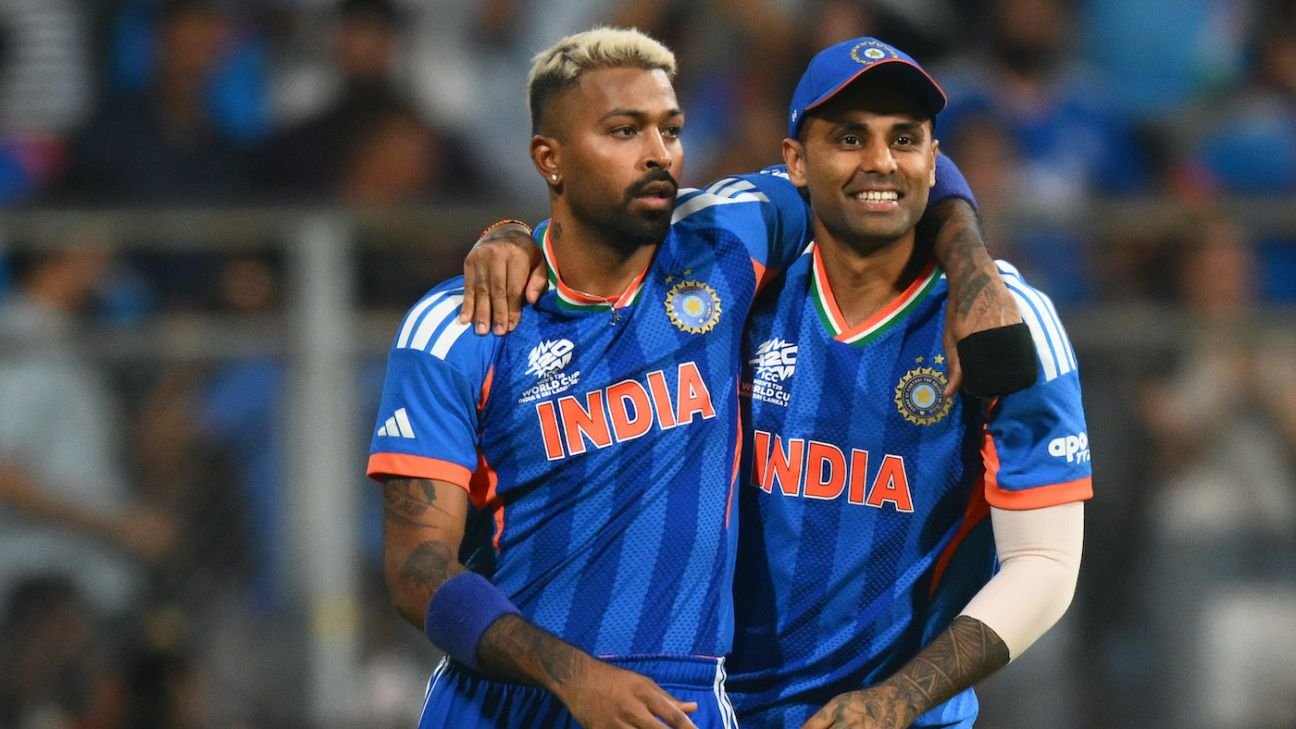
He bowled the final over at the Chinnaswamy a decade ago. He bowled the final over at Kensington Oval two years ago. He bowled the 19th over on Thursday night at the Wankhede.
If India are bowling second in a T20 World Cup match of immense significance and the contest goes right down to the wire, Hardik Pandya is usually in the middle of it, ball in hand, typically bowling right after Jasprit Bumrah has finished his final over. Typically, Bumrah has bowled an incredible over that everyone will talk about for days afterwards, the pivotal over that has tilted the match India’s way.
Typically, Hardik finishes the job. What he does is harder to pin down than what Bumrah does, because Hardik doesn’t have Bumrah’s freakish skillset or laser precision. He bowls a decent yorker and an extremely effective into-the-pitch cutter when the conditions offer grip, but you wouldn’t count him among the best in the world at executing any one particular skill.
And sometimes, it feels like Hardik simply runs in and lets destiny do its thing. He was the bowler when Bangladesh imploded with one to get off three balls. He was the bowler when Suryakumar Yadav caught David Miller so close to the boundary cushions that conspiracy theorists still believe he stepped on them. And on Thursday, he was the bowler when Sam Curran picked out Tilak Varma at the midwicket boundary when England needed 32 off 10 balls. A couple of yards either side of the fielder…
In terms of skill, Hardik isn’t a gun death bowler like Bumrah or Arshdeep Singh. But he’s one of only 29 bowlers to have bowled at least 100 balls in the death overs (17-20) in T20 World Cups. And of those 29 bowlers, only eight have better economy rates than his 8.23.
Here’s an incomplete list of the bowlers among those 29 with worse economy rates than Hardik’s: Pat Cummins (8.24), Arshdeep (8.30), Sam Curran (8.29), Mohammad Amir (8.34), Lasith Malinga (8.57), Kagiso Rabada (8.88), Andre Russell (9.55), Shaheen Shah Afridi (9.65), Dwayne Bravo (9.81), Mitchell Starc (11.2).
And of the 29 bowlers to have sent down 100 balls in the death overs in T20 World Cups, Hardik is the only one to have also faced 100 balls in that phase as a batter. No one, in fact, has scored more runs than him (307) in that phase. And of the 13 batters with 100-plus runs, only two, Virat Kohli (197.50) and Michael Hussey (196.42) have better strike rates than Hardik’s 193.08. Those two, unlike Hardik, are top-order batters who are typically well-set when the death overs begin.
Hardik, typically, has only just come to the crease at that point. As he had on Thursday, when he got off the mark off his third ball with a nonchalant, minimalist ramp to the fine third boundary off Jamie Overton. He proceeded to score 27 off 12, the last in a chain of frenetic, no-let-up innings from India’s batters that took their total past 250.
This innings and the 19th over he bowled would have sufficed to add up to an outstanding day on the field, but they may not even have been his best or most impactful contributions on the night.
That, instead, may have been the first over he bowled, the second of England’s innings, in which he took out Phil Salt with a perfectly pitched outswinger – full, but not a half-volley – before bowling four successive dots (one yielding a leg-bye) to Jos Buttler, swinging the ball both ways without ever being floaty. He was, in fact, swinging the ball while landing on the shorter side of a good length.
There aren’t that many specialist new-ball bowlers who can do this, and Hardik isn’t even renowned for new-ball bowling. He bowls in that phase because it allows India to hold Bumrah back for later, but he wouldn’t be doing that job if he didn’t have the skills for it.
Hardik isn’t widely renowned for his fielding either, but there’s a reason why India always station him in the hotspots. There aren’t too many others they would have wanted at long-off when Jacob Bethell drilled the first ball of the final over in that direction; Hardik moved swiftly to his left, his wrong side, picked the ball up while barely breaking stride, and swung around smoothly to throw to the far end, knowing England’s danger man would make a desperate dash to keep the strike.
He had already won India the semi-final with the bat and with the ball at both ends of the innings. He had won it again with one final act in the field.
List all the ingredients you think you need if you’re building a seam-bowling white-ball allrounder in a lab. India have had the flesh-and-blood version for a decade.

