For years, NASCAR’s biggest battles played out on pit road, atop the pit box and behind the wheel.
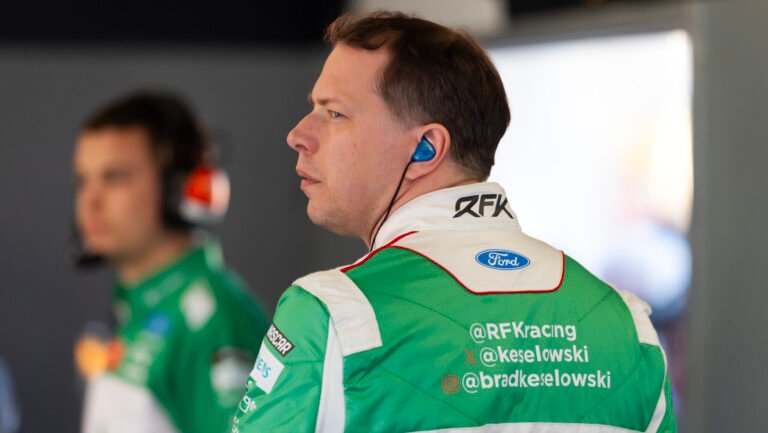
Brad Keselowski believes the sport’s most important competition has moved somewhere else.
Speaking Friday at Chicagoland Speedway, the RFK Racing co-owner offered one of the most revealing assessments yet of why Toyota has dominated the 2026 NASCAR Cup Series season, arguing the manufacturer’s greatest advantage isn’t horsepower or aerodynamics. It’s organizational philosophy.
Advertisement
Toyota teams have won 11 of the season’s first 18 races entering Chicagoland. Joe Gibbs Racing and 23XI Racing have combined to establish themselves as the benchmark in the Cup garage, and Keselowski says that success didn’t happen by accident.
Instead, he believes Toyota found a formula the rest of the industry has yet to duplicate.
Keselowski says Toyota changed the game
Keselowski traced the shift back several years, when NASCAR’s changing rules gradually moved more influence away from individual race teams and toward manufacturers.
In his view, Toyota recognized earlier than everyone else that competing internally was limiting its ceiling.
Advertisement
Rather than allowing organizations to operate independently, the manufacturer encouraged deeper collaboration between its top programs.
“They’ve recognized that that stalemate is not necessarily good for the sport or for them as an OEM,” Keselowski said. “They’ve done a lot of things to push elite collaboration amongst their top organizations so that they have, for reference, two ‘A’ organizations, rather than an ‘A,’ ‘B’ and ‘C.’
“As I’ve seen to date, the other OEMs have not done that, and Toyota is making them pay for that with results on the race track. They deserve credit for that.”
The numbers support his point.
Advertisement
Toyota has spent much of the season controlling the championship conversation behind the combined strength of Joe Gibbs Racing and 23XI Racing. Week after week, multiple Toyotas have qualified near the front, led laps and contended for victories, while Ford has managed just one points-paying Cup Series win through the season’s first 18 races.
Keselowski doesn’t believe that’s a coincidence.
Ford has speed, but not Toyota’s level of collaboration
The former Cup champion made clear he isn’t questioning the talent inside Ford’s organizations.
Instead, he believes the manufacturer hasn’t reached the level of information-sharing that Toyota has built across its top teams.
Advertisement
“The challenge that I see is: Will the other two OEMs actually react to that? I haven’t seen that at the moment,” Keselowski said.
“I think RFK is doing all the things it needs to do to position itself to be successful if that were to happen, particularly in the Ford camp. But at this point we have not seen the level of collaboration at Ford that we see at Toyota, and it creates challenges for the program.”
His comments quickly became one of the biggest talking points to emerge from Friday’s media sessions at Chicagoland because they offered a rare public look inside the competitive dynamics that manufacturers rarely discuss openly.
Veteran NASCAR reporter Jeff Gluck called it “one of the most fascinating news conferences of the season.”
Advertisement
Denny Hamlin, who owns 23XI Racing while continuing to drive for Joe Gibbs Racing, later added important context after Keselowski’s remarks began circulating.
Hamlin explained that 23XI Racing pays Joe Gibbs Racing for technical support and that the relationship is not directed or mandated by Toyota, describing it as a business partnership rather than a manufacturer-controlled alliance.
Even so, Keselowski’s broader point remained intact: Toyota’s top organizations operate with a level of alignment he believes Ford and Chevrolet have yet to match.
Keselowski says the next move belongs to Ford
Keselowski stopped short of criticizing Ford itself.
Advertisement
Instead, he challenged the manufacturer and its leadership to respond before Toyota’s advantage becomes even more difficult to overcome.
“In my mind, at least, I think the burden is on the OEMs and the decision-makers at the highest of levels that want their programs to be successful in NASCAR to react accordingly within the rules,” he said.
“We’re hopeful that we can continue to innovate with them to this next level. We’re in a lull right now that we don’t want to be in. Ford doesn’t want to be in the same lull. The onus is on us to step it up and figure it out.”
It was a remarkably candid assessment from one of the sport’s most respected owner-drivers.
Advertisement
Rather than blaming bad luck, rules packages or execution, Keselowski pointed to something far less visible: the structure behind NASCAR’s most successful manufacturer.
If he’s right, Toyota’s biggest competitive advantage isn’t under the hood.
It’s in how its best teams work together.

